
Four Antenna Ports, One Reader That Runs Your Logic
1300+ tags/sec, output adjustable up to 33dBm, and 4 channel 50Ω TNC antenna ports.
The URA4 reads at 1300+ tags/sec with receive sensitivity quoted below -84dBm, and drives four antennas from its own ports rather than an external multiplexer. Four builds share one Aluminium alloy enclosure: 1W models run on POE (802.3af 13W) or DC, 2W models run on POE+ (802.3at 25.5W) or DC, and each power class is ordered with either 2 GB + 16 GB or 3 GB + 32 GB of memory. The RFID front end is based on Impinj E Series chips and supports Impinj Gen2X, while the host side runs a Qualcomm 1.8 GHz Octa-core. Android 9.0 runs on the reader itself, so tag filtering, 720P output over HDMI Type A, and RS-232 or RJ45 links to an existing controller are all handled without a separate PC in the cabinet.
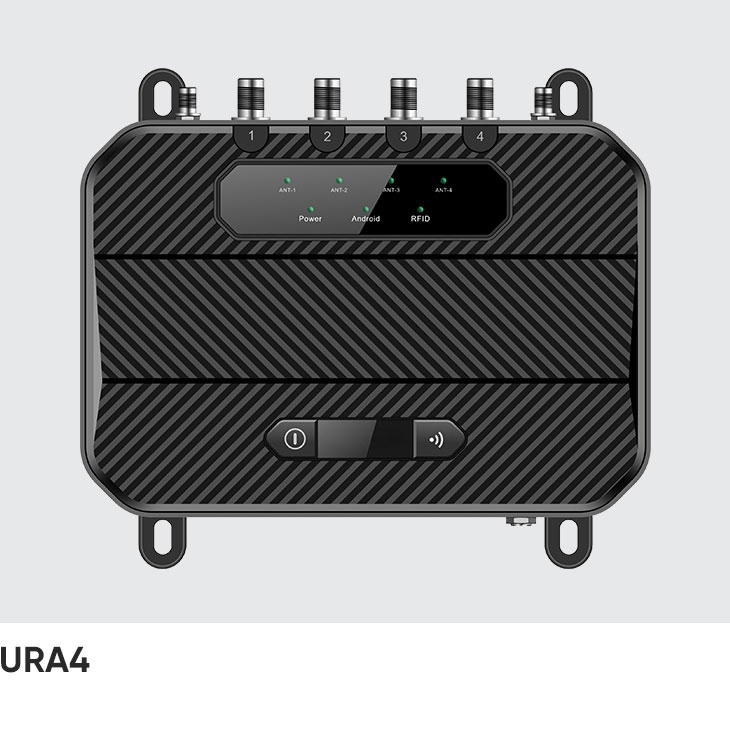
- Impinj E SeriesUHF RFID engine chipset
- Impinj Gen2XSupported by the engine
- EPC Class 1 Gen 2Also ISO 18000-6C
- Qualcomm Octa-core1.8 GHz host processor
- Android 9.0Runs on the reader
- 802.11 a/b/g/n/ac2.4G/5G dual-band
- Bluetooth 4.2Down to 2.1+EDR
- POE 802.3af13W, powers 1W builds
- POE+ 802.3at25.5W, powers 2W builds
- 802.11r Fast RoamingWith PMKID caching, OKC
- 4 channel 50Ω TNC port6dBic and 9dBic antennas
- HDMI Type A720P video output
Overview
The URA4 is a four channel fixed reader for installations where the tags come to the reader instead of the reader going to the tags: portal frames, conveyor lanes, cabinet doors and shelving. Its four 50Ω TNC ports each take their own antenna, so one unit covers an opening from several angles without a multiplexer between the reader and the RF path. Read rate is quoted at 1300+ tags/sec and receive sensitivity at less than -84dBm.
What separates it from a plain network reader is that the decision logic does not have to leave the enclosure. Android 9.0 runs on a Qualcomm 1.8 GHz Octa-core with up to 3 GB + 32 GB of memory, so filtering, buffering and a local screen over HDMI Type A stay on the reader. Four isolated inputs and four isolated outputs drive gates, lights and sensors directly, and RS-232, RJ45, three USB2.0 Type A ports and one Type C port cover the wiring already installed at most sites. Power arrives over DC 10V – 24V, POE or POE+, which usually means one cable to the ceiling instead of two.
The RFID front end is based on Impinj E Series chips with Impinj Gen2X supported, reads EPC global UHF Class 1 Gen 2 and ISO 18000-6C tags, and works with antennas such as 6dBic and 9dBic. Integration uses the CedaGlo Software Development Kit in Java, built with Eclipse or Android Studio. Explore the full range of fixed RFID readers.
Key Features
Host Platform and Interfaces
- Qualcomm 1.8 GHz Octa-core
- Android 9.0 on the reader
- 3 GB + 32 GB or 2 GB + 16 GB
- RS-232, RJ45, USB Type A and C
- HDMI Type A, 720P output
Power and Field Wiring
- DC 10V – 24V input
- POE 802.3af 13W, POE+ 25.5W
- Standby current < 30mA
- 4 in / 4 out isolated GPIO
- -25 °C to 65 °C operating
UHF RFID Performance
- Based on Impinj E Series chips
- 1300+ tags/sec read rate
- 1W (30dBm) or 2W (33dBm)
- Receive sensitivity < -84dBm
- 4 channel 50Ω TNC port
Features & Functions at a Glance
Choose Your Configuration
| Feature | 1W / 2 GB + 16 GB | 1W / 3 GB + 32 GB | 2W / 2 GB + 16 GB | 2W / 3 GB + 32 GB |
|---|---|---|---|---|
| Best for | Medical instrument cabinets and shelf reads, with a host controller running the application | Archive, library and laundry installations that run the application on the reader | Wider portals and Latin America installations driven from a host controller | Production lines and jewelry or watch cabinets that need the extra output power plus on-device apps |
| Form factor | Fixed reader, 214 (L) x 148 (W) x 30 (H) mm, 1000g / 35.27 oz. (without antenna), Aluminium alloy | |||
| Shared hardware | Identical in all 4 configurations | |||
| Antenna Port | 4 channel 50Ω TNC port | |||
| Engine | Based on Impinj E Series chips, with Impinj Gen2X supported | |||
| Fastest Read Rate | 1300+ tags/sec | |||
| Receive Sensitivity | < -84dBm | |||
| Comm Interface | 1*RS-232 , 1*RJ45, 3*USB2.0 Type A, 1*Type C, USB Host | |||
| GPIO | 4 Input Optical-couplings, 4 Output Optical-couplings, isolation | |||
| Ordered per build | The rows below are the only differences | |||
| Output Power | 1W (30dBm, support +5~+30dBm adjustable, POE/DC power) | 1W (30dBm, support +5~+30dBm adjustable, POE/DC power) | 2W (33dBm, support +10~+33dBm adjustable, POE+/DC power, for Latin America, etc.) | 2W (33dBm, support +10~+33dBm adjustable, POE+/DC power, for Latin America, etc.) |
| RAM+ROM | 2 GB + 16 GB | 3 GB + 32 GB | 2 GB + 16 GB | 3 GB + 32 GB |
| Platform | Common to all 4 configurations | |||
| Operating System | Android 9.0 | |||
| CPU | Qualcomm 1.8 GHz Octa-core | |||
| SDK | CedaGlo Software Development Kit, Java, Eclipse/Android Studio | |||
| Wireless | 2.4G/5G dual-band WLAN, Bluetooth 4.2, WWAN 2G/3G/4G | |||
| Power Supply | DC (12V), POE (802.3af 13W), POE+ (802.3at 25.5W) | |||
| Operating Temp. | -25 °C to 65 °C | |||
Accessory compatibility — All 4 configurations use the same 4 channel 50Ω TNC ports and work with antennas such as 6dBic and 9dBic, which are ordered separately. Each build has 1 slot for a Nano SIM card and 1 slot for a TF card. The 2W builds reach their rated output on POE+ (802.3at 25.5W) or DC, so an 802.3af switch port will not carry them at 33dBm.
Every value in this table matches the full Specifications section below.
A Closer Look at the Hardware
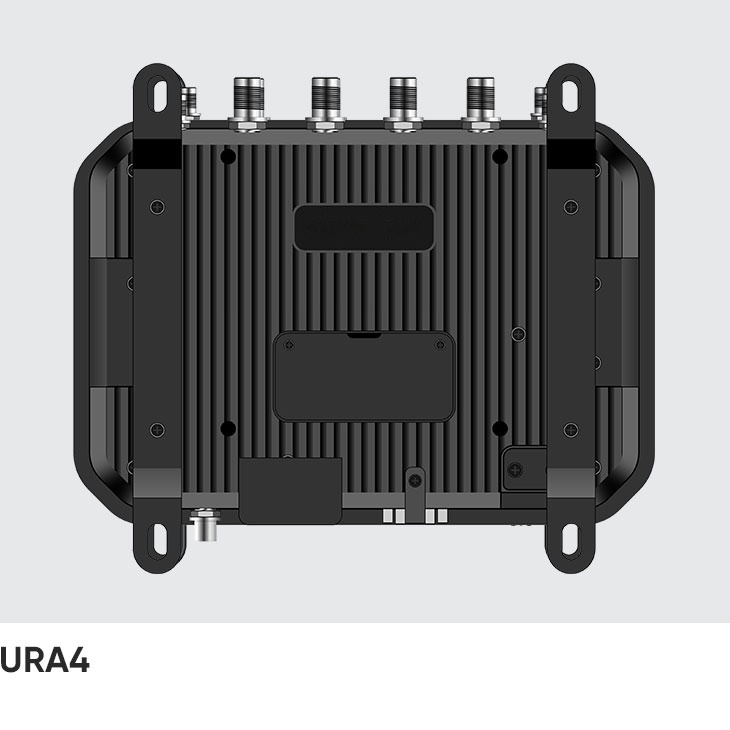
The back panel is the heat sinkThe whole rear face of the Aluminium alloy body is cast as fins, which is the surface the air cooling works across. Two brackets with slotted holes run down the left and right edges, so the reader bolts flat to a wall or a portal frame and the fins stay clear.
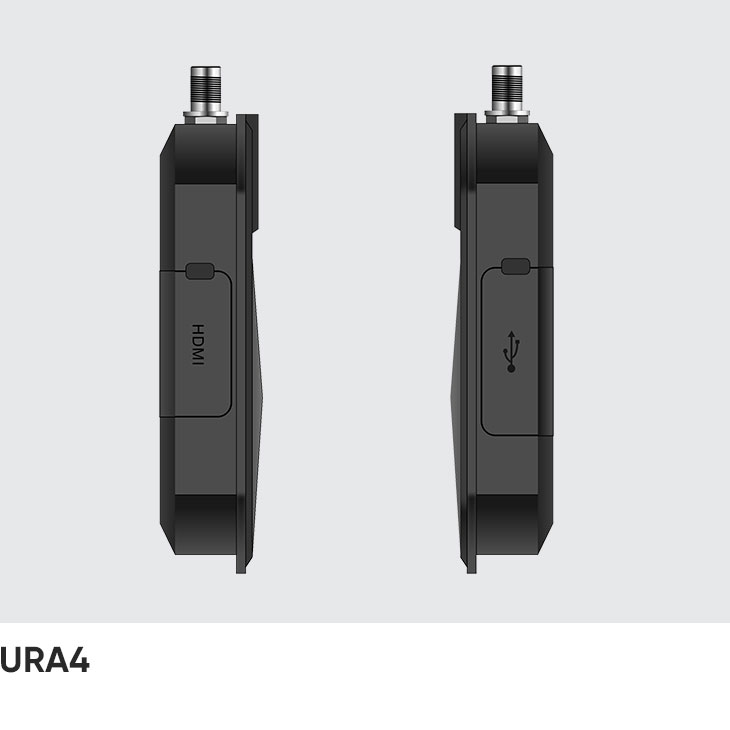
Each side port closes under a coverOne side carries the HDMI Type A port, the other the USB port, and each has its own hinged cover with a single latch. A service technician opens one side to connect a screen or a keyboard, then closes it again for the rest of the installation.
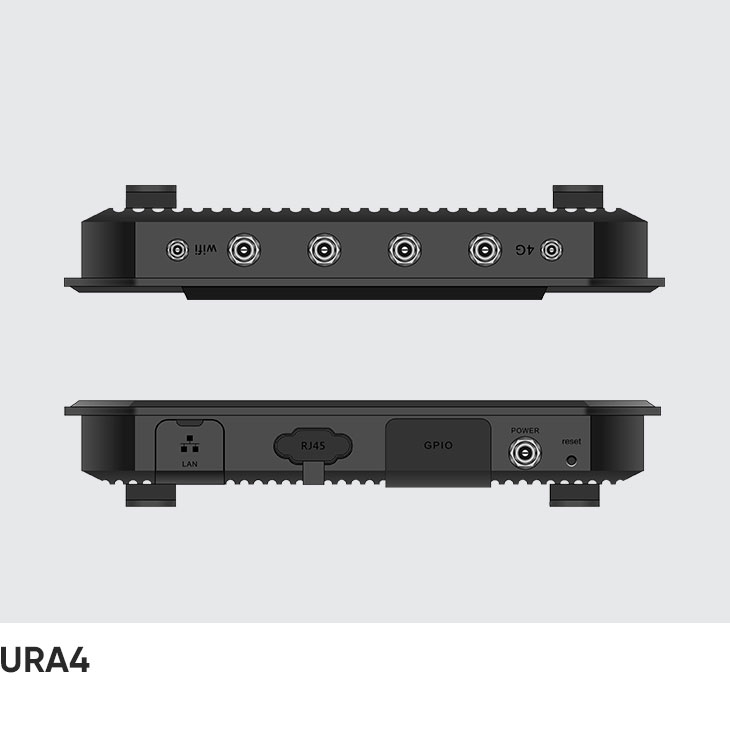
RF above, wiring belowThe top edge carries the four numbered TNC antenna ports between the WLAN and 4G antenna connectors. The bottom edge groups the LAN and RJ45 connectors, the GPIO block, the power connector and a recessed reset button, so coaxial runs and control wiring leave the reader on opposite edges.
Specifications
Physical Characteristics
- Dimensions
- 214 (L) x 148 (W) x 30 (H) mm
- Weight
- 1000g / 35.27 oz. (without antenna)
- Material
- Aluminium alloy
- Expansion Slot
- 1 slot for Nano SIM card, 1 slot for TF card
- Input Voltage
- DC 10V – 24V
- Standby Current
- < 30mA
- Comm Interface
- 1*RS-232 , 1*RJ45, 3*USB2.0 Type A, 1*Type C, USB Host
- GPIO
- 4 Input Optical-couplings, 4 Output Optical-couplings, isolation
- Baud Rate
- 115200 bps
- Cooling Mode
- Air cooling
- Work Current
- 1300mA +/-5% @ DC 12V Input
- Display Interface
- HDMI Type A, support 720P
- Power Supply
- DC (12V), POE (802.3af 13W), POE+ (802.3at 25.5W)
Communication
- Ethernet interface
- 10/100 Base-T Ethernet (RJ45)
- WLAN
- Support 802.11 a/b/g/n/ac/d/e/h/i/k/r/v,2.4G/5G dual-band, IPV4,IPV6; Fast roaming: PMKID caching, 802.11r, OKC; Operating Channels: 2.4G(channel 1~13), 5G(channel 36,40,44,48,52,56,60,64,100,104,108,112,116,120,124,128,132,136,140,149, 153,157,161,165), Depends on local regulations; Security and Encryption: WEP,WPA/WPA2-PSK(TKIP and AES),WAPI- PSK—EAP-TTLS,EAP-TLS, PEAP-MSCHAPv2, PEAP-LTS,PEAP-GTC,etc.
- WWAN (Europe, Asia)
- 2G: B1/B5/B8
3G: CDMA EVDO: BC0
TD-SCDMA: B34/B39
WCDMA: B1/B5/B8
4G: TDD-LTE: B34/B38/B39/B40/B41
FDD-LTE: B1/B3/B5/B7/B8/B20 - WWAN (America)
- 3G: B2/B4/B5
4G: B2/B4/B5/B7/B12/B13/B17/B28a/B28b - Bluetooth
- Bluetooth 4.2/4.1+HS/4.0/3.0+HS/2.1+EDR
Developing Environment
- Operating System
- Android 9.0
- SDK
- CedaGlo Software Development Kit
- Language
- Java
- Tool
- Eclipse/Android Studio
Performance
- CPU
- Qualcomm 1.8 GHz Octa-core
- RAM+ROM
- 3 GB + 32 GB
2 GB + 16 GB (optional)
User Environment
- Operating Temp.
- -25 °C to 65 °C
- Storage Temp.
- -40 °C to 85 °C
- Humidity
- 5% - 95%
UHF RFID
- Engine
- Based on Impinj E Series chips
- Frequency
- 865-868 MHz / 920-925 MHz / 902-928 MHz
- Impinj Gen2X
- Supported
- Protocol
- EPC global UHF Class 1 Gen 2 / ISO 18000-6C
- Antenna
- Supporting a variety of antennas, such as 6dBic, 9dBic
- Output Power
- 1W (30dBm, support +5~+30dBm adjustable, POE/DC power)
2W Optional (33dBm, support +10~+33dBm adjustable, POE+/DC power, for Latin America, etc.) - Output Power Precision
- +/- 1dB
- Output Power Flatness
- +/- 0.2dB
- Receive Sensitivity
- < -84dBm
- RSSI
- Supported
- Ambient Temp Monitor
- Supported
- Fastest Read Rate
- 1300+ tags/sec
- Antenna Detector
- Supported
- Antenna Port
- 4 channel 50Ω TNC port
Every row above is transcribed from the URA4 configuration sheet. Items not listed there are not offered on this page.
Why Buy the URA4 From CedaGlo
Components you can verify
We name the parts instead of describing them. The RFID front end is based on Impinj E Series chips and the host is a Qualcomm processor, so you can read both vendors' own documentation before you ever talk to us.
Four builds, one order form
Output power and memory tier are decided at order time, not swapped in the field afterwards. Tell us the region and the antenna plan, and we confirm which of the four builds ships against your purchase order.
Try a unit before you commit
Ask for an evaluation reader and run it against your own tags, your own antenna spacing and your own network. What you measure on your site is what we quote against, not a number from a bench.
Support after the install
Software development kit versions, firmware images and replacement units are kept available for this platform, and the commercial terms that go with them are written into your order documents rather than left to a web page.
Frequently Asked Questions
How fast can the URA4 read tags?
The configuration sheet quotes a fastest read rate of 1300+ tags/sec and receive sensitivity of less than -84dBm, with the engine based on Impinj E Series chips and Impinj Gen2X supported. The sheet does not attach a test setup to those two numbers, so treat them as bench figures and confirm the rate against your own tag type, antenna gain and reader spacing before you size a lane.
Which of the four configurations should I order?
Start with output power. The 1W builds give 30dBm with a +5 to +30dBm adjustable range and run on POE 802.3af 13W or DC. The 2W builds give 33dBm with a +10 to +33dBm range, need POE+ 802.3at 25.5W or DC, and are listed for Latin America among other regions. Then pick memory: 3 GB + 32 GB when applications run on the reader itself, 2 GB + 16 GB when a host controller does that work.
What components are inside the URA4?
The RFID front end is based on Impinj E Series chips and supports Impinj Gen2X, reading EPC global UHF Class 1 Gen 2 and ISO 18000-6C tags through 4 channel 50 ohm TNC ports. The host side is a Qualcomm 1.8 GHz Octa-core running Android 9.0, and wireless is 2.4G/5G dual-band WLAN with Bluetooth 4.2. Every one of those names can be checked on the component vendor's own site.
How long will this platform stay available?
The URA4 runs Android 9.0 with the CedaGlo Software Development Kit in Java, built with Eclipse or Android Studio, so an integration written today keeps building against the same toolchain. Production lifetime, firmware support windows and spare-part availability are confirmed in writing on your order rather than promised on a web page.
What environment can the URA4 work in?
The configuration sheet quotes an operating range of minus 25 to 65 degrees Celsius, a storage range of minus 40 to 85 degrees Celsius, and humidity of 5% to 95%. The body is Aluminium alloy and the cooling mode is air cooling. The sheet lists no sealing rating and no drop rating for this reader, so we do not claim either one.
How is the URA4 maintained after installation?
The reader reports RSSI, antenna detector status and ambient temperature, so a failing antenna cable shows up in your own monitoring before read counts drop. For local service the side cover opens onto the USB port, and the bottom edge carries a recessed reset button. Warranty length and the return process are set out in the order documents issued with the units.
Related Products
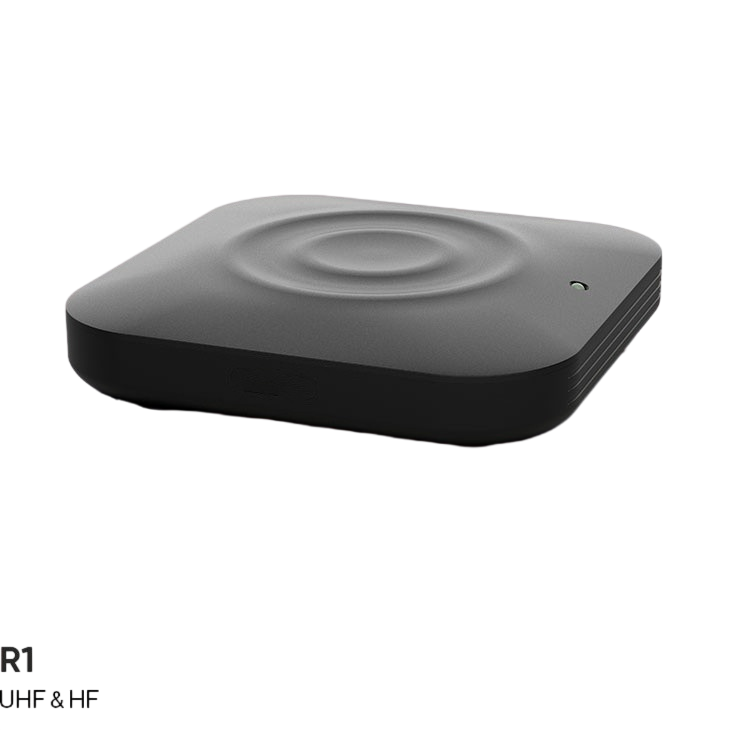
R1 Desktop UHF and HF RFID Reader/Writer
Desktop RFID reader and writer. Impinj E Series UHF engine with Gen2X, 13.56 MHz HF across five card standards, two PSAM slots on ISO7816, Type-C.
View Details
Printed RFID Labels | Custom Finished RFID
Custom finished RFID labels from CedaGlo with printable face stock, adhesive backing, barcode, QR code, serial number and UHF/NFC chip.
View Details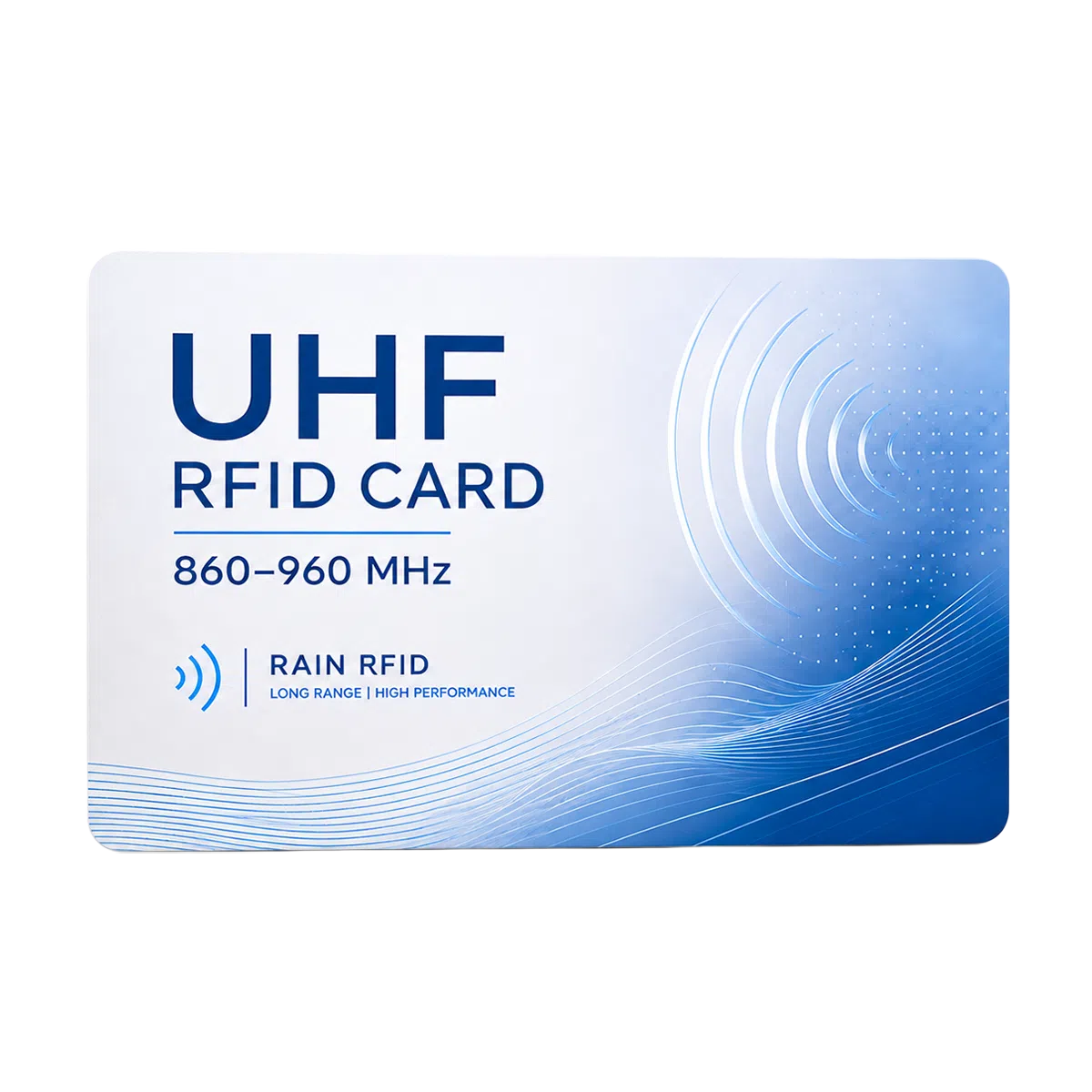
UHF Card | 860–960 MHz RAIN RFID Card
Standard CR80 UHF RFID cards with Impinj, NXP UCODE, Alien Higgs chip options. Ideal for parking, asset tracking & warehouse inventory. OEM/ODM available.
View Details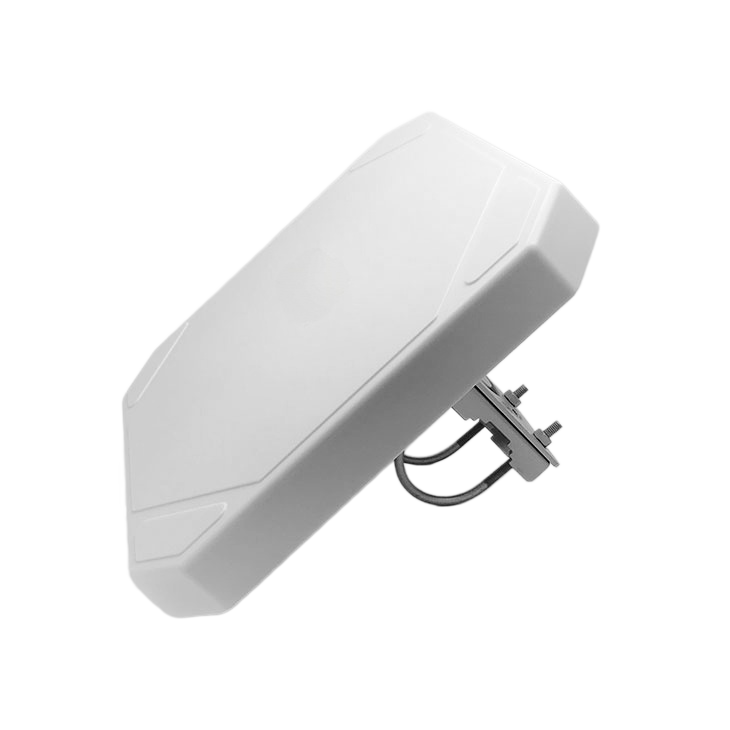
9dBi UHF RFID Panel Antenna
9dBi RHCP panel antenna, 60 by 55 degree 3dB beam-width, N-Type Female at 50 ohms, IP67 sealed, 255 by 255 by 30 mm.
View DetailsPick the Output Power, Then the Memory
The 1W builds hold 30dBm on POE 802.3af; the 2W builds reach 33dBm on POE+ 802.3at. Both drive the same four 50 ohm TNC ports and the same Android 9.0 image, so one application build covers every unit you install. Send us your tag type, antenna gain and region, and we confirm which of the four ships.