Four-Port UHF Reading With Android 13 On Board
1300+ tags/sec across four 50Ω TNC ports, with receive sensitivity below -84dBm.
Four TNC ports drive up to four antennas from one enclosure, and the reader accepts a variety of antennas such as 6dBic and 9dBic. The standard configuration transmits 1W at 30dBm and takes power from a single POE drop; the optional 2W configuration reaches 33dBm on POE+ or DC. The RFID engine uses Impinj E Series chips, and Impinj Gen2X is supported. Android 13 runs on an octa-core 2.0 GHz processor with 3GB of RAM and 32GB of storage, inside a 214 x 148 x 30 mm aluminium alloy body that brings RS-232, RJ45, USB and HDMI Type A out to its edges.
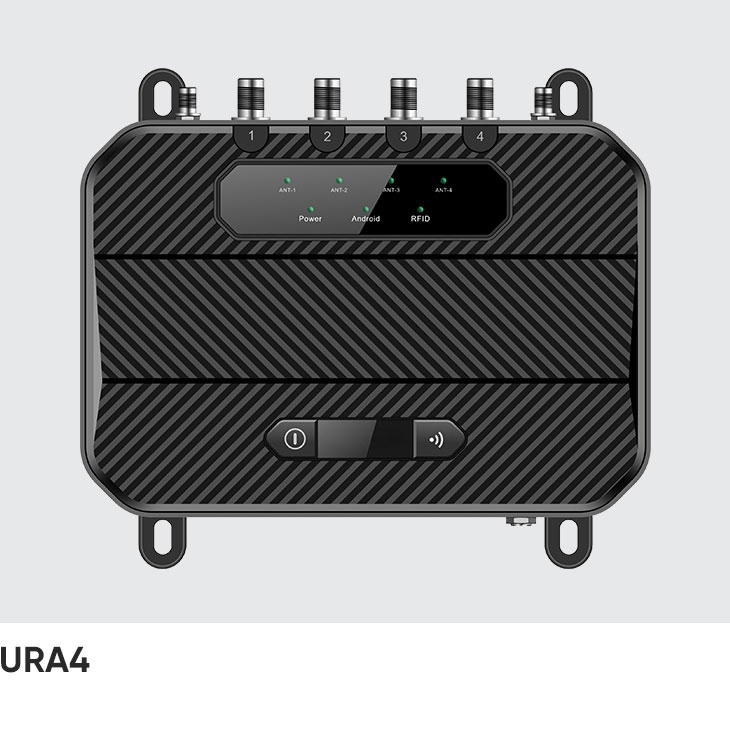
- Impinj E SeriesRFID engine chipset
- Impinj Gen2XSupported by the engine
- EPC Class 1 Gen 2UHF air interface
- ISO 18000-6CAir interface standard
- Android 13Operating system
- Bluetooth 5.1Short-range radio
- 802.11 a/b/g/n/ac2.4G and 5G dualband
- 802.11r Fast RoamingWith PMKID caching, OKC
- 802.3af / 802.3atPOE 13W, POE+ 25.5W
- 10/100 Base-TEthernet over RJ45
- HDMI Type ADisplay output, 720P
- 50Ω TNC Ports4 antenna channels
Overview
The URA4 is a fixed reader that carries its own computer. A single 214 x 148 x 30 mm enclosure feeds four antennas from its 50Ω TNC ports, while an octa-core 2.0 GHz processor with 3GB of RAM and 32GB of storage runs Android 13 on the unit itself. Filtering and buffering happen where the antennas are, not on a server elsewhere in the building.
The two configurations differ in output power and in nothing else. The standard unit transmits 1W at 30dBm, adjustable from +5 to +30dBm, and draws everything it needs from one POE drop. The optional 2W unit reaches 33dBm, adjustable from +10 to +33dBm, and needs POE+ or DC instead. Every other line of the specification is shared, so both units take the same software image and the same integration work.
Behind the ports, the engine is built on Impinj E Series chips with Impinj Gen2X added, and it reads EPC global UHF Class 1 Gen 2 and ISO 18000-6C tags at 1300+ tags/sec. Wired and wireless links are both present: 10/100 Base-T Ethernet over RJ45, 802.11 a/b/g/n/ac on 2.4G and 5G with 802.11r fast roaming, Bluetooth 5.1, plus RS-232, USB and HDMI Type A for equipment at the reader. Explore the full range of fixed RFID readers.
Key Features
Platform and Networking
- Android 13
- Octa-core 2.0 GHz
- 3GB + 32GB
- 802.11 a/b/g/n/ac, 2.4G/5G
- Bluetooth 5.1
Power and Interfaces
- DC 12V, POE 13W, POE+ 25.5W
- 1*RS-232, 1*RJ45, USB Host
- 3*USB2.0 Type A, 1*Type C
- HDMI Type A, support 720P
- GPIO: 4 Input, 4 Output, isolation
UHF Data Capture
- 1300+ tags/sec
- 4 channel 50Ω TNC port
- Receive sensitivity below -84dBm
- Output power up to 33dBm
- Impinj Gen2X supported
Features & Functions at a Glance
Choose Your Configuration
| Feature | URA4 (1W) | URA4 (2W) |
|---|---|---|
| Best for | Fixed reading points fed by a single POE drop, such as portal frames, conveyor runs and cabinet interiors | Wider read zones, and regions whose regulations allow 33dBm, where POE+ or DC reaches the mounting point |
| Form factor | 214 (L) x 148 (W) x 30 (H) mm aluminium alloy body, 1000g / 35.27 oz. (without antenna) | |
| Reading capability | Identical in both configurations | |
| Antenna Port | 4 channel 50Ω TNC port | |
| Engine | Based on Impinj E Series chips | |
| Impinj Gen2X | Supported | |
| Protocol | EPC global UHF Class 1 Gen 2 / ISO 18000-6C | |
| Frequency | 865-868 MHz / 920-925 MHz / 902-928 MHz | |
| Antenna | Supporting a variety of antennas, such as 6dBic, 9dBic | |
| Fastest Read Rate | 1300+ tags/sec | |
| Receive Sensitivity | < -84dBm | |
| Where they differ | The two rows below are the only differences | |
| Output Power | 1W (30dBm, support +5~+30dBm adjustable, POE/DC power) | 2W Optional (33dBm, support +10~+33dBm adjustable, POE+/DC power, for Latin America, etc.) |
| Power required | DC (12V), POE (802.3af 13W) | DC (12V), POE+ (802.3at 25.5W) |
| Platform | Common to both configurations | |
| Operating System | Android 13 | |
| CPU | Octa-core 2.0 GHz | |
| RAM+ROM | 3GB + 32GB | |
| Comm Interface | 1*RS-232, 1*RJ45, 3*USB2.0 Type A, 1*Type C, USB Host | |
| Display Interface | HDMI Type A, support 720P | |
| GPIO | 4 Input Optical-couplings, 4 Output Optical-couplings, isolation | |
Antenna compatibility — both configurations use the same 4 channel 50Ω TNC port and support a variety of antennas, such as 6dBic and 9dBic. Antennas and antenna cabling are ordered separately.
Every value in this table matches the full Specifications section below.
A Closer Look at the Hardware
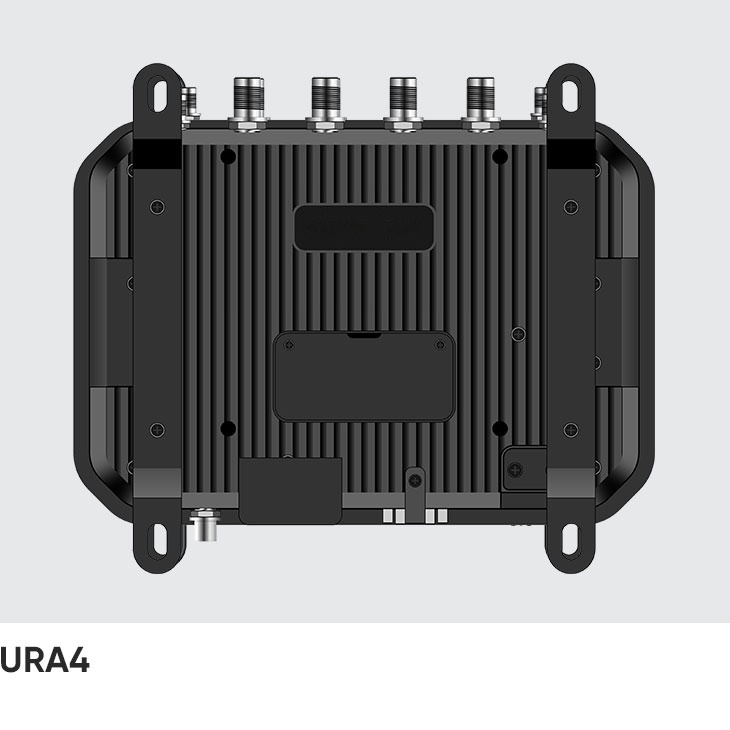
Finned Aluminium Alloy BackThe whole rear face is one finned aluminium alloy panel, and the cooling mode is air cooling. Four slotted lugs are placed outside the fin area, so the mounting bolts never cross the cooling surface.
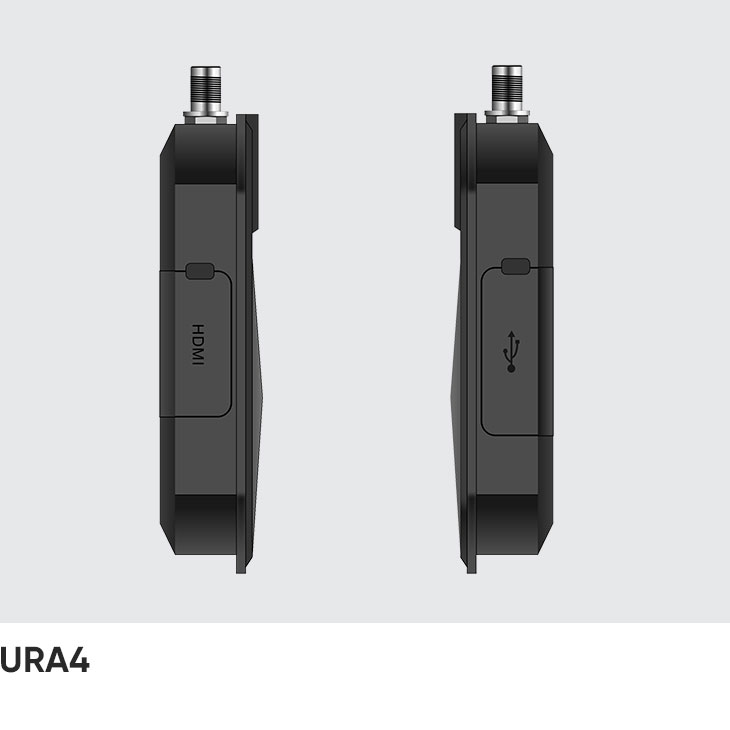
Side Ports Under CoversHDMI Type A sits behind the cover on one side and USB behind the cover on the other. Each cover clips flush with the body, so a unit that needs only the network cable leaves both of them closed.
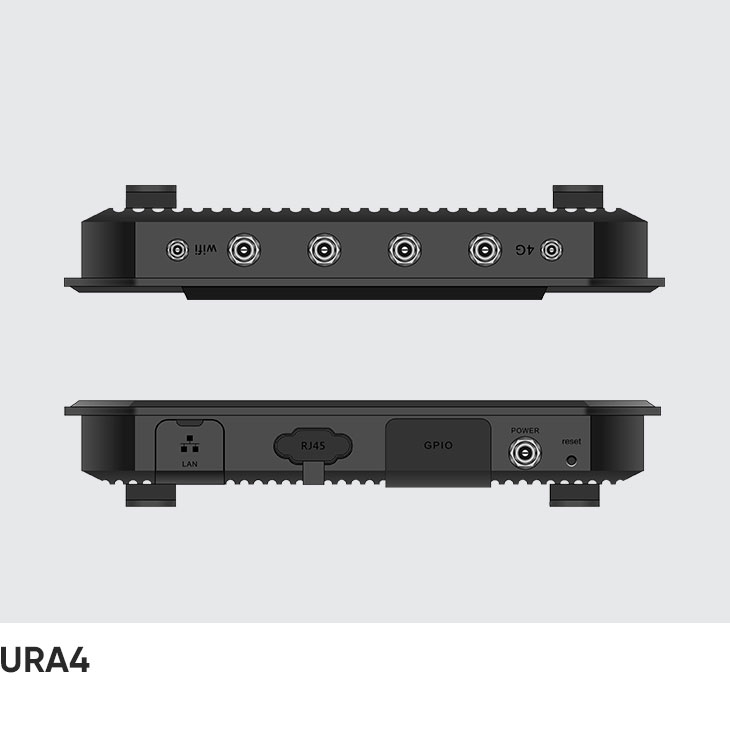
Antennas Up, Cabling DownThe top edge carries the antenna connectors, with the WLAN and 4G positions marked at either end of the row. LAN, RJ45, GPIO, POWER and reset are grouped along the bottom edge instead, so coaxial runs and cable runs leave the body in opposite directions.
Specifications
Physical Characteristics
- Dimensions
- 214 (L) x 148 (W) x 30 (H) mm
- Weight
- 1000g / 35.27 oz. (without antenna)
- Power
- DC (12V), POE (802.3af 13W), POE+ (802.3at 25.5W)
- Material
- Aluminium alloy
- Expansion Slot
- 1 slot for Nano SIM card, 1 slot for TF card
- Input Voltage
- DC 10V – 24V
- Standby Current
- < 30mA
- Comm Interface
- 1*RS-232, 1*RJ45, 3*USB2.0 Type A, 1*Type C, USB Host
- GPIO
- 4 Input Optical-couplings, 4 Output Optical-couplings, isolation
- Baud Rate
- 115200 bps
- Cooling Mode
- Air cooling
- Work Current
- 1300mA +/-5% @ DC 12V Input
- Display Interface
- HDMI Type A, support 720P
Communication
- Ethernet interface
- 10/100 Base-T Ethernet (RJ45)
- WLAN
- Support 802.11 a/b/g/n/ac/d/e/h/i/k/r/v,2.4G/5G dualband, IPV4,IPV6;
Fast roaming: PMKID caching, 802.11r, OKC;
Operating Channels: 2.4G(channel 1~13), 5G(channel 36,40,44,48,52,56,60,64,100,104,108,112,116,120,124,128,132,136,140,149,153,157,161,165), Depends on local regulations;
Security and Encryption: WEP,WPA/WPA2-PSK(TKIP and AES),WAPI-PSK—EAP-TTLS,EAP-TLS, PEAPMSCHAPv2, PEAP-LTS,PEAP-GTC,etc. - WWAN (Europe, Asia)
- 2G: GSM/EDGE (MHz): 850/900/1800/1900
3G: WCDMA: B1/B2/B4/B5/B8
4G: TDD-LTE: B38/B40/B41
FDD-LTE: B1/B2/B3/B4/B5/B7/B8/B20/B28 - WWAN (America)
- 4G: TDD-LTE: B41
FDD-LTE: B2/B4/B5/B7/B12/B13/B14/B17/B25/B26/B66/B71 - Bluetooth
- 5.1
Developing Environment
- Operating System
- Android 13
- SDK
- CedaGlo Software Development Kit
- Language
- Java
- Tool
- Eclipse/Android Studio
Performance
- CPU
- Octa-core 2.0 GHz
- RAM+ROM
- 3GB + 32GB
User Environment
- Operating Temp.
- -25 °C to 55 °C
- Storage Temp.
- -40 °C to 85 °C
- Humidity
- 5% - 95%
UHF RFID
- Engine
- Based on Impinj E Series chips
- Frequency
- 865-868 MHz / 920-925 MHz / 902-928 MHz
- Impinj Gen2X
- Supported
- Protocol
- EPC global UHF Class 1 Gen 2 / ISO 18000-6C
- Antenna
- Supporting a variety of antennas, such as 6dBic, 9dBic
- Output Power
- 1W (30dBm, support +5~+30dBm adjustable, POE/DC power)
2W Optional (33dBm, support +10~+33dBm adjustable, POE+/DC power, for Latin America, etc.) - Output Power Precision
- +/- 1dB
- Output Power Flatness
- +/- 0.2dB
- Receive Sensitivity
- < -84dBm
- RSSI
- Supported
- Ambient Temp Monitor
- Supported
- Fastest Read Rate
- 1300+ tags/sec
- Antenna Detector
- Supported
- Antenna Port
- 4 channel 50Ω TNC port
Every row above is transcribed from the URA4 configuration sheet. Items not listed there are not offered on this page.
Why Buy the URA4 From CedaGlo
Components You Can Verify
Every part name on this page comes from the configuration sheet, not from a brochure. Impinj, Android and the 802.11 letters are printed the way their suppliers print them, so you can check each one before you talk to us.
Configured Before It Ships
Tell us which output power the site needs and which band your regulator allows. We set both here, so the unit that arrives is already the one you specified, not a default that somebody has to change on a ladder.
Borrow One Before Committing
Ask for a unit on loan and run it against your own tag population. Read rates depend on the tags and the surroundings, so two weeks on your own racks tells you more than any figure we could print here.
Supported For the Long Run
Firmware and the SDK stay available for hardware you already have in service. Warranty length, spare part supply and the RMA route are commercial terms, so we put them in writing with the order rather than on a web page.
Frequently Asked Questions
How many tags per second can the URA4 actually read?
The configuration sheet lists a fastest read rate of 1300+ tags/sec, with receive sensitivity below -84dBm and RSSI reported on every read. Real throughput at your own site depends on the tags themselves, on the antenna gain you fit and on whatever else is radiating nearby, so treat 1300+ tags/sec as the ceiling of the engine rather than a number you should expect to see unchanged. Borrow a unit and measure it on your own stock before you write any number into a specification.
Which of the two configurations should I order?
Output power is the only thing that separates them. The standard URA4 transmits 1W at 30dBm, adjustable from +5 to +30dBm, and runs from DC 12V or from a single POE drop rated 802.3af 13W. The optional 2W URA4 transmits 33dBm, adjustable from +10 to +33dBm, and needs DC or POE+ rated 802.3at 25.5W instead. Everything else is identical, including the four TNC antenna ports, the engine and the whole platform, so both configurations take one software image.
What is the RFID engine built on?
The engine is based on Impinj E Series chips and supports Impinj Gen2X. It reads EPC global UHF Class 1 Gen 2 and ISO 18000-6C tags across 865-868 MHz, 920-925 MHz and 902-928 MHz. On the computing side the unit runs Android 13 on an octa-core 2.0 GHz processor with 3GB of RAM and 32GB of storage. Each of those names belongs to its own supplier, so you can pull up every datasheet without coming through us.
How long will the URA4 be supported?
Firmware, the CedaGlo Software Development Kit and the Java sample code stay available for units already in the field, and the toolchain is Eclipse or Android Studio, both of which are ordinary Android tooling rather than anything proprietary to this reader. Production life, spare part supply years and warranty length are commercial terms rather than specifications, so they are confirmed in writing with the order.
What operating environment is the URA4 rated for?
The configuration sheet gives an operating temperature range of minus 25 degrees Celsius to 55 degrees Celsius, a storage range of minus 40 degrees Celsius to 85 degrees Celsius, and humidity from 5% to 95%. The body is aluminium alloy and the cooling mode is air cooling, so there is no fan to fail. Those are the design figures the manufacturer supplies. No ingress protection rating and no drop rating are claimed anywhere on this page, because no test report has been issued for either.
How is the reader managed once it is installed?
Android 13 runs on the reader itself, so your application executes locally and keeps working through a network outage, and the RJ45 port, the WLAN radio and the 4G radio give three separate routes back to the unit. A reset control sits on the bottom edge beside the POWER connector for local recovery. Repair routing, RMA turnaround and spare part terms are confirmed in writing with the order.
Related Products
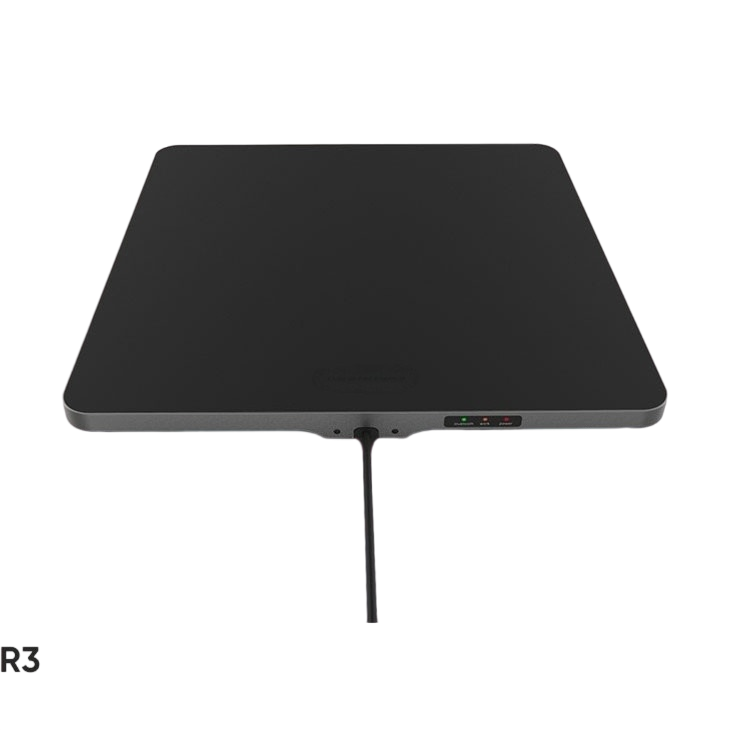
R3 Desktop UHF RFID Reader
Desktop UHF reader, 318 mm square and 20 mm thick. Over 100 cm read range with an Impinj M750 tag, 100+ tags in 5s, BLE 4.0.
View Details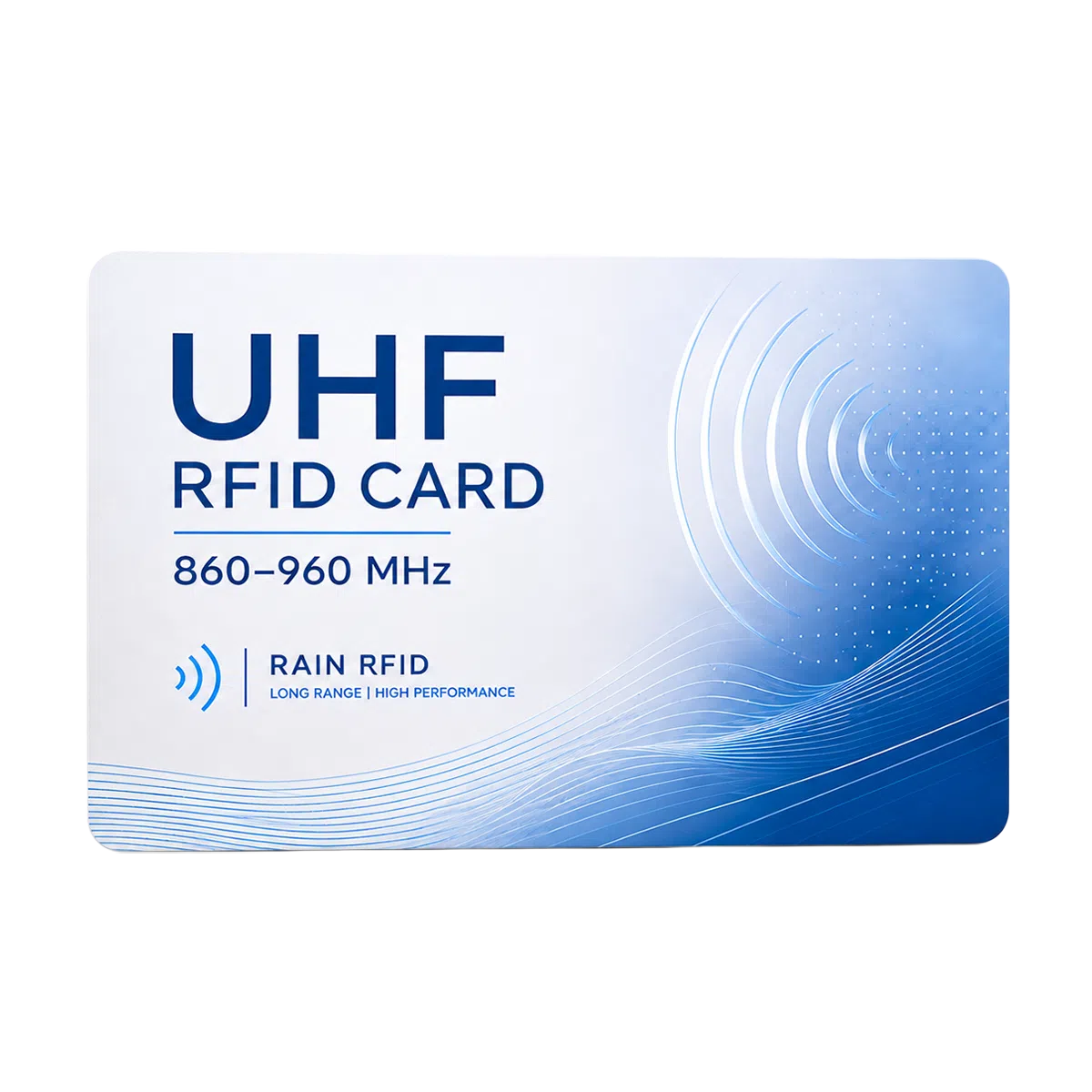
UHF Card | 860–960 MHz RAIN RFID Card
Standard CR80 UHF RFID cards with Impinj, NXP UCODE, Alien Higgs chip options. Ideal for parking, asset tracking & warehouse inventory. OEM/ODM available.
View Details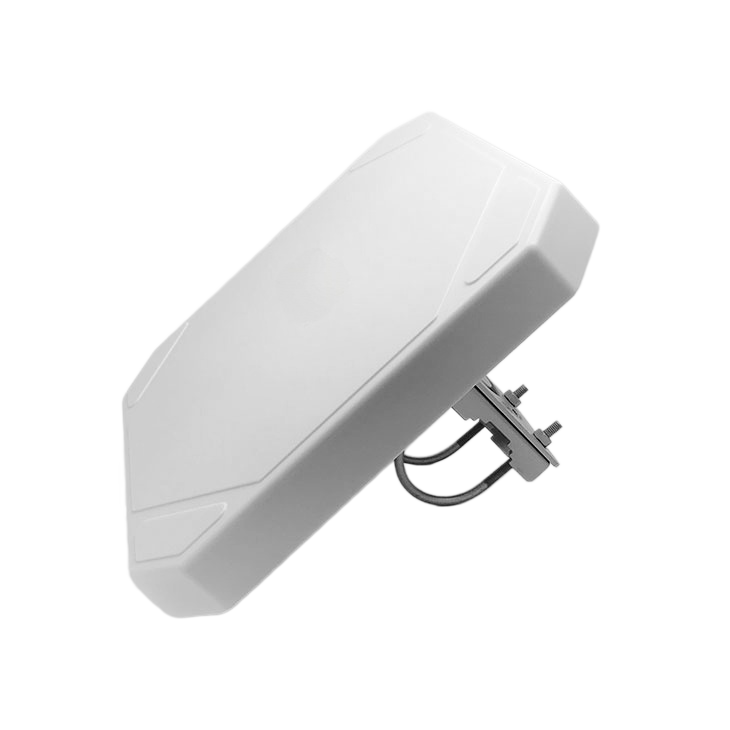
9dBi UHF RFID Panel Antenna
9dBi RHCP panel antenna, 60 by 55 degree 3dB beam-width, N-Type Female at 50 ohms, IP67 sealed, 255 by 255 by 30 mm.
View Details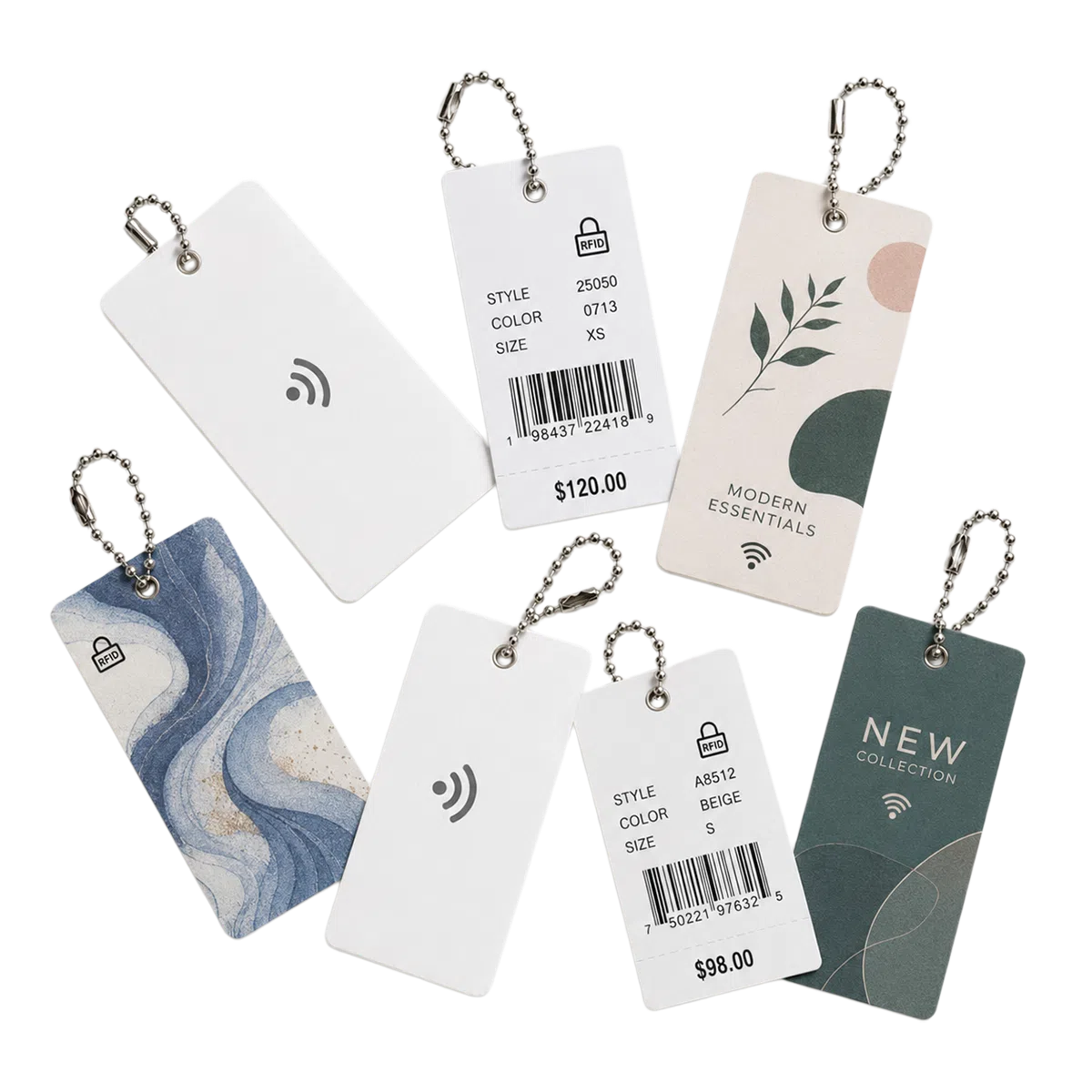
RFID Apparel Hang Tags for Retail Inventory & NFC Engagement
Custom RFID apparel hang tags from CedaGlo with UHF, NFC, barcode, QR code, artwork printing, EPC encoding and packaging options.
View DetailsMatch the Reader to the Room, Not the Reverse
The URA4 reads 1300+ tags/sec through four TNC ports, and the optional 2W build lifts output to 33dBm where local rules allow. Both builds take one Android 13 image and one SDK, so integration happens once. Send us your tag type, your antenna gain and the power method you have at the installation.