
Run Four Antennas From One 390g Reader
1300+ tags/sec, four 50Ω SMA antenna ports, and 1W (30dBm) output that adjusts down to +5dBm.
The UR4 is a four-port fixed UHF reader that lists 1300+ tags/sec as its fastest read rate and a receive sensitivity below -84 dBm. The 1W build covers 30dBm sites with output adjustable from +5dBm, while the 2W option reaches 33dBm for Latin America and other markets that allow it. The RFID engine is based on Impinj E Series chips and supports Impinj Gen2X, EPC global UHF Class 1 Gen 2, and ISO 18000-6C. RS-232, RJ45, and 10/100 Base-T Ethernet put the reader on an existing network, with POE (802.3af 13W) and POE+ (802.3at 25.5W) listed as options. The SDK runs on Windows, Linux, and Android.
- Impinj E SeriesChips behind the engine
- Impinj Gen2XListed as supported
- EPC Class 1 Gen 2EPCglobal air interface
- ISO 18000-6CSame air interface
- 865-868 MHzBand on the datasheet
- 920-925 MHzSecond listed band
- 902-928 MHzThird listed band
- RS-232 / RJ45Host comm interface
- 10/100 Base-TEthernet over RJ45
- POE 802.3af 13WListed as optional
- POE+ 802.3at 25.5WHigher optional budget
- 4 x 50Ω SMAAntenna port on the unit
Overview
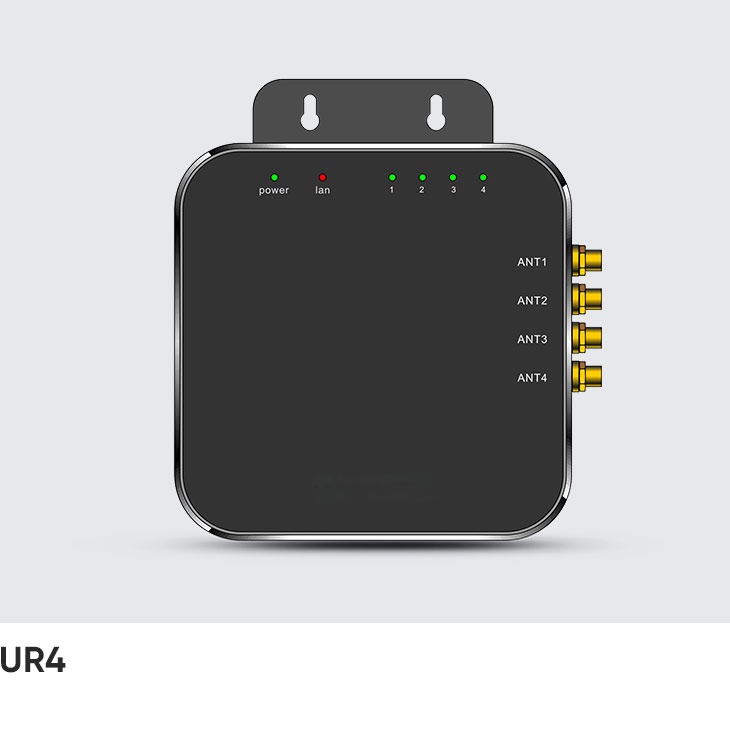
The UR4 fits a four-port UHF reader into a 102.8 mm square housing that weighs 390g. Every port is a 50Ω SMA connector, so one unit covers four antenna positions on a portal, a shelf bay, or a production line point instead of two boxes on the wall.
Output power is where the two builds separate. The standard unit runs 1W at 30dBm and turns down as far as +5dBm for close-range work, while the 2W option reaches 33dBm for Latin America and other markets that allow it. Everything else is shared: 1300+ tags/sec at the top of the range, a receive sensitivity below -84 dBm, antenna detection, RSSI, and a GPIO block with 2 channel input optical coupling and 1 channel output electric relay for site equipment.
The engine is based on Impinj E Series chips and supports Impinj Gen2X, EPC global UHF Class 1 Gen 2, and ISO 18000-6C. RS-232 and RJ45 carry host traffic at 115200 bps, 10/100 Base-T Ethernet handles the network side, and POE or POE+ can bring power over the same run. Explore the full range of fixed RFID readers.
Key Features
Wiring and Control
- RS-232 / RJ45 at 115200 bps
- 10/100 Base-T Ethernet (RJ45)
- POE (802.3af 13W) (Optional)
- POE+ (802.3at 25.5W) (Optional)
- GPIO: 2 in, 1 relay, 1 optical out
Housing and Environment
- Aluminium alloy housing
- 102.8 x 102.8 x 28 mm, 390g
- Air cooling
- Operating -25 °C to 65 °C
- Humidity 10%- 95%
Reading Performance
- Based on Impinj E Series chips
- Impinj Gen2X supported
- 1W (30dBm), +5~+30dBm adjustable
- 1300+ tags/sec, < -84 dBm
- 4 channel 50Ω SMA port
Features & Functions at a Glance
Choose Your Configuration
| Feature | UR4 / 1W | UR4 / 2W |
|---|---|---|
| Best for | Portals, shelf bays, and production line points running at 30dBm | Markets that allow 33dBm, such as Latin America |
| Shared hardware | Identical in both configurations | |
| Form factor | 102.8 mm(L) x 102.8 mm(W) x 28 mm(H), 390g, Aluminium alloy | |
| Antenna port | 4 channel 50Ω SMA port | |
| Antenna | Supporting a variety of antennas, such as 6dBic, 9dBic | |
| Comm interface | RS-232 / RJ45 at 115200 bps | |
| Ethernet | 10/100 Base-T Ethernet (RJ45) | |
| Power supply | DC 9V – 12V; POE (802.3af 13W) (Optional); POE+ (802.3at 25.5W) (Optional) | |
| GPIO | 2 channel input optical coupling, 1 channel output electric relay, 1 channel output optical coupling (in reserve) | |
| Read rate | 1300+ tags/sec | |
| Receive sensitivity | < -84 dBm | |
| Frequency | 865-868 MHz / 920-925 MHz / 902-928 MHz | |
| Where they differ | The row below is the only difference | |
| Output power | 1W (30dBm, support +5~+30dBm adjustable) | 2W Optional (33dBm, support +10~+33dBm adjustable, for Latin America, etc.) |
| Platform | Common to both configurations | |
| Engine | Based on Impinj E Series chips, Impinj Gen2X supported | |
| Protocol | EPC global UHF Class 1 Gen 2 / ISO 18000-6C | |
| SDK | Windows, Linux, Android | |
Antenna compatibility — both configurations use the same 4 channel 50Ω SMA port and support a variety of antennas, such as 6dBic, 9dBic. Cables and antennas are ordered separately and do not change the reader build.
Every value in this table matches the full Specifications section below.
A Closer Look at the Hardware
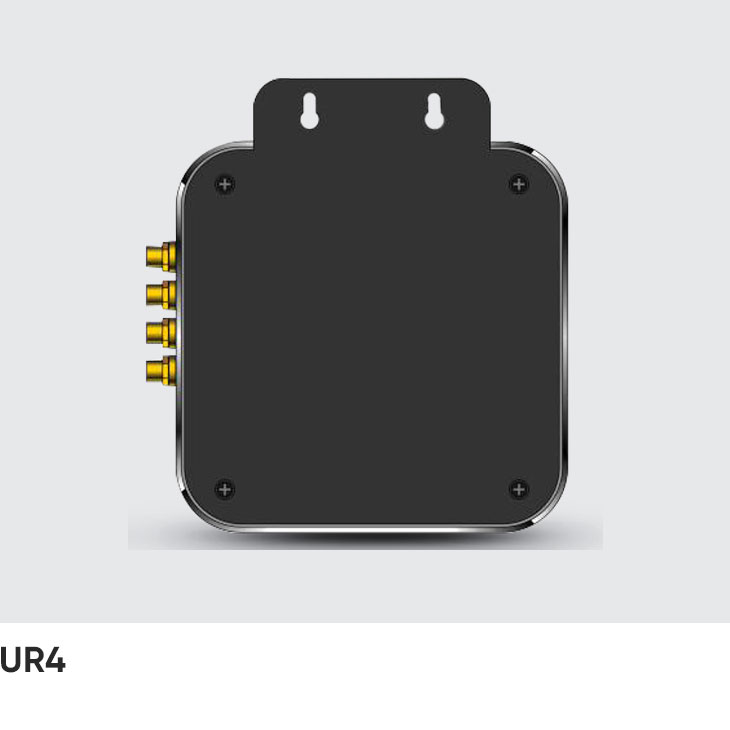
Bracket with two keyhole slotsThe bracket sits flush against the back face, so the reader drops onto two screws already in the wall or the gantry. Four screws hold the cover, and the antenna ports stay clear of the bracket on the left edge.
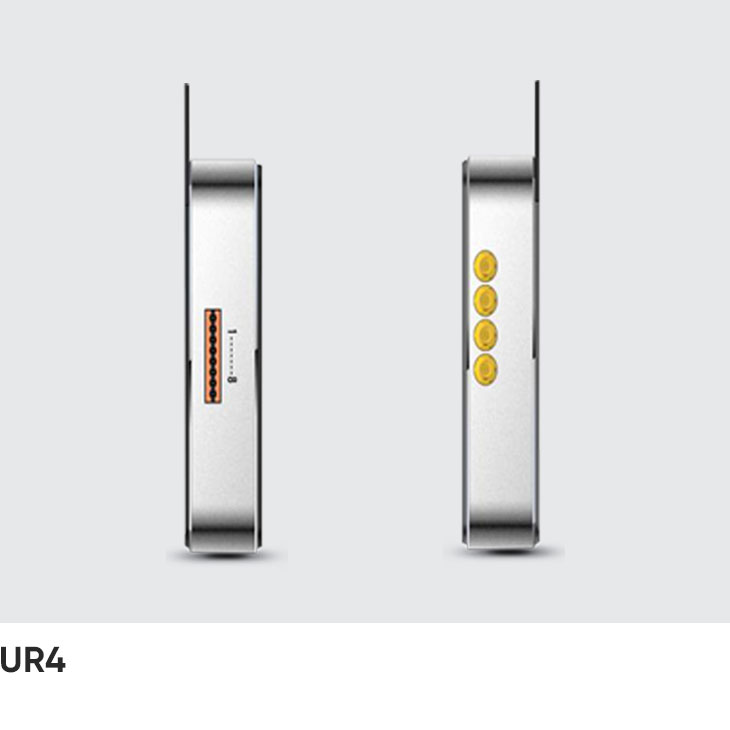
GPIO on one side, antennas on the otherThe numbered terminal block takes the GPIO wiring on one narrow side. The four 50Ω SMA ports line up on the opposite side, which keeps signal cable and control wiring on separate routes into the enclosure.
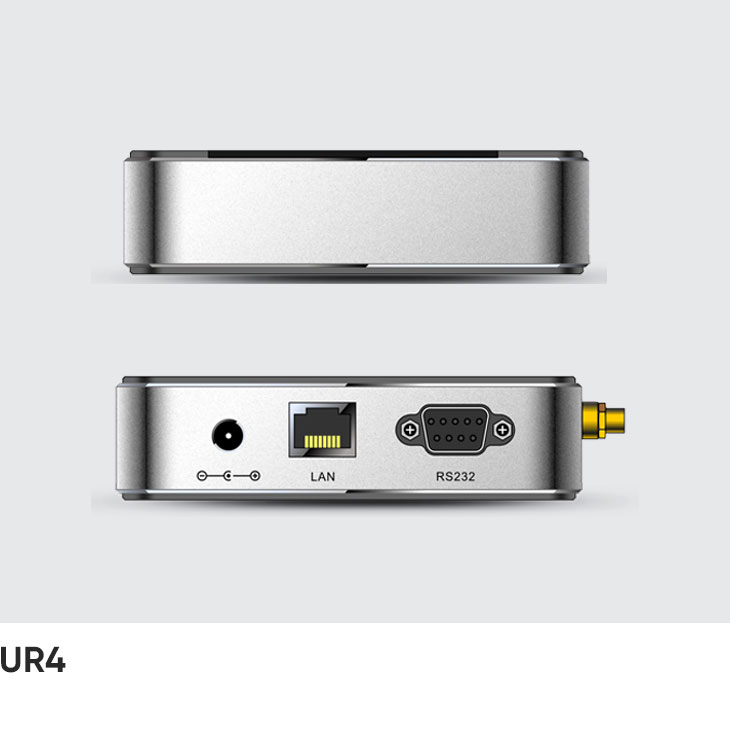
Three labelled host connectionsThe interface face carries the DC jack, the LAN port, and the RS232 connector, each marked on the housing. The top edge is a plain extruded band with no vents cut into it, matching the air cooling listed in the specifications.
Specifications
Physical Characteristics
- Dimensions
- 102.8 mm(L) x 102.8 mm(W) x 28 mm(H)
- Weight
- 390g
- Material
- Aluminium alloy
- Input Voltage
- DC 9V – 12V
- Standby Current
- < 30mA
- Comm Interface
- RS-232 / RJ45
- GPIO
- 2 channel input optical coupling, 1 channel output electric relay, 1 channel output optical coupling (in reserve)
- Baud Rate
- 115200 bps
- Cooling Mode
- Air cooling
- Work Current
- 800mA +/-5% @ DC 12V Input
- Ethernet interface
- 10/100 Base-T Ethernet (RJ45)
- Power Supply
- POE (802.3af 13W) (Optional) POE+ (802.3at 25.5W) (Optional)
Developing Environment
- SDK
- Windows, Linux, Android
User Environment
- Operating Temp.
- -25 °C to 65 °C
- Storage Temp.
- -40 °C to 85 °C
- Humidity
- 10%- 95%
UHF RFID
- Engine
- Based on Impinj E Series chips
- Frequency
- 865-868 MHz / 920-925 MHz / 902-928 MHz
- Impinj Gen2X
- Supported
- Protocol
- EPC global UHF Class 1 Gen 2 / ISO 18000-6C
- Antenna
- Supporting a variety of antennas, such as 6dBic, 9dBic
- Output Power
- 1W (30dBm, support +5~+30dBm adjustable) 2W Optional (33dBm, support +10~+33dBm adjustable, for Latin America, etc.)
- Output Power Precision
- +/- 1dB
- Output Power Flatness
- +/- 0.2dB
- Receive Sensitivity
- < -84 dBm
- RSSI
- Supported
- Ambient Temp Monitor
- Supported
- Fastest Read Rate
- 1300+ tags/sec
- Antenna Detector
- Supported
- Antenna Port
- 4 channel 50Ω SMA port
Every row above is transcribed from the UR4 configuration sheet. Items not listed there are not offered on this page.
Why Buy the UR4 From CedaGlo
Components You Can Verify
We name the parts rather than describing them. The chip family, the air interface standards, and the Ethernet power classes all belong to third parties, so you can check each one at the source before a unit ships.
Two Power Levels, One Order
Regional radio rules decide whether a site takes 30dBm or 33dBm. Both builds leave the same line with the same housing and the same port count, so a mixed rollout across regions stays one purchase order and one spares pool.
Test Before You Standardize
Read rate depends on your tags, your antennas, and the metal around them. Put a unit on the real portal with the real stock, measure what it does over a full week, and decide afterwards whether the numbers hold up.
Kept Running After Install
Fixed readers stay on a wall for years, so the questions that matter arrive later. Production lifetime, spare coverage, and firmware maintenance go into your order in writing rather than sitting as a claim on a web page.
Frequently Asked Questions
How fast can the UR4 actually read tags?
The configuration sheet lists 1300+ tags/sec as the fastest read rate, together with a receive sensitivity below minus 84 dBm. The sheet does not state the tag population, antenna gain, or spacing behind that figure, so treat it as a ceiling rather than a site guarantee and confirm it against your own tags and antenna layout during evaluation.
Should I order the 1W or the 2W configuration?
Both configurations share one housing, one antenna port count, and one software image. The 1W unit outputs 30dBm and adjusts from plus 5dBm to plus 30dBm. The 2W option outputs 33dBm and adjusts from plus 10dBm to plus 33dBm, and the sheet lists it for Latin America and similar markets. Local radio rules decide which one you may deploy.
What is inside the RFID engine?
The engine is based on Impinj E Series chips and supports Impinj Gen2X. Air interface support covers EPC global UHF Class 1 Gen 2 and ISO 18000-6C, and the listed frequency options are 865-868 MHz, 920-925 MHz, and 902-928 MHz. Those are third-party names, so you can verify them with the chip vendor and the standards bodies directly.
How long will this model stay available?
Production lifetime, spare part coverage, and firmware maintenance are confirmed in writing with your order rather than promised on this page. Ask for that written statement before you standardize on the UR4 across sites, and we will match it to your rollout schedule and the volume you plan to install.
How tough is the UR4 and where can it be mounted?
The housing is aluminium alloy, weighs 390g, measures 102.8 mm by 102.8 mm by 28 mm, and uses air cooling. Operating temperature is listed as minus 25 degrees Celsius to 65 degrees Celsius, with humidity from 10 percent to 95 percent. No ingress protection rating is listed on the sheet, so plan a sheltered mounting position.
What do integration and after sales support look like?
The SDK covers Windows, Linux, and Android. The host link runs over RS-232 at 115200 bps or over the RJ45 port, which is 10/100 Base-T Ethernet. GPIO gives 2 channel input optical coupling and 1 channel output electric relay for site equipment. Warranty terms and the return process are confirmed in writing with your order.
Related Products
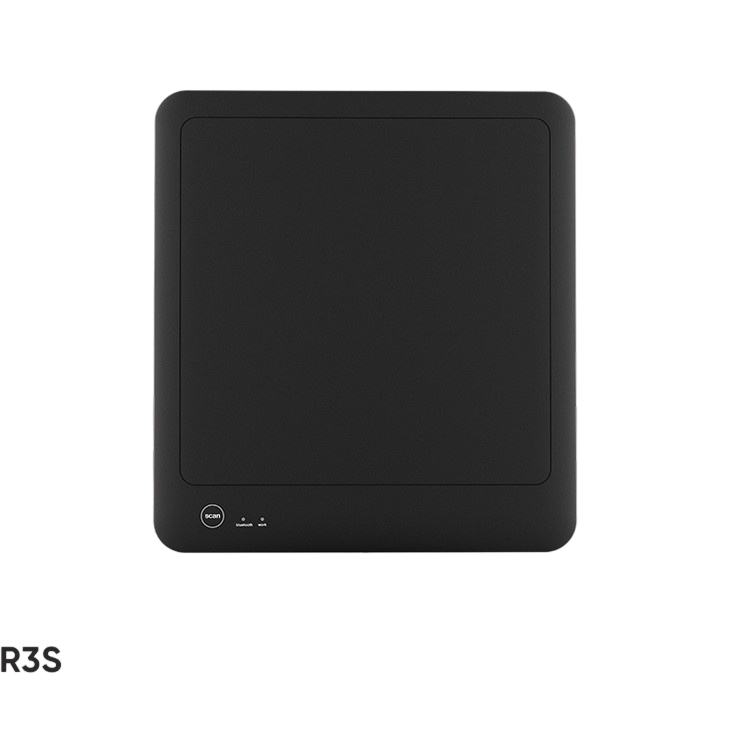
R3S Desktop RFID Reader
The CedaGlo R3S desktop RFID reader runs an Impinj E Series engine, reads 70+ tags in 5 seconds, and ships in Type-C, DC and PoE+ port builds for counters.
View Details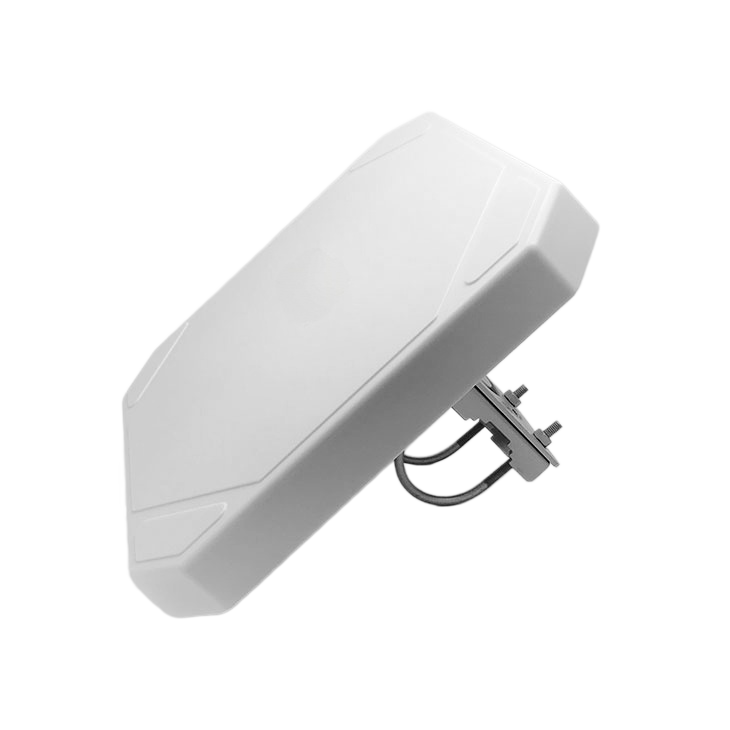
9dBi UHF RFID Panel Antenna
9dBi RHCP panel antenna, 60 by 55 degree 3dB beam-width, N-Type Female at 50 ohms, IP67 sealed, 255 by 255 by 30 mm.
View Details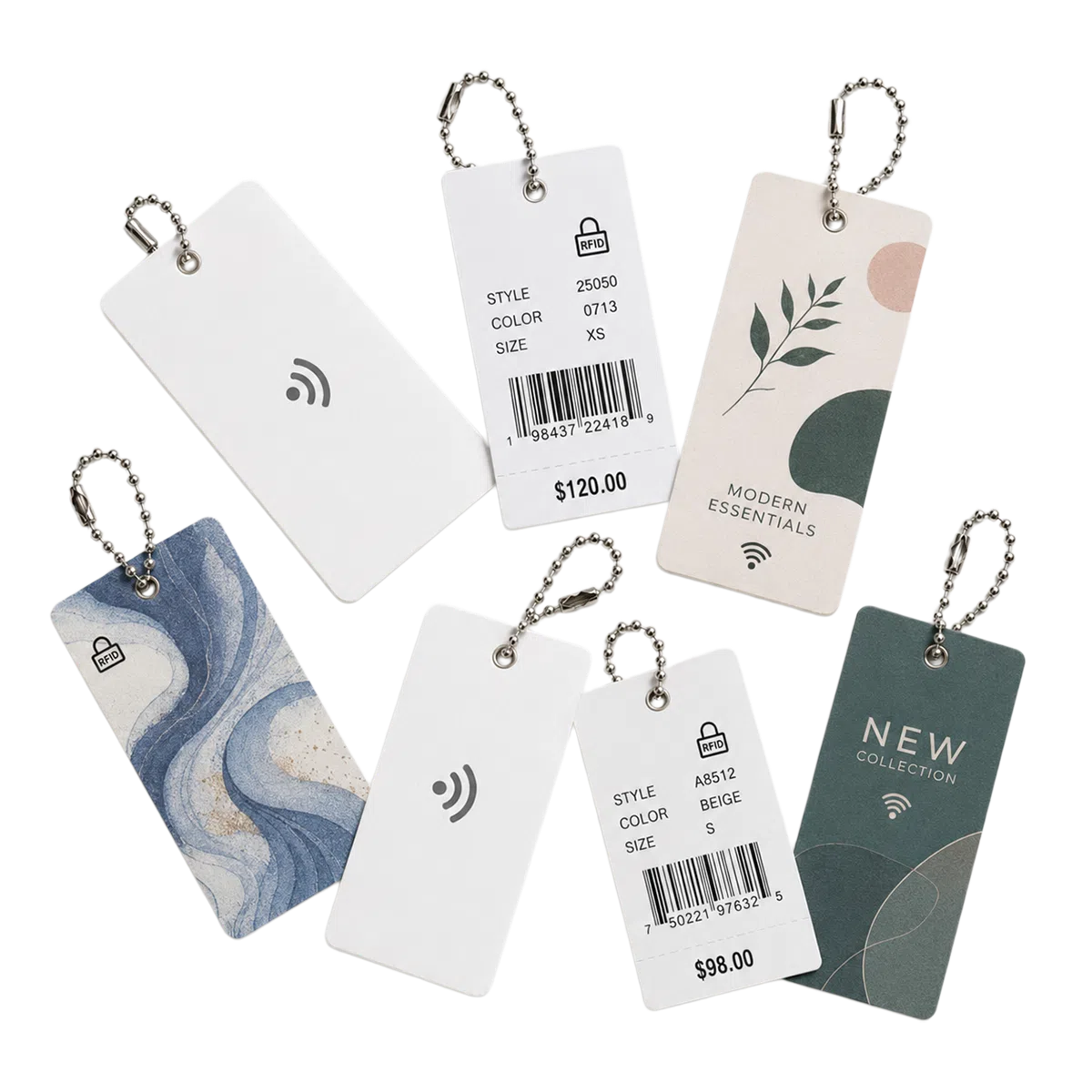
RFID Apparel Hang Tags for Retail Inventory & NFC Engagement
Custom RFID apparel hang tags from CedaGlo with UHF, NFC, barcode, QR code, artwork printing, EPC encoding and packaging options.
View Details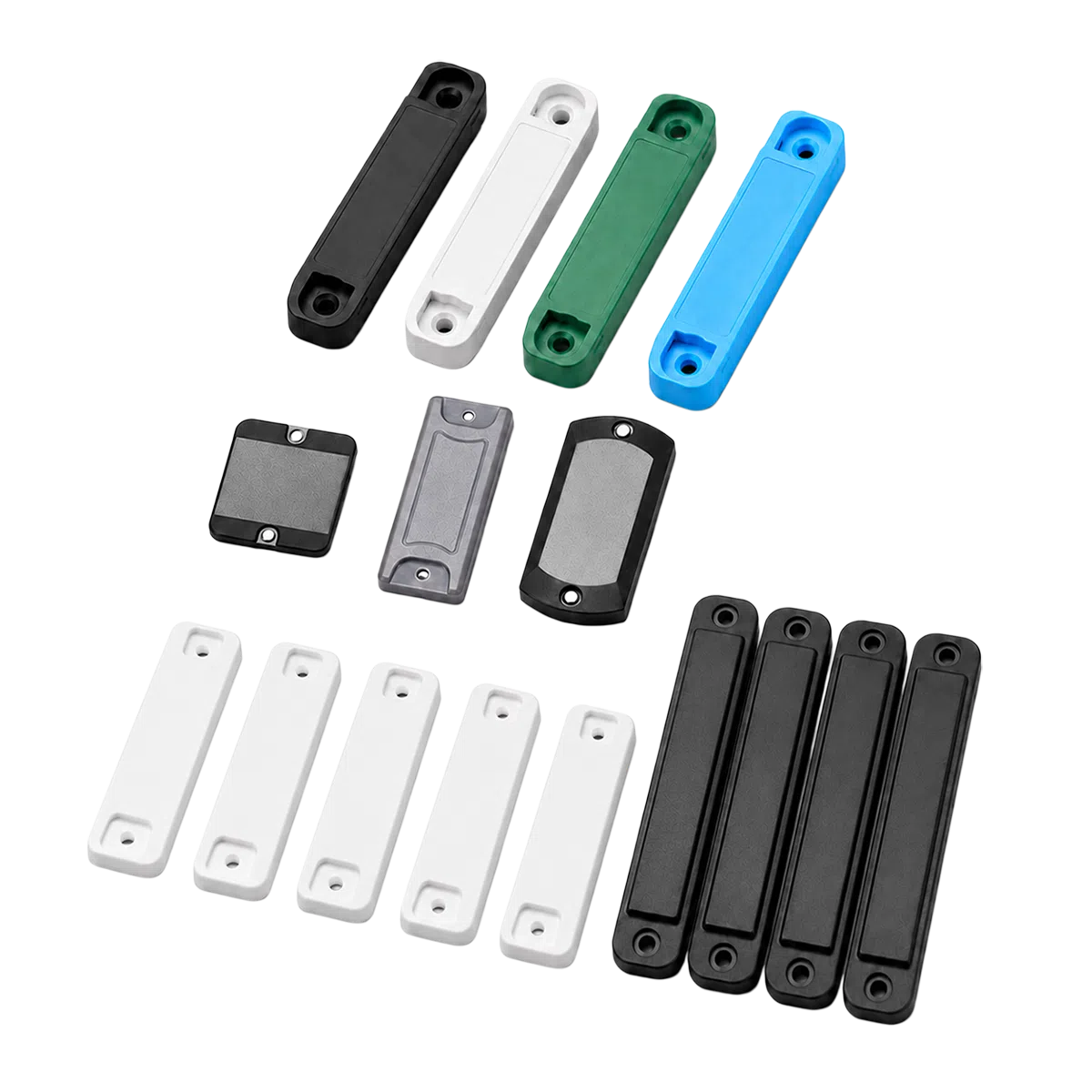
ABS UHF Anti-Metal RFID Tags for Industrial Asset Tracking
Durable on-metal RFID tags from CedaGlo for asset management, warehouse racks, tools, data centers, utilities and equipment tracking.
View DetailsMatch the Reader to Your Antennas
Four 50 ohm SMA ports on one 390g unit, with output adjustable from plus 5dBm to plus 30dBm and a 2W build at 33dBm. Both share one software image, so IT integrates once and deploys twice. Send us your tag type, frequency band, and antenna gain, and we will confirm the port count and power level to order.