
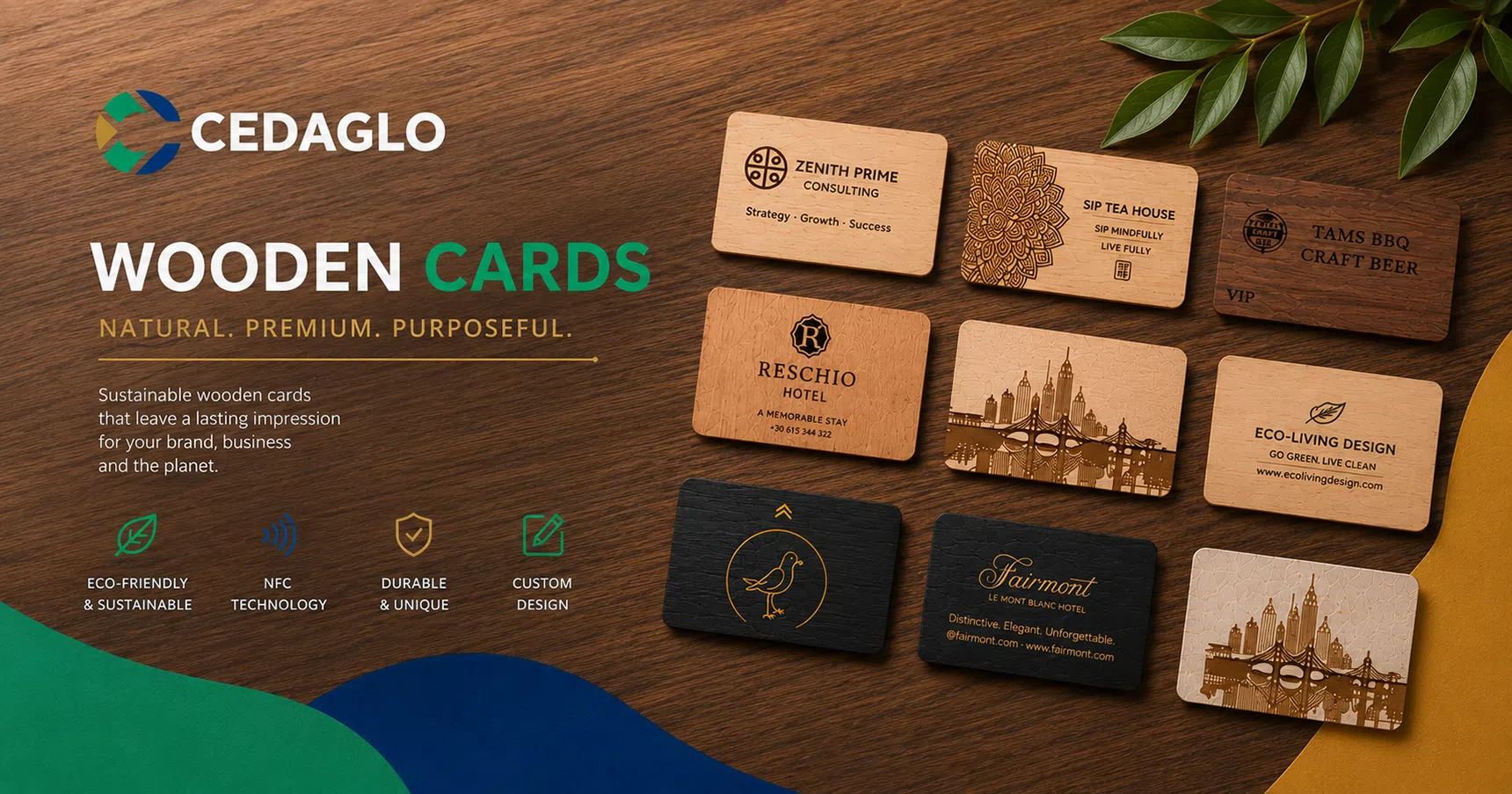
Wooden Smart Cards
Natural Wood RFID & NFC Smart Cards
A genuinely plastic-free card body milled from real wood veneer, laminated to protect the embedded chip and antenna while keeping the wood's natural grain on full display. Every card is compatible with the RFID and NFC systems your hotel, membership program, or brand already runs — no reader upgrades required.
Guests and clients don't throw wooden cards away. They keep them — on a desk, in a wallet, as a keepsake — turning a routine access card into a talking point for your brand long after the first tap.
- 🛡️100% Natural
Wood - 📡NFC / RFID
Ready - 🎯Laser-Engraved
Detail - 🌐Renewable
Material
Product Overview
Most "eco" smart cards are still plastic underneath — a bio-based resin, a recycled polymer, a PVC-look laminate. A Wooden Smart Card isn't. It's a genuine wood veneer sandwich, laminated over a protective core that shields the embedded chip and antenna and keeps the card flat and warp-resistant through years of handling — the same construction principle premium wooden hotel key cards have used for over a decade in hospitality.
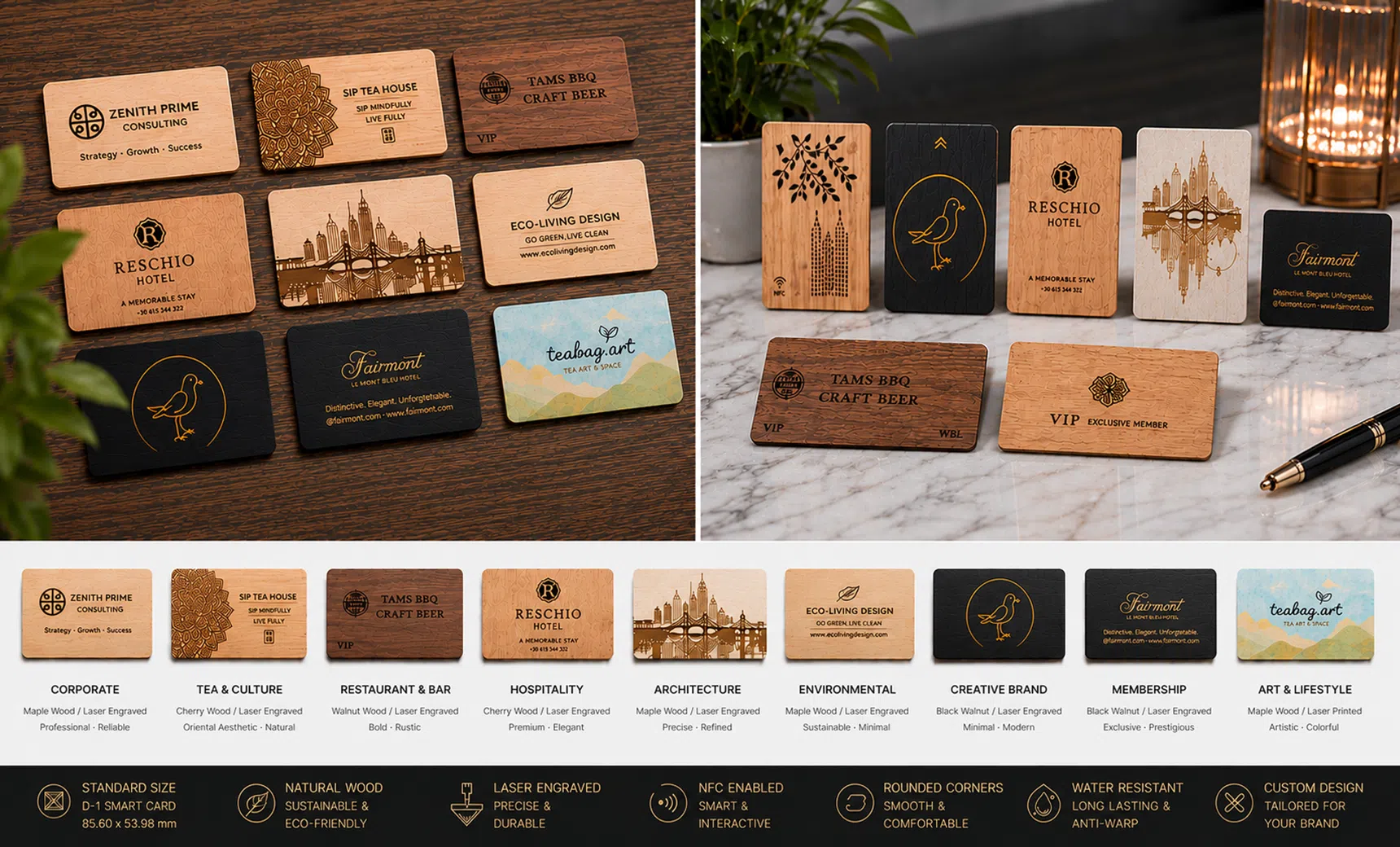
Wood also takes customization differently than plastic. Laser engraving burns logos, typography, and QR codes directly into the grain for a result that reads as crafted rather than printed, while UV spot printing is available where full-color branding is needed. The result is a card your recipient notices the moment it's handed over — and, unlike a plastic card that gets tossed at checkout, a wooden card is the one people keep.
Every card ships ready for your existing infrastructure. Choose from LF, HF/NFC, UHF, dual-frequency, or secure contact CPU chips, and the same wooden card body slots into hotel lock systems, access control, membership platforms, and NFC-enabled business cards without touching your readers.
Industry Application Needs
Hospitality & Hotels
Guests increasingly expect sustainable touchpoints. Wooden key cards replace plastic without compromising RFID lock compatibility.
Membership & Loyalty
Premium wood texture reinforces exclusivity for VIP and loyalty programs where a plastic card would feel generic.
Corporate & Networking
NFC-enabled wooden business cards leave a stronger impression at conferences and client meetings than paper or plastic.
Brand & Event Marketing
Laser-engraved wood cards double as keepsakes, extending brand recall well beyond a single event or campaign.
Access Control
Compatible with standard HF/NFC access systems, enabling a sustainable upgrade path without replacing existing readers.
Retail Gifting & Vouchers
Gift and voucher cards on real wood feel higher-value on unboxing, supporting premium retail positioning.
Our Advantages
Genuine Zero-Plastic Substrate
Real wood veneer, not a wood-look laminate — the difference is obvious the moment someone holds the card.
Full Chip Compatibility
Same HF/NFC, UHF and CPU chip range as plastic cards — drop it into your existing lock or reader system with zero downtime.
Precision Laser Engraving
Crisp, permanent logos, typography and QR codes burned into the grain — no ink to fade or peel.
Flexible MOQ & Fast Turnaround
Trial a 100-piece batch before committing to volume — 10–15 business days from confirmed design to delivery.
Key Technical Highlights
100% Natural Wood
No plastic core — real wood veneer, not a wood-look laminate.
Renewable & Biodegradable
Sourced from renewable wood species, going further than recycled or bio-based plastics.
Laser-Engraved Custom Detail
Fine engraving reproduces logos, typography and QR codes with permanent detail.
Unique Natural Grain
No two cards are identical, unlike uniform plastic surfaces.
Warm Tactile Feel
A natural warmth that distinguishes it from cold plastic or metal cards.
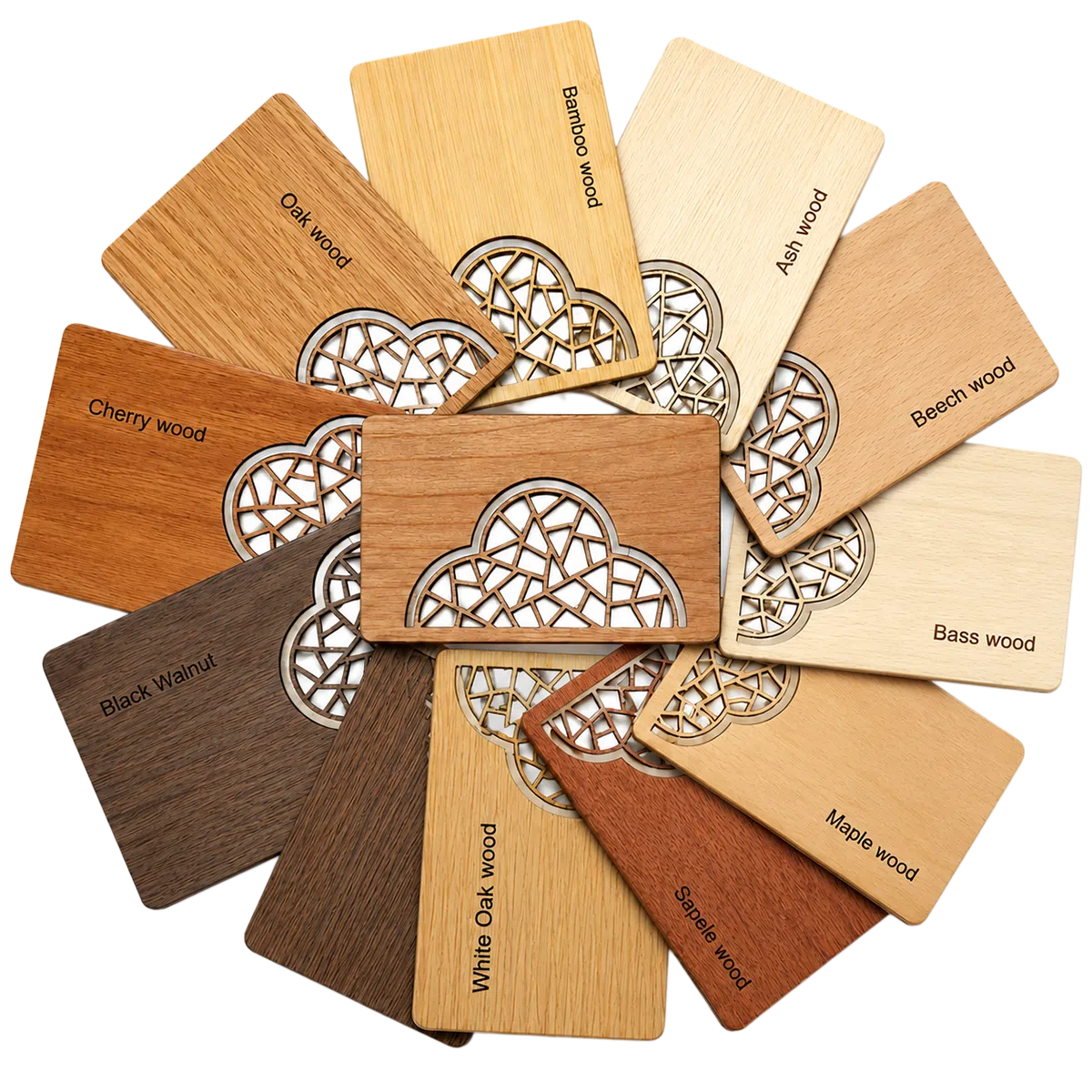
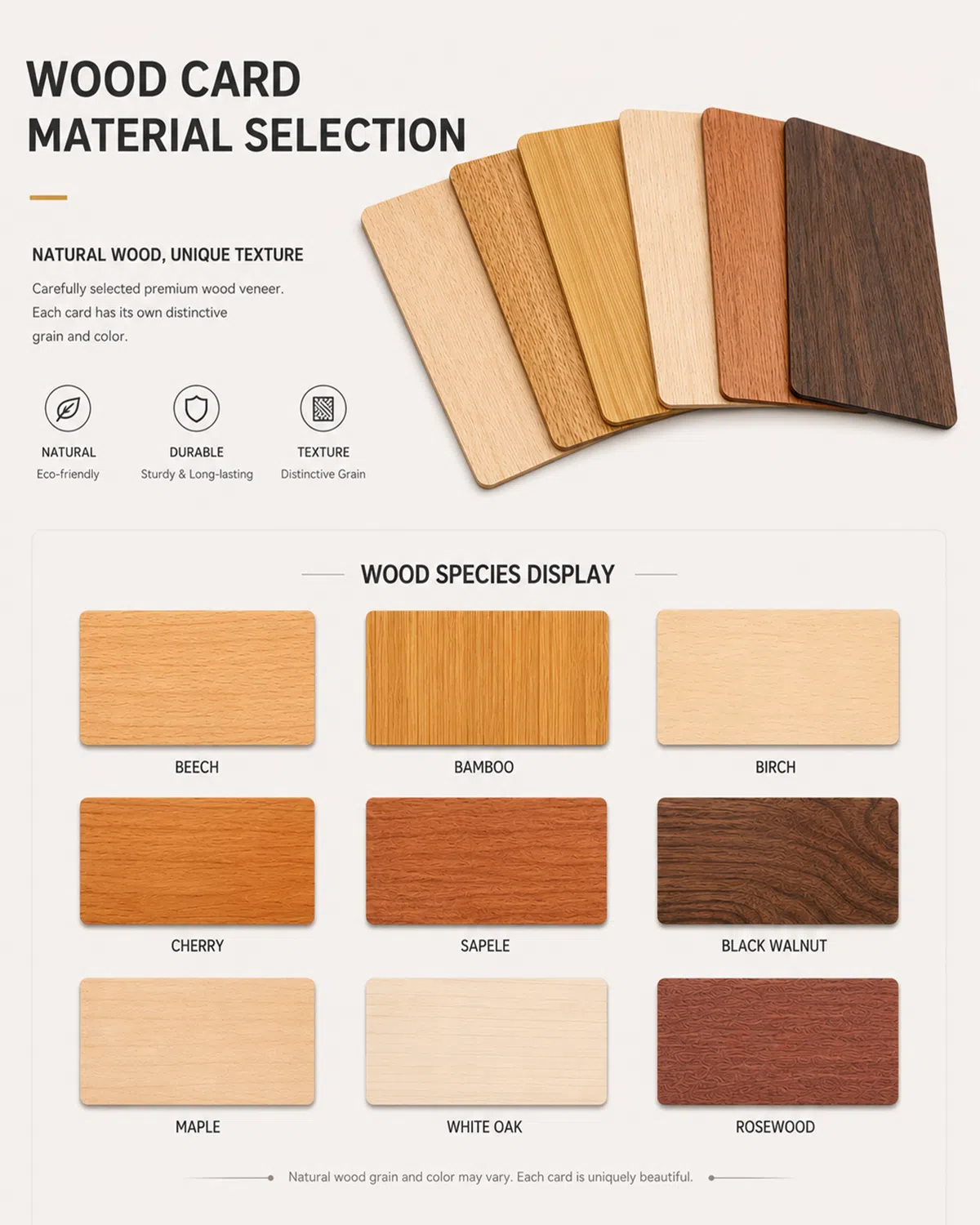
Multiple Wood Species
Choose from bamboo, cherry, walnut, maple, oak and more.
Key Features
📡 Technology
- Compatible with LF, HF/NFC, UHF and Dual-frequency chips
- Supports contact CPU chips for secure ID applications
- Reliable read range matching standard card readers
- NDEF encoding supported for NFC use cases
🌐 Material & Sustainability
- Premium wood veneer from renewable, FSC-sourced options
- Zero plastic content in the card substrate
- Sandwich lamination resists warping and protects the chip
- Distinctive natural grain, no two cards alike
🔧 Customization
- Precision laser engraving for logos and text
- Multiple wood species and finishes available
- Custom shapes and die-cut options on request
- QR code and serial number engraving supported
Technical Specifications
| Specification | Details |
|---|---|
| Material | Natural wood veneer (bamboo, cherry, walnut, maple, oak, and more) |
| Card Size | 85.60 × 53.98 mm (CR80 standard) or custom die-cut shapes |
| Thickness | 0.8 mm – 1.0 mm |
| Chip Options | LF, HF/NFC, UHF, Dual-frequency, and contact CPU chips |
| Printing / Marking | Precision laser engraving; optional UV spot printing |
| Water Resistance | Water-resistant lamination protecting the embedded chip |
| Edge Finish | Smooth rounded corners, anti-warp construction |
| MOQ | 100 pieces |
| Lead Time | 10–15 business days after design confirmation |
| Applications | Hotel key cards, membership cards, business cards, gift cards, access control |
Volume Pricing
| Quantity | Unit Price (USD / pc) |
|---|---|
| 100 – 199 pcs | From US$0.38 |
| 200 – 299 pcs | From US$0.36 |
| 300+ pcs | Contact Sales |
Final pricing depends on chip selection, card configuration, printing method, and order quantity. Contact our team for a tailored quote.
Supported Chip Platforms
Wooden card bodies support a broad range of HF/NFC, UHF and secure CPU chip platforms. Browse the tables below or use the search box to find a specific chip, brand, or use case.
Scrolls horizontally on desktop; shows as stacked cards on mobile.
RF Chip Platforms
| Chip | Brand | Freq. / Standard | Memory | R/W | Security | Best For |
|---|---|---|---|---|---|---|
| HF / NFC — 13.56 MHz | ||||||
| MIFARE Classic 1K / 4K (MF1S50/MF1S70, EV1) | NXP | 13.56 MHz · ISO 14443A | 1 KB / 4 KB EEPROM | Read/Write | Crypto-1 (legacy, cryptographically broken) | Transit, access, closed-loop ticketing… |
| MIFARE Ultralight / C / EV1 / AES | NXP | 13.56 MHz · ISO 14443A, NFC Type 2 | 48–192 B | Read/Write | Ultralight C: 3DES · Ultralight AES: AES-128 | Limited-use tickets, events, transit |
| MIFARE Plus EV1 / EV2 | NXP | 13.56 MHz · ISO 14443A | 2 KB / 4 KB | Read/Write | AES-128, security levels SL1–SL3, Crypto-1 upgrade | Transit, access, ticketing |
| MIFARE DESFire EV1 / EV2 / EV3 / Light | NXP | 13.56 MHz · ISO 14443A, NFC Type 4 | 2 / 4 / 8 KB | Read/Write | AES-128, up to 28 apps, CC EAL5+, EMVCo | Transit, access, micro-payment, multi-app ID |
| MIFARE DUOX — newest | NXP | 13.56 MHz · ISO 14443-4 | secure file system | Read/Write | AES-256 + ECC, public-key, DES removed | High-security transit, access, ID |
| NTAG 210 / 212 | NXP | 13.56 MHz · ISO 14443A, NFC Type 2 | 48 / 128 B | Read/Write | Basic mass-market NFC | Retail, gaming, publishing |
| NTAG 213 / 215 / 216 | NXP | 13.56 MHz · NFC Type 2 | 144 / 504 / 888 B | Read/Write | Password, UID mirror, TagTamper option | NFC marketing, product engagement, digital… |
| NTAG 424 DNA / TagTamper | NXP | 13.56 MHz · ISO 14443-4, NFC Type 4 | 416 B | Read/Write | AES-128, Secure Unique NFC (SUN), CC-certified | Anti-counterfeit, secure authentication |
| NTAG 223 / 224 DNA (+ StatusDetect) — newest | NXP | 13.56 MHz · NFC Type 2/4 | user memory | Read/Write | AES-128, SUN, CC-certified, tamper / battery-free… | Trusted IoT, healthcare, tamper detection |
| NTAG 5 (NT5H) / NTAG I2C plus (NT3H) | NXP | 13.56 MHz · ISO 15693 / NFC Type 5 + I2C | up to 8 KB | Read/Write | Connected NFC, I2C bridge, energy harvesting | IoT pairing, sensors, consumer electronics |
| NTAG X DNA — newest | NXP | 13.56 MHz · ISO 14443-4 + I2C, VHBR | secure EEPROM | Read/Write | CC EAL6+, PKI / ECC public-key | Device / consumable authentication |
| ICODE SLIX / SLIX2 / SLI-L / DNA | NXP | 13.56 MHz · ISO 15693, NFC Type 5 | 128 B – 2560-bit | Read/Write | Long range, anti-collision, EAS · DNA adds AES-128 | Library, item-level retail, supply chain |
| ST25TA (Type 4) | STMicroelectronics | 13.56 MHz · ISO 14443A, NFC Type 4 | 512 b – 64 kb EEPROM | Read/Write | Password protection, ~200-yr data retention | Consumer NFC, product information |
| ST25TN / ST25TV (Type 5) | STMicroelectronics | 13.56 MHz · ISO 15693, NFC Type 5 | 512 b – 64 kb | Read/Write | TruST25 digital signature, tamper-detect | Brand protection, wine/pharma, electronic… |
| ST25DV (dynamic NFC) | STMicroelectronics | 13.56 MHz · ISO 15693, NFC Type 5 + I2C | 4 – 64 kb | Read/Write | Energy harvesting, 256-B fast-transfer mailbox | IoT, ESL, industrial, metering |
| ST25TB / SRIX4K (transport) | STMicroelectronics | 13.56 MHz · ISO 14443B | 512 b – 4 kb | Read/Write | Anti-tearing, transport-optimized | Transit ticketing, event access |
| EM4233 / EM4237 | EM Microelectronic | 13.56 MHz · ISO 15693, NFC Type 5 | up to 2 kbit | Read/Write | Anti-collision, EAS | Library, asset, ticketing |
| my-d move NFC (SLE 66R) / my-d | Infineon | 13.56 MHz · ISO 14443 / 15693, NFC | up to 10 kbit | Read/Write | Configurable, secure options | Ticketing, access, IoT |
| FM11RF08 / FM11RF08S / FM11RF32 | Fudan / FMSH | 13.56 MHz · ISO 14443A | 1 KB / 4 KB | Read/Write | MIFARE Classic-compatible | Transit, access, campus (cost-driven) |
| FM1108 / FM11RF005 | Fudan / FMSH | 13.56 MHz · ISO 14443A, NFC Type 2 | 1 KB / Ultralight-class | Read/Write | MIFARE Classic / Ultralight compatible | Access, disposable tickets |
| LEGIC advant / prime | LEGIC (dormakaba) | 13.56 MHz · ISO 14443 / 15693 | up to 64 kB | Read/Write | Proprietary secure (AES/DES), managed keys | High-security access, closed systems |
| Tag-it HF-I (RF-HDT) | Texas Instruments | 13.56 MHz · ISO 15693, NFC Type 5 | 256 b – 2 kb | Read/Write | Legacy vicinity tag | Library, laundry (legacy) |
| UHF / RAIN — 860–960 MHz | ||||||
| Monza 4 (4D / 4E / 4QT / 4iL) | Impinj | 860–960 MHz · EPC Gen2v2, ISO 18000-63 | up to 512-bit user | Read/Write | AutoTune, Integra, QT public/private memory | Retail, supply chain, general purpose |
| Monza R6 / R6-P / R6-A | Impinj | 860–960 MHz · EPC Gen2v2 | 32–96-bit user | Read/Write | AutoTune adaptive tuning, high sensitivity | Retail apparel, logistics, hospitality |
| Monza X-2K / X-8K DURA | Impinj | 860–960 MHz · EPC Gen2 + I2C | 2 / 8 kbit | Read/Write | Battery-assist mode, embedded IoT, tag-data protection | Equipment mgmt, cold chain, IoT sensors |
| M700 (M730 / M750 / M770 / M775) | Impinj | 860–960 MHz · EPC Gen2v2 | 32-bit user, 128-bit EPC | Read/Write | Sensitivity ~−22 to −24 dBm, high throughput | Retail, logistics, high-density inventory |
| M700 expanded (M780 / M781) | Impinj | 860–960 MHz · EPC Gen2v2 | larger user memory | Read/Write | Extended item-attribute storage | Pharma, food, automotive (batch/date/weight) |
| M800 (M810 / M830 / M850) — newest | Impinj | 860–960 MHz · EPC Gen2v2 / Gen2X | up to 32-bit user | Read/Write | −25.5 dBm, AutoTune V3, smallest die | High-speed inventory, difficult environments |
| UCODE 7 / 7m / 7xm | NXP | 860–960 MHz · EPC Gen2v2, ISO 18000-63 | up to 2 kbit user | Read/Write | High sensitivity, pre-serialized EPC, EAS | Retail, brand protection |
| UCODE 8 / 8m | NXP | 860–960 MHz · EPC Gen2v2 | 128-bit EPC / user option | Read/Write | Self-adjust tuning, high performance | Retail apparel, logistics |
| UCODE 9 / 9xe / 9xm — newest mainstream | NXP | 860–960 MHz · EPC Gen2v2 | 96–496-bit EPC, up to 128 user | Read/Write | −24 dBm, self-adjust, miniaturized die | Retail, food, logistics |
| UCODE DNA / DNA City / DNA Track | NXP | 860–960 MHz · EPC Gen2v2 | user memory | Read/Write | AES-128 cryptographic authentication | Secure supply chain, tolling, brand… |
| UCODE G2iM / G2iM+ (legacy) | NXP | 860–960 MHz · EPC Gen2 | up to 512-bit user | Read/Write | Configurable memory | Industrial, asset (legacy) |
| Higgs-3 (H3) | Alien Technology | 860–960 MHz · EPC Gen2v2, ISO 18000-63 | 800-bit (96–480 EPC, 512 user) | Read/Write | Large user memory, very versatile | Baggage, laundry, manufacturing genealogy |
| Higgs-4 (H4) | Alien Technology | 860–960 MHz · EPC Gen2v2 | 448-bit (128 EPC, 128 user) | Read/Write | Small die, high-volume | Apparel hang tags, retail |
| Higgs-EC | Alien Technology | 860–960 MHz · EPC Gen2v2 | 480-bit (128 EPC, 32 user) | Read/Write | High read/write sensitivity, IoT-oriented | General high-volume, IoT |
| Higgs-9 (H9) — newest | Alien Technology | 860–960 MHz · EPC Gen2v2 | 1024-bit (up to 496 EPC, 688 user) | Read/Write | High memory + high performance | High-memory asset, offline data storage |
| EM4124 / EM4126 | EM Microelectronic | 860–960 MHz · EPC Gen2, ISO 18000-63 | 96–496 EPC / 512-bit user | Read/Write | Passive Gen2 | Logistics, asset tracking |
| EM4325 | EM Microelectronic | 860–960 MHz · EPC Gen2v2 + ISO 18000-64, SPI | 4 kbit | Read/Write | Battery-assist, on-chip temp sensor, active mode | Cold chain, sensing, aerospace logistics |
| QR2233 / eStar series | Quanray | 860–960 MHz · EPC Gen2v2 | up to 512-bit user | Read/Write | Low-cost domestic Gen2 | Retail, apparel (cost-driven) |
| FM13UF / UHF series | Fudan / FMSH | 860–960 MHz · EPC Gen2v2 | varies by part | Read/Write | Domestic Gen2 | Logistics, asset |
| Magnus S3 sensor IC | Axzon (RFMicron) | 860–960 MHz · EPC Gen2 + sensor | sensor + user memory | Read/Write | On-chip moisture / temperature sensing | Sensing, moisture, medical / industrial |
| Dual-Frequency | ||||||
| EM4423 | EM Microelectronic | ISO 15693/NFC Type 5 + EPC Gen2v2 | shared user memory | Read/Write | HF+UHF single die, shared UID | Smart packaging, brand protection + logistics |
| EM4425 (em|echo-V) | EM Microelectronic | ISO 15693/NFC Type 5 + EPC Gen2v2 / ISO 18000-63 | 2048-bit shared | Read/Write | AES-128, digital signature, shared memory & UID | Retail, authentication, consumer engagement |
| LF (EM4100/T5577) + HF (MIFARE/DESFire) in one card | Multi-vendor combo | 125 kHz + ISO 14443A | per embedded chip | Mixed | Two independent chips; migration bridge card | LF→HF access-control migration window |
CPU / Secure ID Chip Platforms
Certification is chip/platform level; product-level payment/ID approvals (EMVCo, Visa, Mastercard, UnionPay, PBOC) are obtained per project. China-brand CPU chips support international algorithms (DES/3DES/RSA/ECC/AES) plus SM1–SM4.
| Brand | Part | Memory | Certification | Cross-Reference | Best For |
|---|---|---|---|---|---|
| Contactless CPU | |||||
| NXP | MIFARE DESFire EV3 — MF3D2301 / MF3D4301 / MF3D8301 (H = high-cap variant: MF3DH…) | 2 / 4 / 8 KB NVM | CC EAL5+ | ↔ Fudan FM1208 / FM1280 (RF use-case) | Transit, access, ticketing, micro-payment, smart city |
| NXP | MIFARE DESFire EV2 — MF3Dx2 (2K / 4K / 8K) — legacy, replaced by EV3 | 2 / 4 / 8 KB NVM | CC EAL5+ | ↔ Fudan FM1208 (use-case) | Transit, ticketing (existing systems) |
| NXP | MIFARE Plus EV2 — MF1P2200 / MF1P4200 (H-variant MF1PH…) | 2 / 4 KB | CC EAL5+ | ↔ Fudan FM11RF08 family (upgrade path) | Transit, access, closed-loop ticketing |
| NXP | SmartMX3 P71D321 (contactless configuration) | up to ~150 KB Flash | CC EAL6+, EMVCo | ↔ Unigroup THD89 · Huada CIU9872B | ePassport, eID, contactless bank card |
| Infineon | SLE78CLFX2400P / CLFX4000P / CLFX5000PH (contactless config) | 240 / 404 / 528 KB NVM | CC EAL6+, EMVCo | ↔ Unigroup THD89 | eID, ePassport, contactless payment |
| STMicroelectronics | ST31G256 / G320 / G384 / G480 (contactless config, MIFARE/Calypso) | 256 / 320 / 384 / 480 KB Flash | CC EAL6+, EMVCo | ↔ Fudan FM1280 · Huada CIU9872B | Transit (Calypso), eID, payment |
| Fudan / FMSH | FM1204 / FM1204M01 (4K CPU, +1K MIFARE option) | 4 KB EEPROM (5 KB array) | PBOC 2.0 | ↔ NXP MIFARE Plus (use-case) | Transit, campus, small-value |
| Fudan / FMSH | FM1208 — FM1208-09 (8K) / FM1208M01 (7K+1K M1) / FM1208-23 (4K+4K S70) | 8 KB EEPROM, 32 KB ROM | PBOC 2.0 (e-wallet) | ↔ NXP DESFire / MIFARE Plus | Transit, campus, highway, micro-payment |
| Fudan / FMSH | FM1280 (contactless configuration, Java / native COS, VHBR) | up to 64 KB EEPROM | Bank-grade secure chip · payment cert. at product level | ↔ NXP SmartMX / Infineon / ST | Social-security, health, transit, citizen card |
| Huada / HED | CIU9872B / CIU9872B_01 (contactless configuration, 32-bit) | 80 KB user memory | CC EAL6+, EMVCo (ICCN0219) | ↔ NXP SmartMX / Infineon | Digital-RMB hard wallet, transit, eID |
| Unigroup Tongxin | THD89 (contactless configuration) | large-capacity (per ordering code) | CC EAL6+ (SOGIS), EMVCo, SM L2 | ↔ NXP SmartMX / Infineon | ePassport, eID, contactless payment |
| Contact CPU | |||||
| NXP | SmartMX2 — P60C080 / P60C144 (contact) | 80 / 144 KB EEPROM · 384 KB ROM | CC EAL6+, EMVCo | ↔ Unigroup THD88 · Huada CIU98 | Banking, eID, TPM |
| NXP | SmartMX3 — P71D320 / P71D321 (contact configuration) | up to ~150 KB Flash | CC EAL6+, EMVCo | ↔ Unigroup THD89 · Huada CIU98 | Banking, SIM/UICC, eID |
| Infineon | SLE78CFX2400P / CFX4000P / CFX5000PH | 240 / 404 / 500 KB NVM | CC EAL6+ | ↔ Fudan FM1280 · Huada CIU98 | Banking, ePassport, eID, TPM |
| Infineon | SLE78CAX512SPHM (serial / contact) | 500 KB NVM | CC EAL6+ | ↔ Unigroup THD89 | Secure element, identity, authentication |
| STMicroelectronics | ST33 series (e.g. ST33J2M0 contact config) · ST23 legacy | up to 2 MB Flash | CC EAL6+, EMVCo | ↔ Fudan FM1280 · Huada CIU98 | Banking, eSIM, TPM (FIPS-140-3) |
| Samsung | S3FS / S3 secure-MCU series (contact config) | varies by part | CC EAL5+/6+, EMVCo | ↔ Unigroup THD89 | Banking, SIM, identity |
| Fudan / FMSH | FM1216 (16 KB) · FM1232 (32 KB) · FM1280 (≤64 KB) — contact config | 16 / 32 / up to 64 KB EEPROM · 64 KB ROM | Bank-grade · SM cert. · EAL4+ (FM1216/1232) | ↔ Infineon / NXP / ST | Social-security, banking, ESAM/PSAM, citizen card |
| Huada / HED | CIU5132A (contact SS) · SHC1302 (banking, 32-bit SC100) · CIU98M25 / CIU98M50 (SIM) | SHC1302: 256 KB ROM / 10 KB RAM · CIU98M50: 2.5 MB · CIU98M25: 1.25 MB Flash | CC EAL · payment cert. at product level | ↔ Infineon / NXP | Social-security, banking, super-SIM |
| Unigroup Tongxin | THD88-E48 / E80 / E120 / E160 · THC20 / THC80 (SIM) | ≈48 / 80 / 120 / 160 KB EEPROM | CC EAL5+/6+ · payment cert. at product level | ↔ Infineon / NXP | Banking, SIM/USIM, social-security, eID |
| Datang | DMT-CFN2HG6 | per ordering code | Bank-grade · payment cert. at product level | ↔ Infineon / NXP / ST | Banking, social-security, eHealth |
| Dual-Interface CPU | |||||
| NXP | SmartMX2 — P60D024 / P60D080 / P60D144 / P60D145 | 24 / 80 / 144 KB EEPROM · 384 KB ROM | CC EAL6+, EMVCo | ↔ Unigroup THD89 · Huada CIU9872B | Banking, ePassport, eID, transit |
| NXP | SmartMX3 — P71D320 / P71D321 | up to ~150 KB Flash · RSA 4096 / ECC 640 | CC EAL6+, EMVCo | ↔ Unigroup THD89 · Huada CIU9872B | Banking, ePassport, eID |
| Infineon | SLE78CLFX2400P / CLFX4000P (400VP) / CLFX5000PH / CLFX6280PH | 240 / 404 / 528 / 628 KB NVM | CC EAL6+, EMVCo | ↔ Unigroup THD89 · Huada CIU9872B | Banking, eID, ePassport, transit |
| STMicroelectronics | ST31G256 / G320 / G384 / G480 · ST31P320 / P450 | 256 / 320 / 384 / 480 KB · 320 / 450 KB Flash | CC EAL6+, EMVCo | ↔ Fudan FM1280 · Huada CIU9872B | Banking, transit, eID, biometric card |
| Samsung | S3 dual-interface secure-MCU series | varies by part | CC EAL5+/6+, EMVCo | ↔ Unigroup THD89 | Banking, identity, fingerprint card |
| Fudan / FMSH | FM1232 (32 KB) · FM12CD32 · FM1280 (≤64 KB) — Java / native COS | 32 / up to 64 KB EEPROM | Bank-grade · EAL4+ (FM1232) · payment cert. at product level | ↔ Infineon / NXP / ST | Banking, social-security, transit, health, citizen card |
| Huada / HED | CIU9872B / CIU9872B_01 (32-bit CPU) | 80 KB user memory | CC EAL6+, EMVCo (ICCN0219) | ↔ NXP SmartMX / Infineon / ST | Banking, digital-RMB wallet, ePassport |
| Unigroup Tongxin | THD89 (THD89 1.0.1 series, EMV one-chip dual-app) | large-capacity (per ordering code) | CC EAL6+ (SOGIS), EMVCo, SM L2, AEC-Q100 | ↔ NXP SmartMX / Infineon / ST | Banking (domestic+intl), eID, eUICC, social-security |
| Datang | DMT-CBS-CE3D | up to 128 KB EEPROM | Bank-grade · payment cert. at product level | ↔ Infineon / NXP / ST | Banking, eHealth, social-security |
| Nationz | Z32 secure-MCU series | per ordering code | CC EAL · SM L2 · payment cert. at product level | ↔ NXP / Infineon | Banking, identity, IoT secure element |
No chips match your search. Try a brand (NXP, Fudan, Unigroup), a part name (DESFire, THD89, UCODE) or an application (access, transit, banking).
Part numbers are family / ordering codes; exact suffix, package and delivery format are confirmed per project. Chip availability and specifications may change — confirm current status before design-in.
Application Scenarios
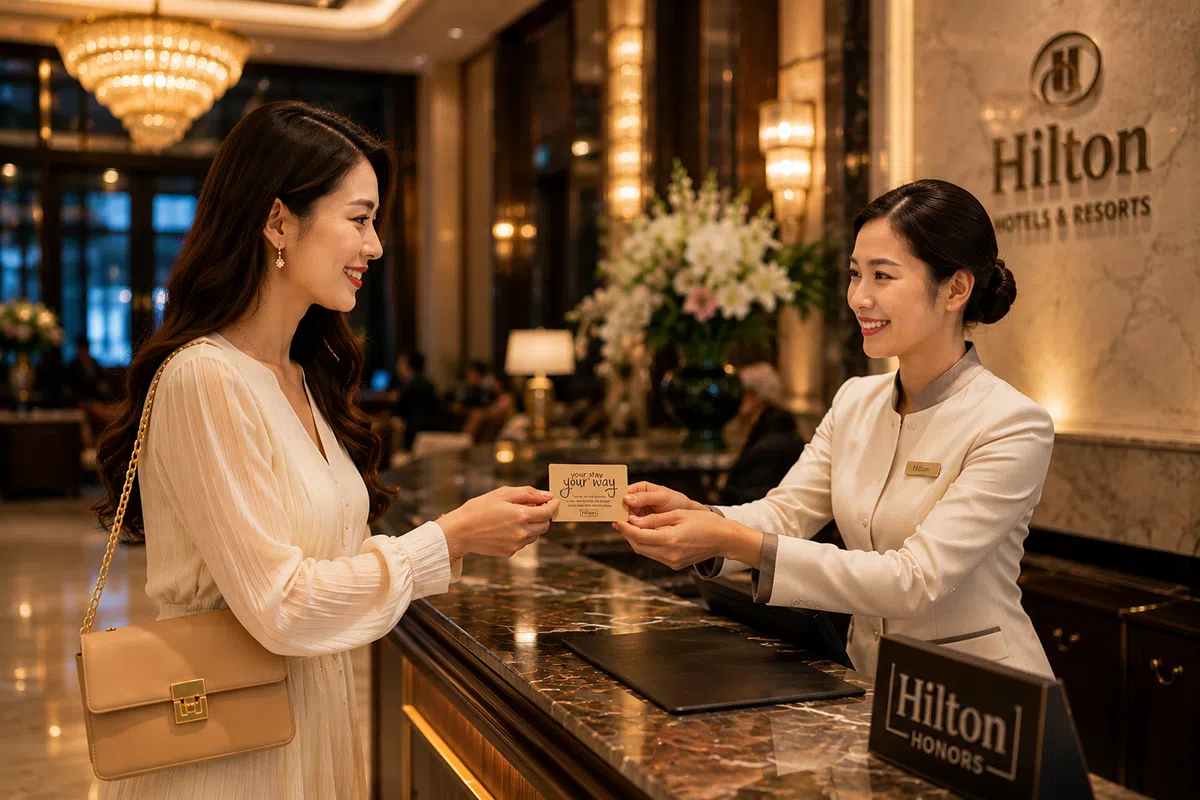
Hotel Key Cards
A memorable first touchpoint guests keep long after checkout.
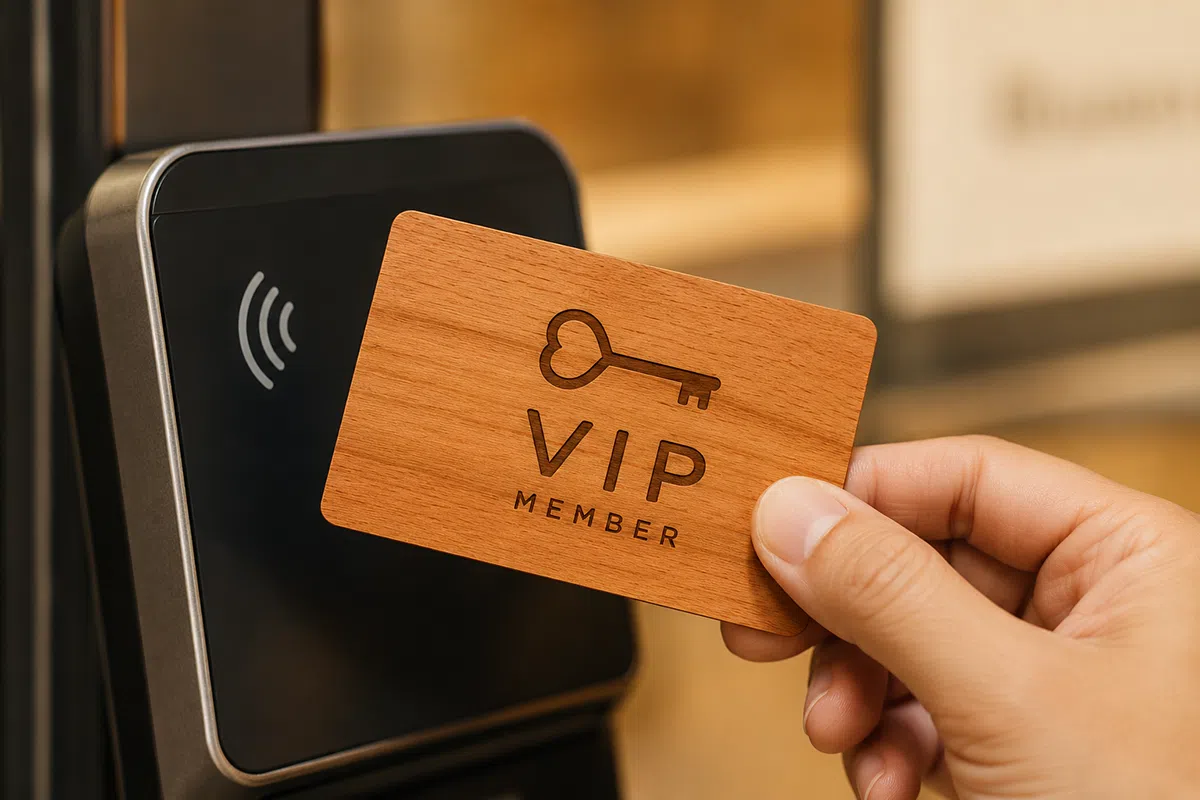
Membership & VIP Cards
Real wood signals exclusivity a plastic card can't match.
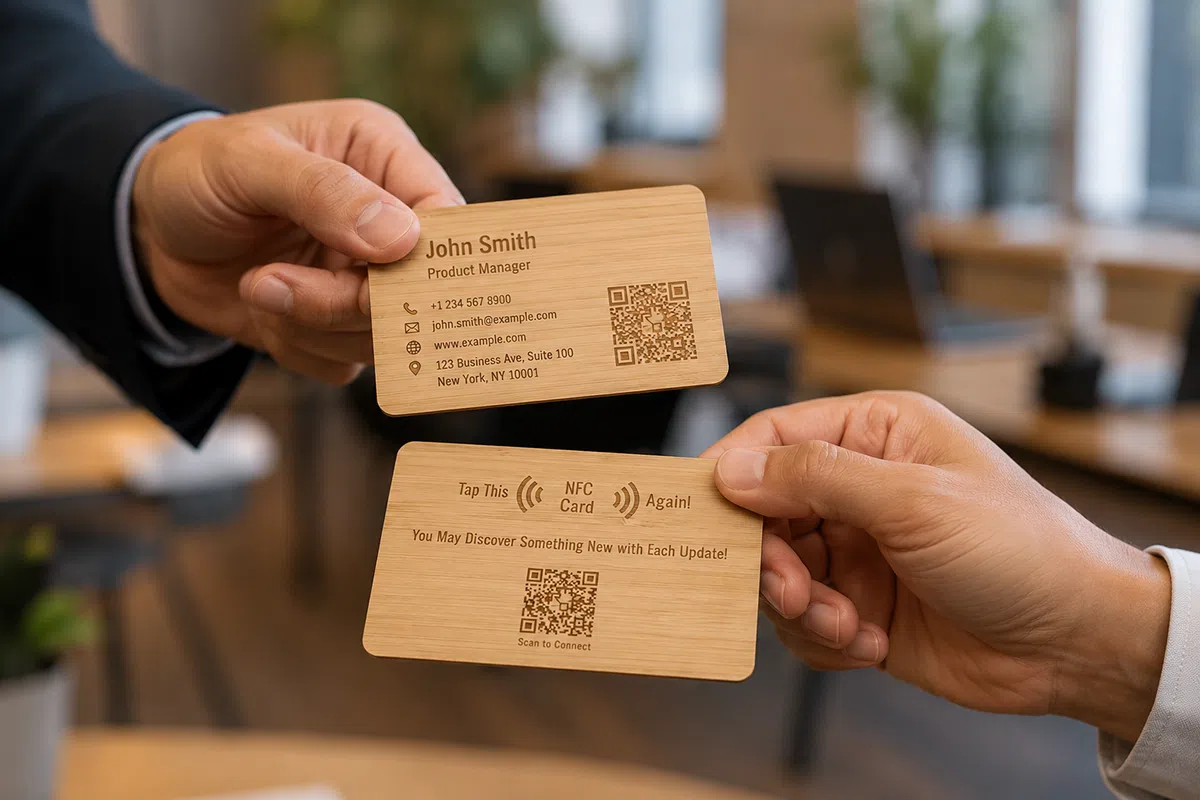
Business Cards
A card recipients hold onto, not discard after the meeting.
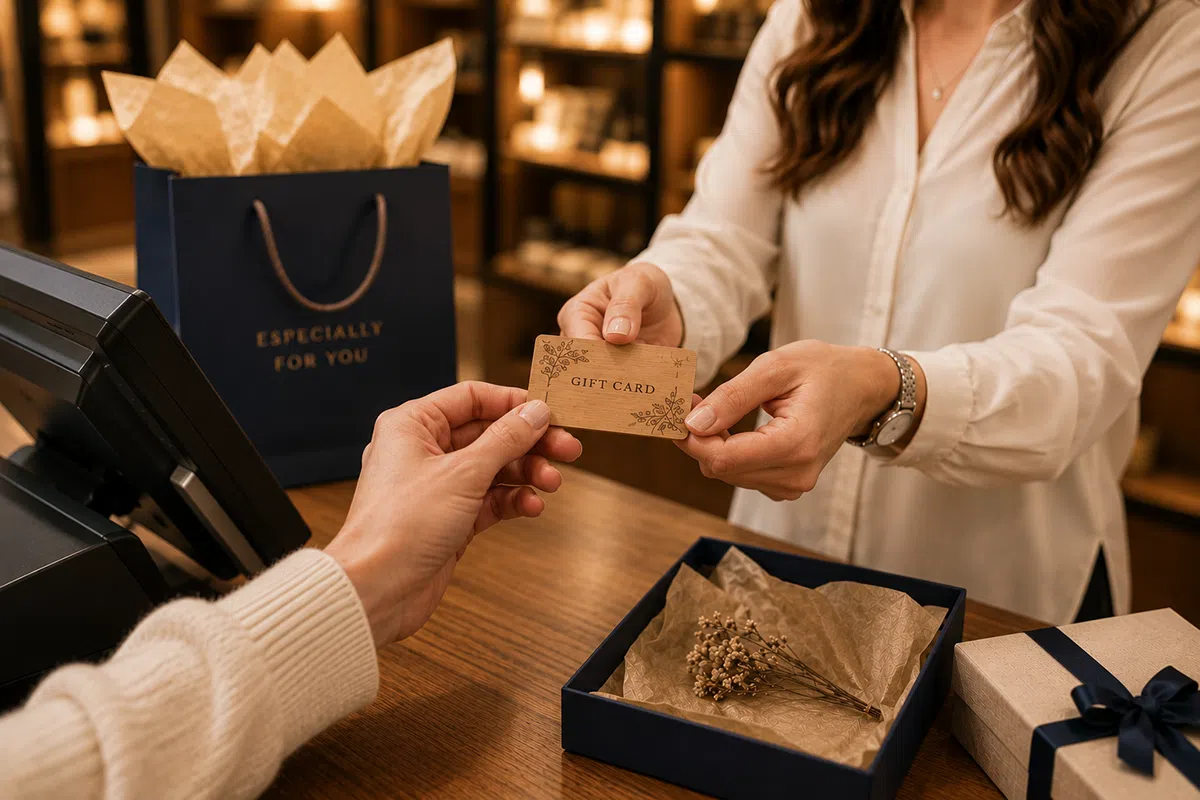
Gift Cards
Premium unboxing feel that elevates the gifting moment.
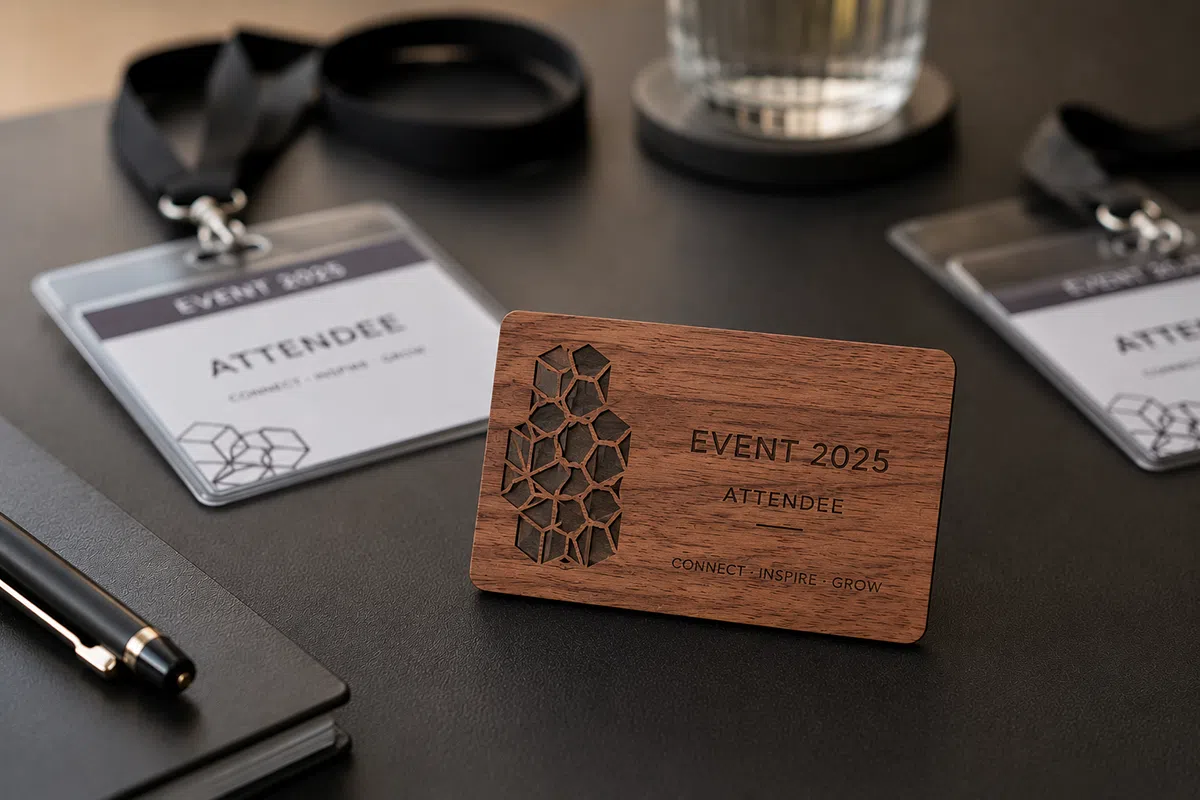
Brand & Event Cards
Extends brand recall well beyond a single campaign or event.
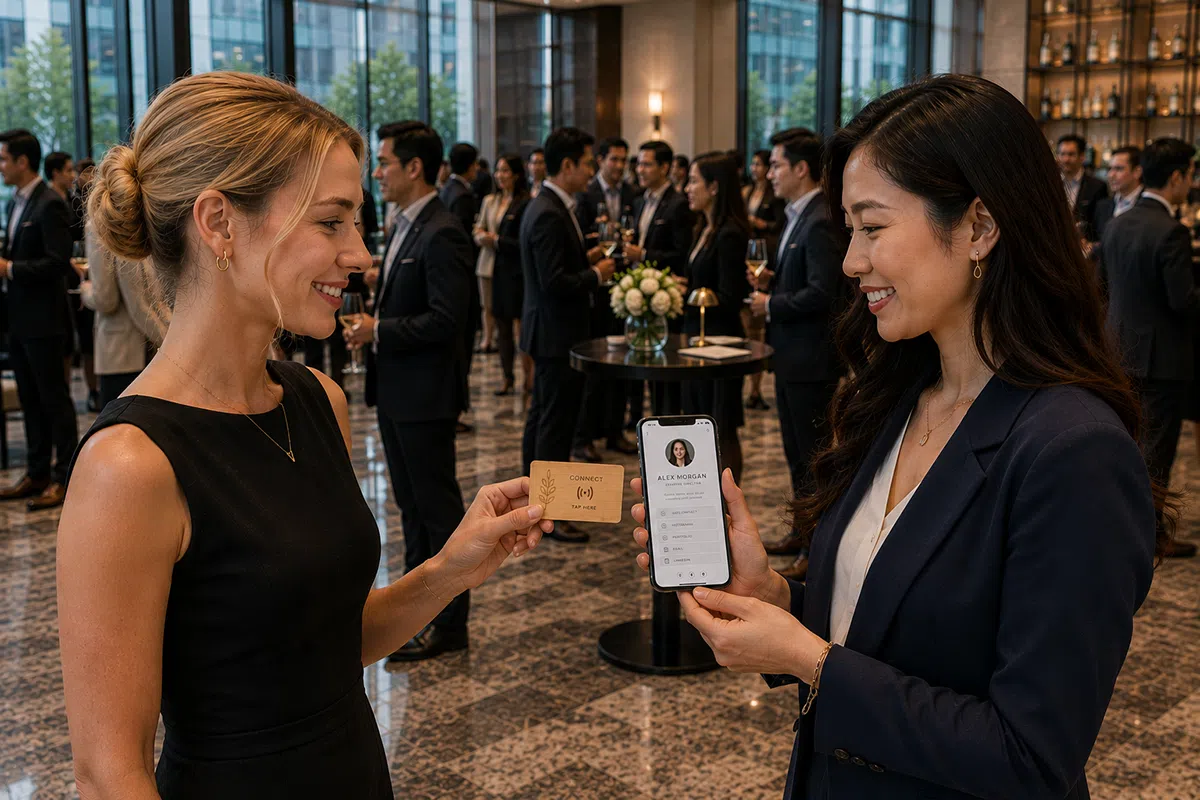
NFC Digital Business Cards
One tap shares your full contact profile, no app required.
Frequently Asked Questions
What wood materials are available for wooden smart cards?
Wooden card bodies are available in bamboo, cherry, walnut, maple, oak, ash, beech, birch, sapele, and rosewood, among other species. Each option has a distinct grain pattern and tone, so color and texture will vary slightly from card to card.
Are wooden NFC/RFID cards durable enough for daily use?
Yes. The wood veneer is bonded with a water-resistant lamination that protects the embedded chip and antenna, and the finished card has smooth, anti-warp rounded edges built for regular tapping and handling.
Can wooden cards be customized with logos or laser engraving?
Yes. Precision laser engraving is used to add logos, text, QR codes, and serial numbers directly onto the wood surface, and custom die-cut shapes are available on request.
What chip options are supported in wooden smart cards?
Wooden card bodies support a wide range of HF/NFC and UHF RF chips as well as secure CPU chips for banking and government ID applications — see the Supported Chip Platforms table above for the full list.
Related Products
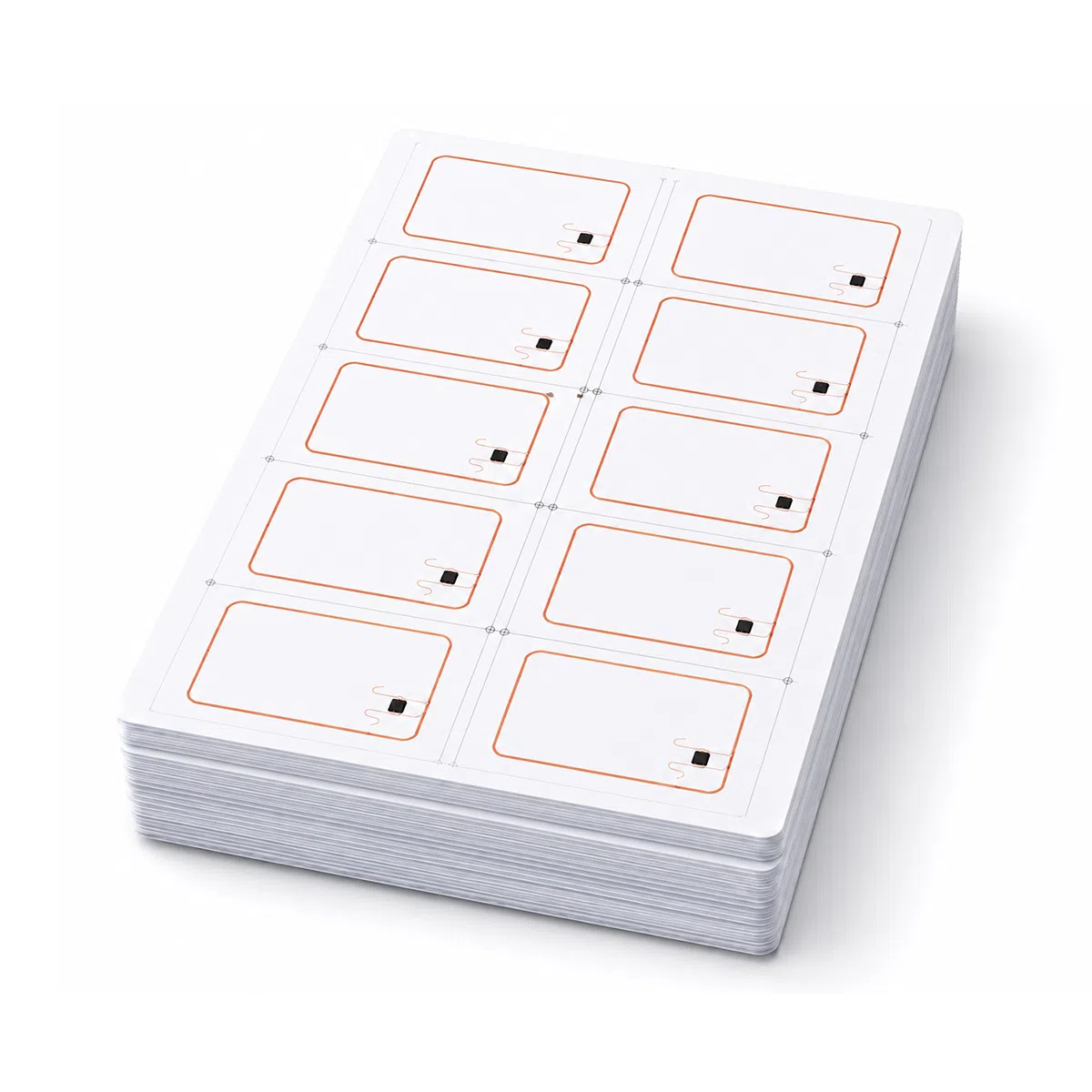
Smart Card Inlays & Prelam Sheets | LF HF UHF Dual-Interface
Prelaminated inlay sheets for card makers - LF, HF/NFC, UHF & dual-interface. NXP, Infineon & Fudan chips, ±0.01mm tolerance, custom layouts.
View Details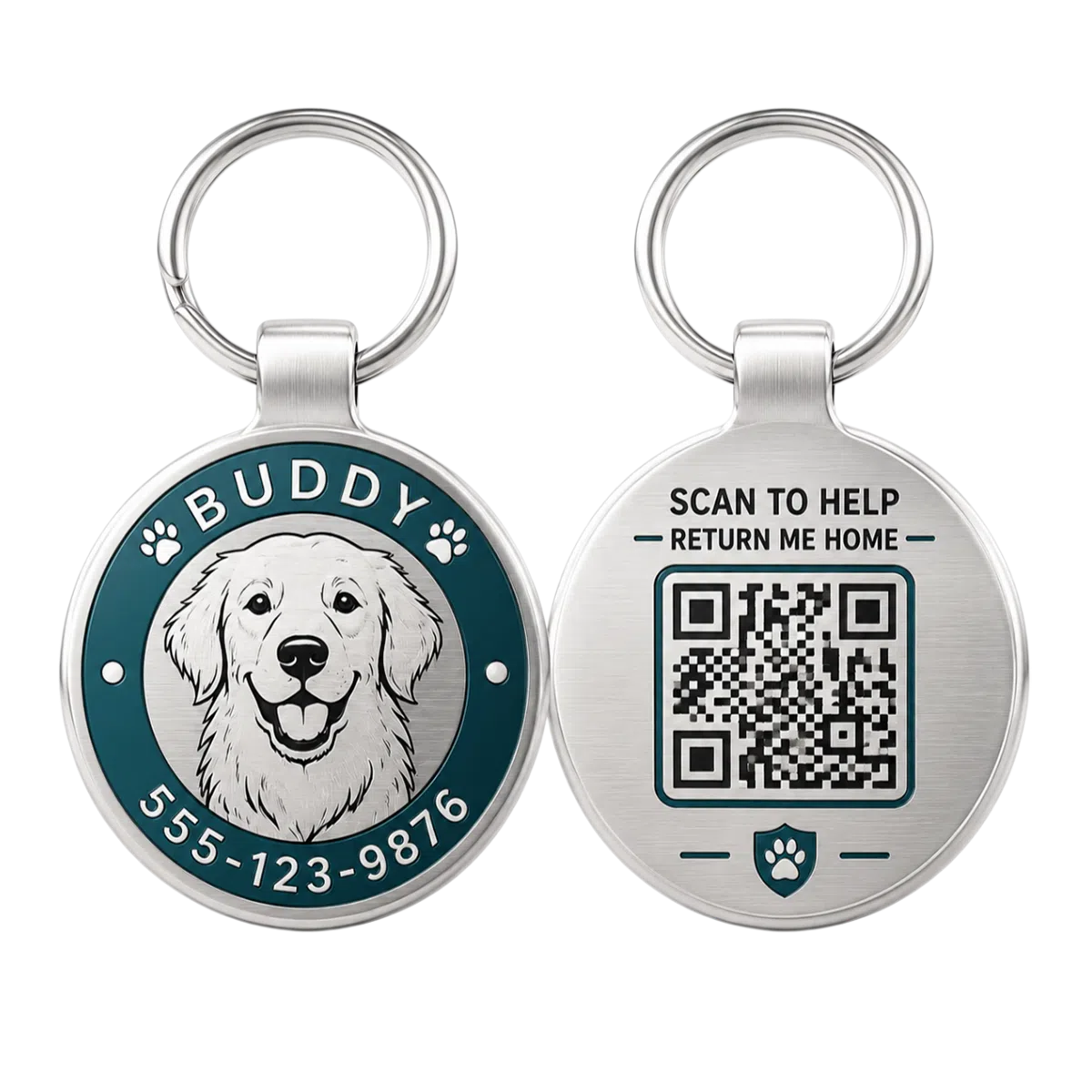
CedaGlo Custom NFC & QR Code Pet ID Tags
Custom NFC QR code pet tags with chip selection, URL encoding, private-label artwork and OEM packaging. Programmable smart tags for online profiles.
View Details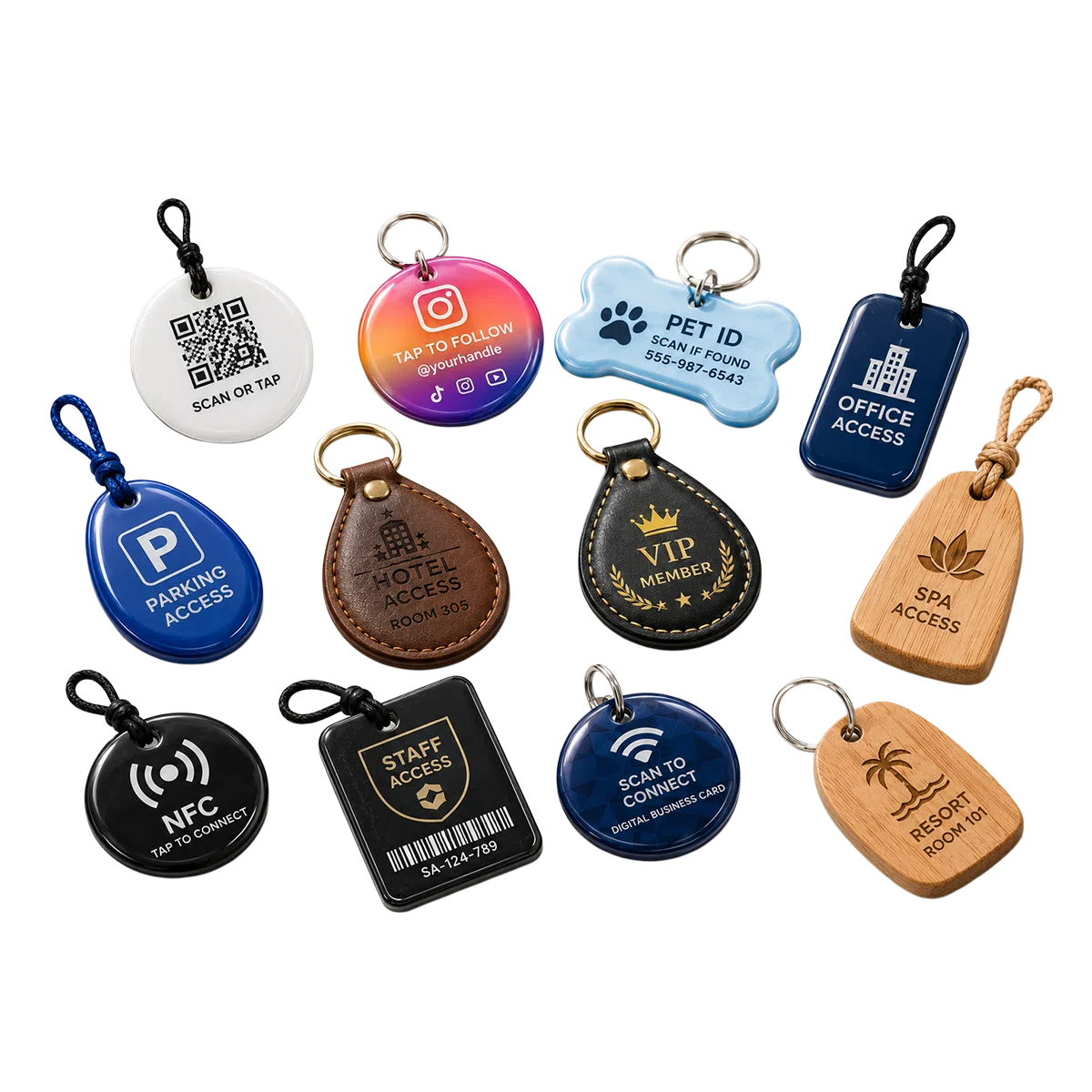
Custom RFID Keyfob │ ABS, Epoxy, Leather & Wood
Order custom RFID keyfobs in ABS, epoxy, leather or wood with LF, HF and NFC chips, logo printing, UID encoding and volume pricing support.
View Details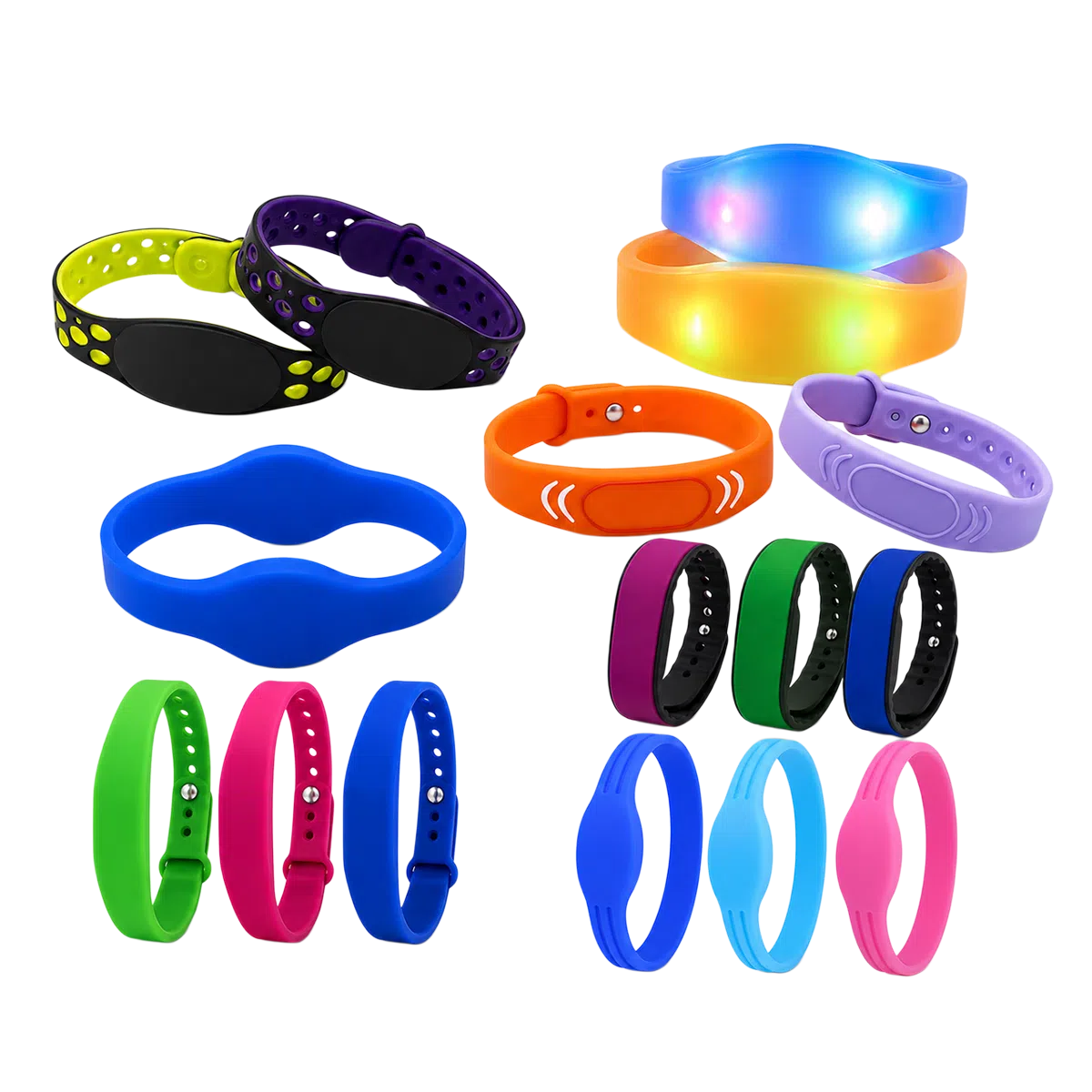
CedaGlo Custom RFID Silicone Wristbands
Reusable custom silicone RFID wristbands with LF, HF and NFC chip options for events, access control, cashless payment and brand promotion.
View DetailsConfirm It Works Before You Commit
Request a sample in your exact chip type and wood species, test it against your existing readers or locks, then order. Most projects start at 100 pieces, ship in 10–15 business days, and every quote includes chip compatibility confirmed upfront — no guesswork, no reorders.