
RFID Tags
Accurate inventory starts at the item level. CedaGlo's RFID inlays and labels tag individual products for automated counting, while Industrial & Asset Tags track pallets, bins, and equipment throughout their time in the warehouse — cutting manual errors and giving staff a real-time view of exactly what's on the shelf.
RFID Readers
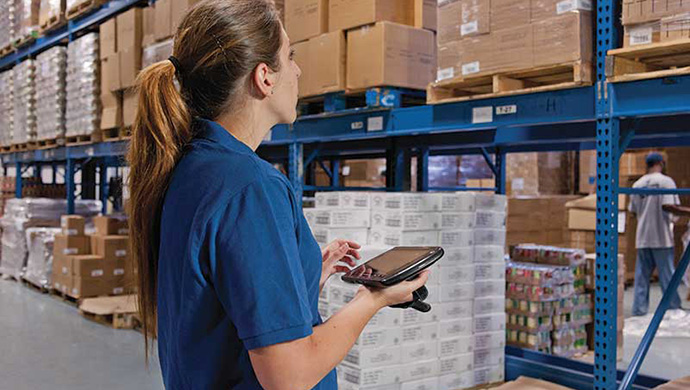
Staff use handheld RFID readers to run full cycle counts in minutes and confirm picks are correct before an order ships — usually the first RFID device a warehouse adopts. Rugged mobile computers support day-to-day receiving, put-away, and pick-and-pack workflows on the floor.
Fixed Readers & Automation
As warehouses scale toward automation, fixed RFID readers and panel antennas integrate with conveyor belts, sorting lines, and robotic systems, letting automated equipment identify and route items with no manual scanning at all.
Applications
RFID technology has penetrated various aspects of the warehousing industry:
Order Fulfillment: Real-time item location speeds up picking and reduces order processing time, improving turnaround and customer satisfaction.
Quality Control & Compliance: Tags storing batch numbers and expiration dates support traceability, regulatory compliance, and faster product recalls.
Workforce Management: RFID-enabled badges and keyfobs track staff movement and task completion, supporting safety protocols and shift accountability.
CedaGlo RFID technology has become an indispensable part of modern warehousing. Through the combination of tags, handheld and fixed readers, and antennas, warehouses achieve accurate inventory, faster fulfillment, and smoother automation — with hardware built to match each stage of the floor, from receiving to the shipping dock.
Frequently Asked Questions
How does RFID improve warehouse cycle counts?
Staff with a handheld RFID reader read every tagged item on a shelf or pallet without scanning labels one by one, so a full cycle count takes minutes and pick accuracy can be confirmed before an order ships.
Should we tag items, cases or pallets?
It depends on what you need to count. RFID inlays and labels suit item-level tagging, while industrial and asset tags track pallets, bins and equipment that stay in the warehouse.
Can RFID work with conveyors and robots?
Yes. Fixed RFID readers with panel antennas mounted on conveyor belts, sorting lines and robotic cells identify and route items without manual scanning.
Can RFID tags carry batch numbers and expiry dates?
Yes. Tags with user memory can store batch numbers and expiry dates, which supports traceability, regulatory compliance and faster product recalls.
Can a warehouse order labels in small runs while testing a layout?
Yes. Inlays, labels and asset tags start from 1 piece, so a test aisle or a single SKU family can be tagged first. Custom samples cost from US$50 per order, and the price per label falls at each volume tier once the layout is proven.