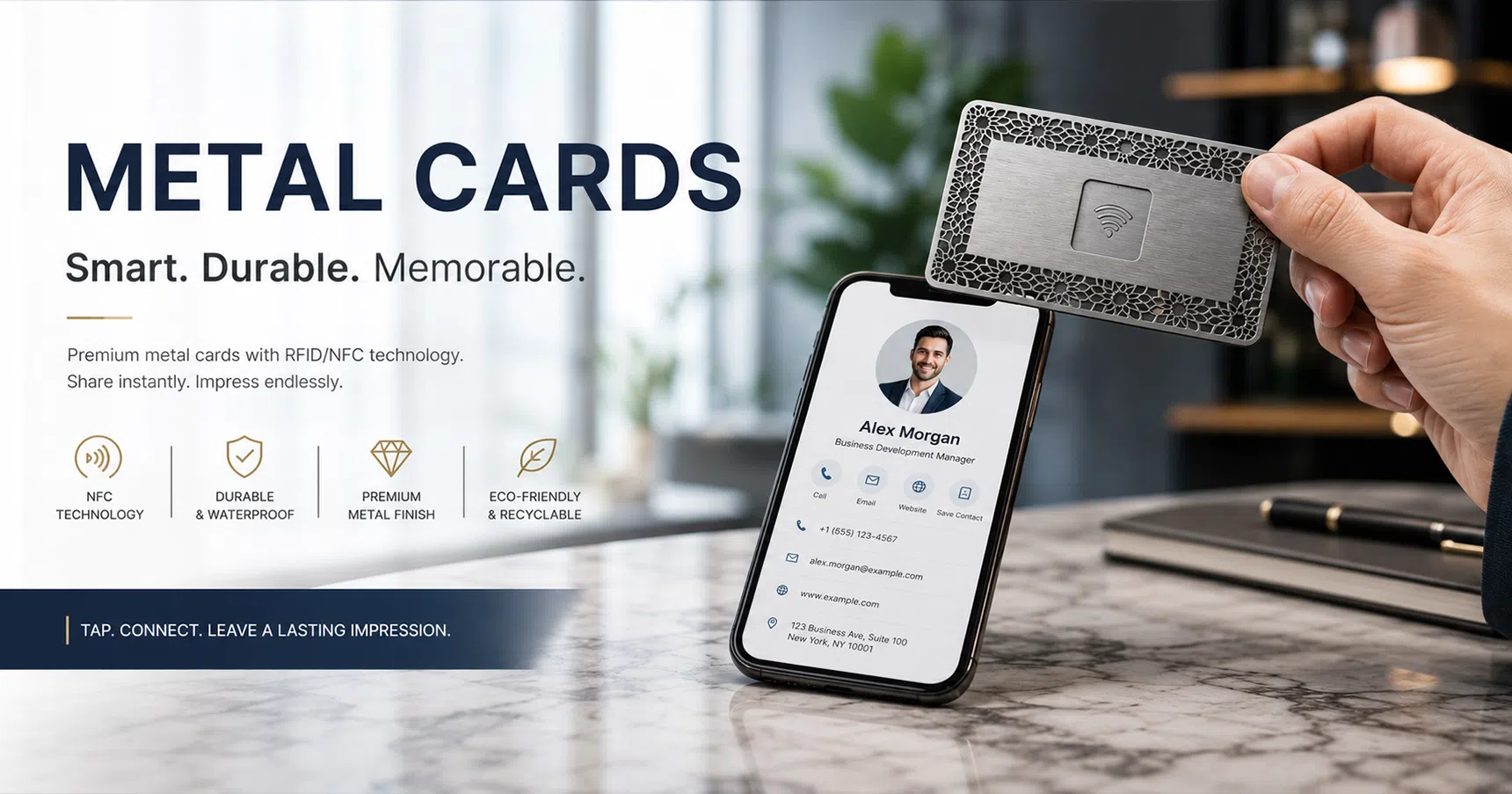
Metal Smart Cards
Stainless Steel RFID & NFC Cards
People judge weight as value before they read a single word. A metal card is cold to the touch, heavier than they expect, and makes a distinct sound when it's set down — three signals a plastic card can't send. It's engineered with an internal antenna cavity or laser-cut window, so none of that weight comes at the cost of chip performance.
Nearly 4 in 10 people form a negative impression from a cheap-feeling card. Metal cards solve the opposite problem: recipients keep them on a desk, in a wallet, as a keepsake — turning a single handoff into months of visible brand exposure a plastic card never gets a chance at.
- 🛡️Premium Metal
Body - 📡NFC / RFID
Ready - 🎯Laser-Engraved
Detail - ⚙️Durable &
Long-Lasting
What Is a Metal Smart Card?
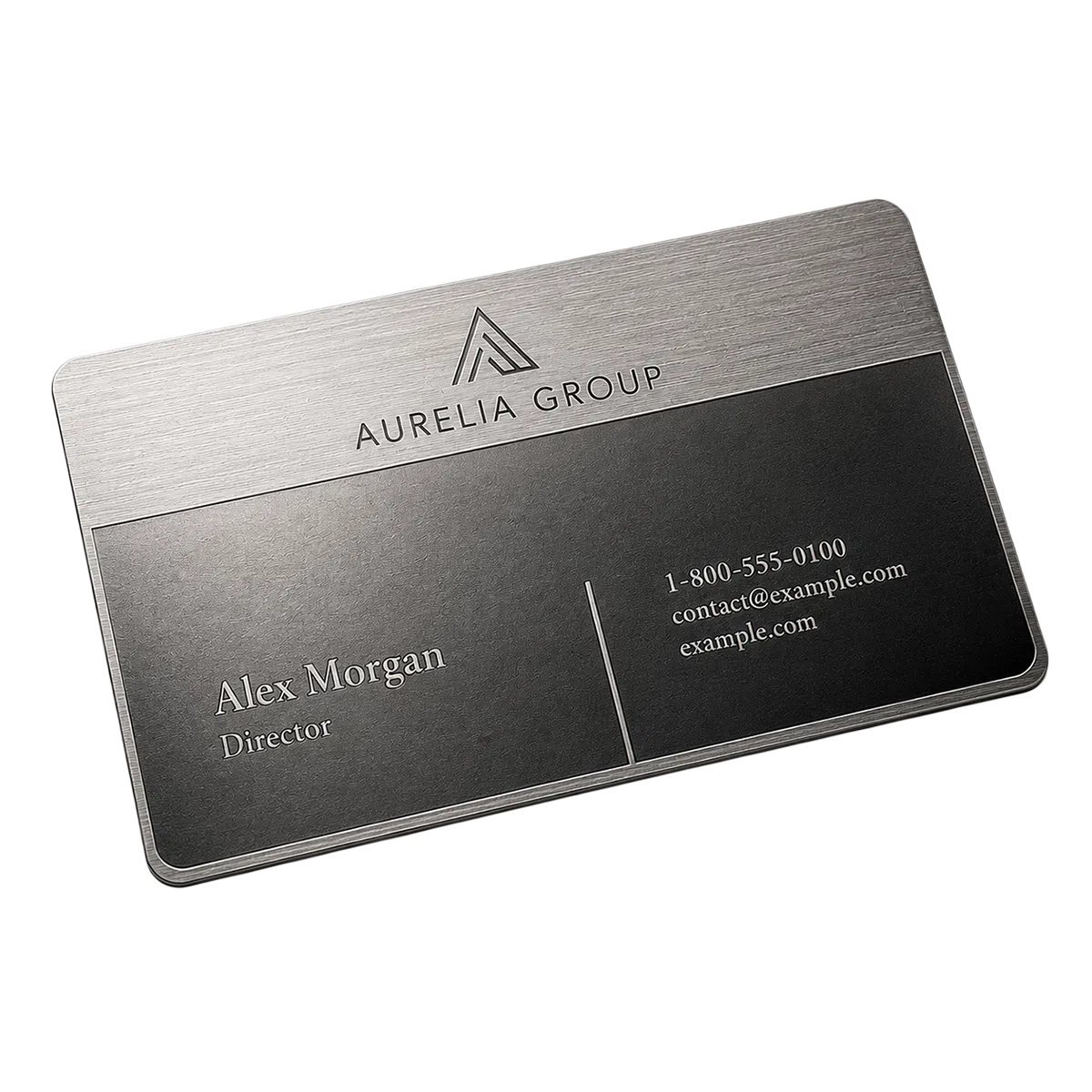
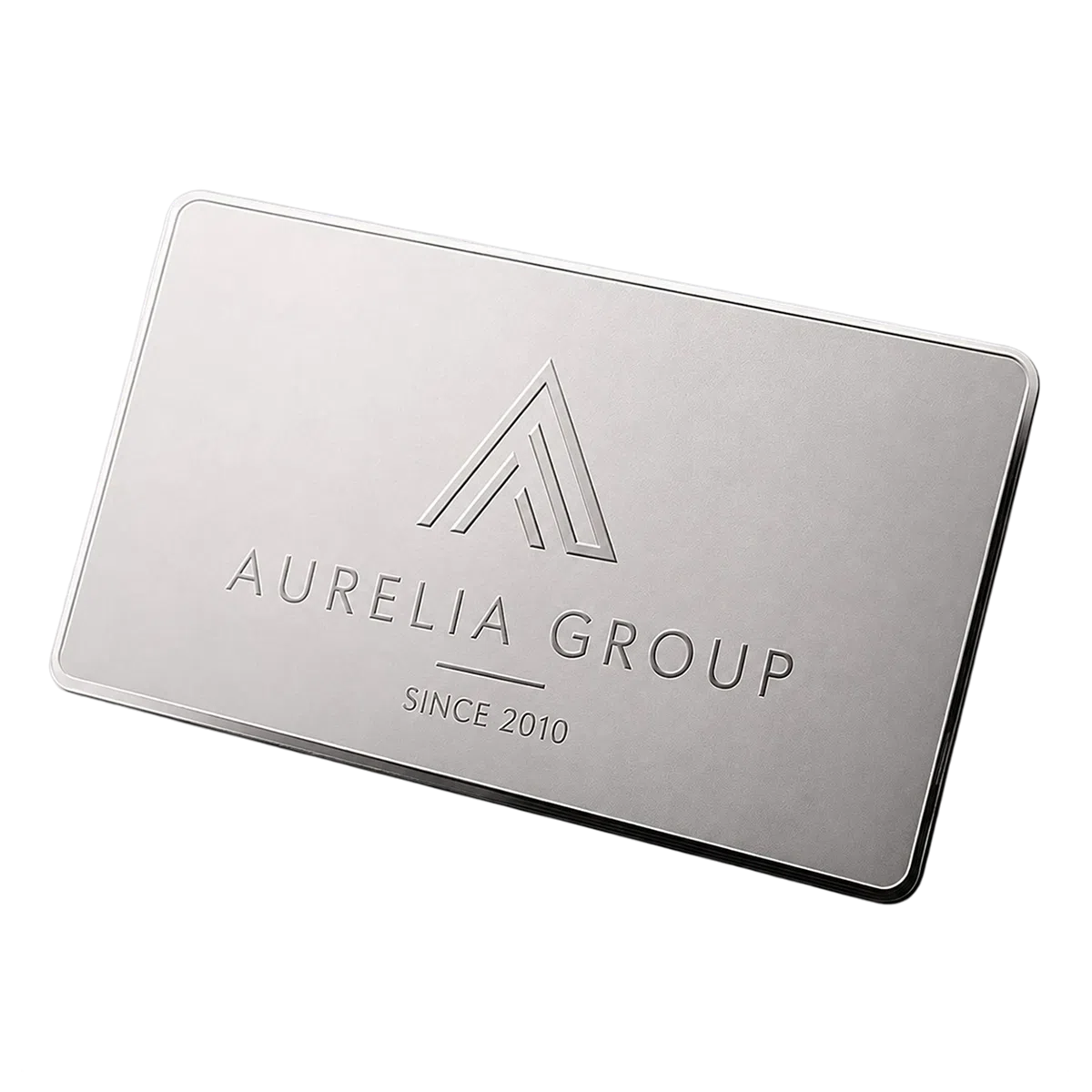
A metal smart card is built on a solid stainless steel core instead of plastic or PVC — the same core weight and rigidity you'd expect from a well-made tool, not a card. Because raw metal blocks radio signals, every CedaGlo metal card is engineered with either an internal non-metallic antenna cavity or a laser-cut window, so the chip reads exactly as reliably as it would in a plastic card. Metal doesn't compromise the technology; it just changes what the card feels like in someone's hand.
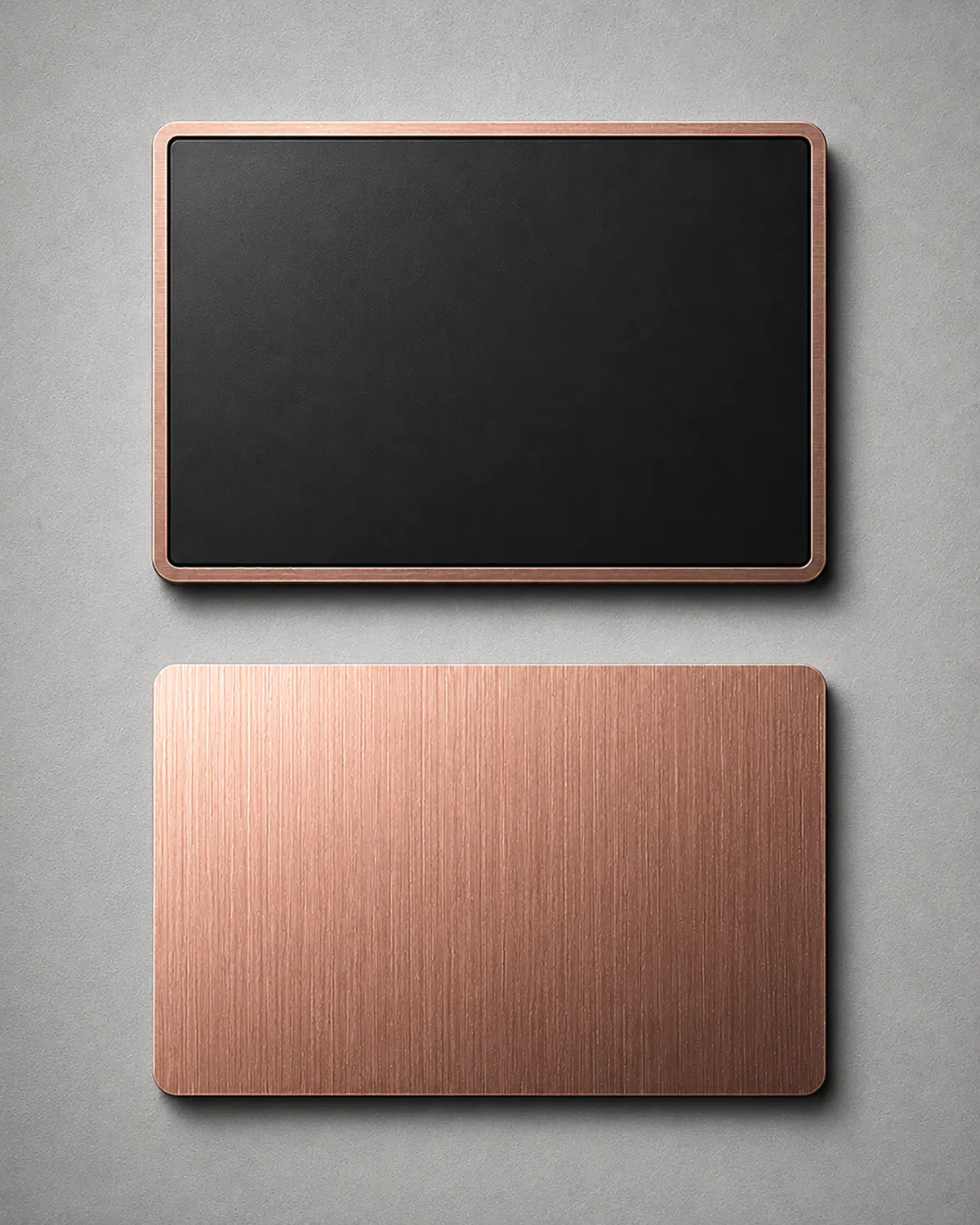
The finish is where metal earns its premium positioning: brushed stainless steel, matte black PVD, brushed gold, or rose gold — each with a weight and cold-to-the-touch quality that plastic and even wood can't replicate. It's the card that gets set down on a table face-up, not shoved to the back of a wallet.
CedaGlo supplies metal card bodies with the same chip range as our plastic and wood lines — LF, HF/NFC, UHF, dual-frequency, and secure contact CPU — so switching to metal is a material upgrade, not a system change.
Why Brands Choose Metal Over Plastic
Executive Access Control
Metal access cards signal a restricted, high-clearance tier without a single word printed on them.
Membership Tier Differentiation
Give top-tier members a card that's visibly, physically different from the standard plastic issue.
Corporate Networking
A metal business card gets kept on a desk, not filed away — extending every introduction.
Premium Hospitality Key Cards
Boutique and luxury properties use metal keys as part of the arrival experience itself.
Brand & Event Marketing
A metal card outlives the campaign — recipients keep it as an object, not a throwaway.
Premium Gift & Retail Cards
Metal gift cards read as a bigger gesture than a plastic one, even at the same face value.
Our Metal Card Advantages
Metal That Doesn't Block Signal
Engineered antenna cavity or laser-cut window keeps read range identical to plastic.
Multiple PVD Finishes
Brushed steel, black, gold, and rose gold — pick the tone that matches your brand.
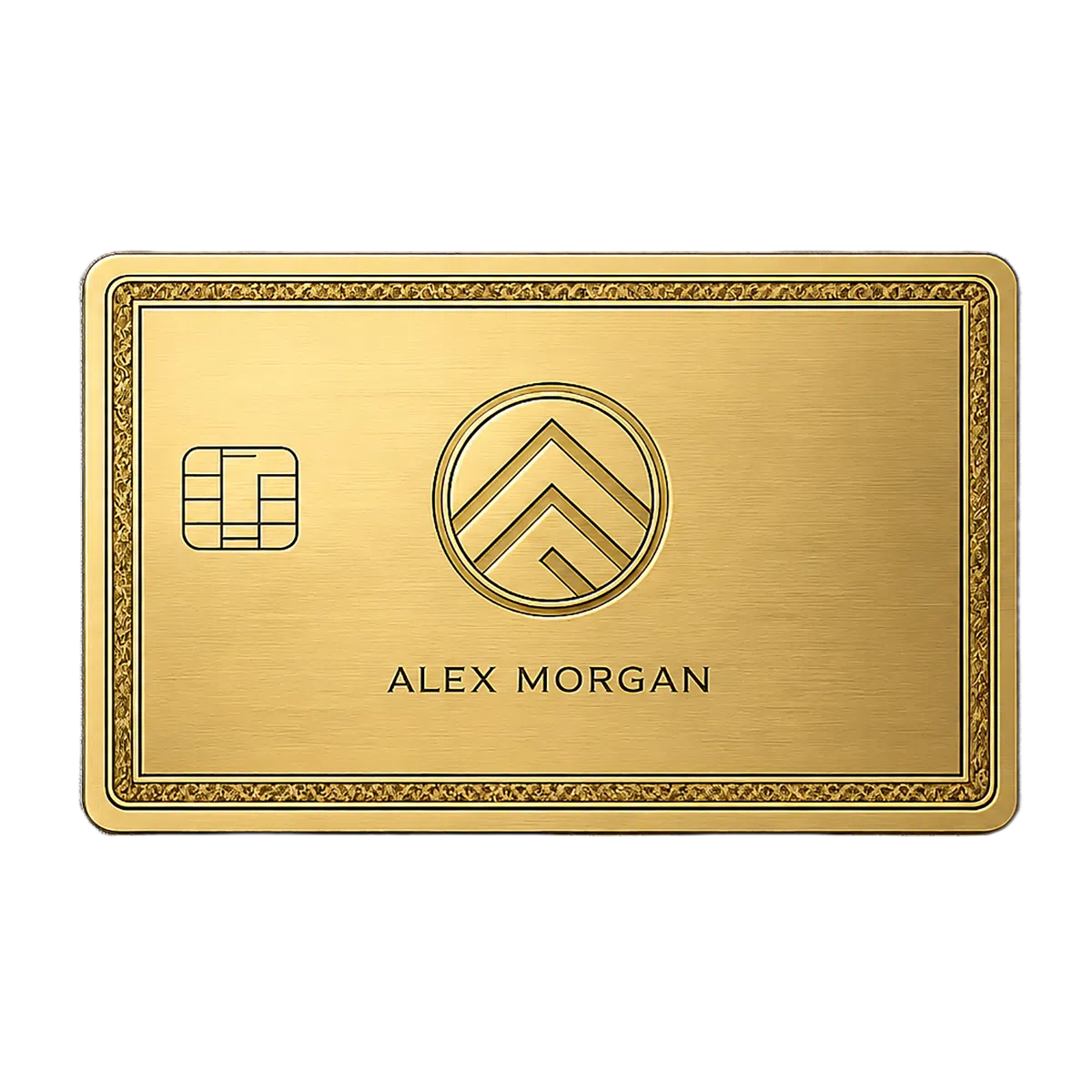
Precision Laser Engraving
Permanent, high-contrast logos and text that won't fade, scratch off, or peel.
Full Chip Compatibility
Same LF/HF/NFC/UHF/CPU range as our plastic and wood card lines.
Key Technical Highlights
Solid Stainless Steel Core
304-grade stainless steel body for genuine weight and rigidity.
Engineered Antenna Cavity
Internal cavity or laser-cut window keeps RFID/NFC performance unaffected by the metal.
Multiple Finish Options
Brushed steel, matte black PVD, brushed gold, and rose gold PVD.
Laser-Engraved Permanent Detail
High-contrast engraving that stays legible for the life of the card.
Heavyweight Premium Feel
Noticeably heavier than plastic or wood — the weight is the point.
Scratch & Corrosion Resistant
PVD coating and stainless steel resist daily wear far longer than printed plastic.
Material, Finish & Chip Options
📡 Technology
- LF, HF/NFC, UHF and Dual-frequency chips
- Contact CPU chips for secure ID
- Internal antenna cavity or laser-cut window design
- Read range matching standard plastic card performance
🌐 Material & Finish
- 304 stainless steel core, 0.8–1.2 mm thickness
- Brushed steel, matte black, gold or rose gold PVD
- Rounded, polished edge finish
- Corrosion and scratch resistant surface
- Approximately 15–20 grams per card
🔧 Customization
- Precision laser engraving for logos and text
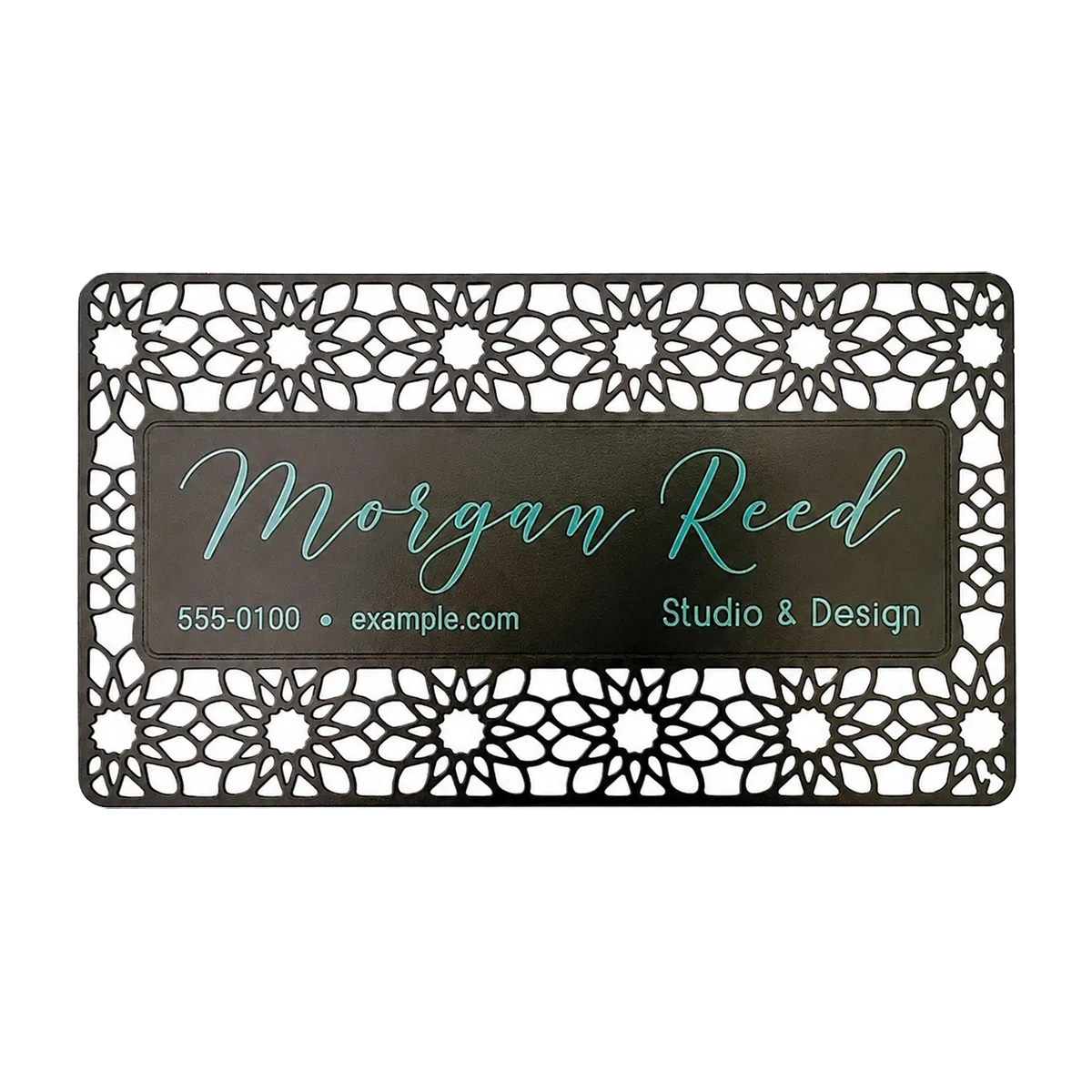
- Laser-cut windows and custom shapes on request
- UV color-fill option for multi-color detail
- QR code and serial number engraving supported
Technical Specifications
| Specification | Details |
|---|---|
| Material | 304 stainless steel (brushed, black PVD, gold PVD, rose gold PVD) |
| Card Size | 85.60 × 53.98 mm (CR80 standard) or custom cutout shapes |
| Thickness | 0.8 mm – 1.2 mm |
| Chip Options | LF, HF/NFC, UHF, Dual-frequency, and contact CPU chips |
| Antenna Design | Internal non-metallic cavity or laser-cut window |
| Marking | Precision laser engraving; optional UV color-fill |
| Edge Finish | Rounded, polished edge |
| MOQ | 50 pieces |
| Lead Time | 12–18 business days after design confirmation |
| Applications | Access control, membership, hotel key, corporate ID, gift cards |
Volume Pricing
| Quantity | Unit Price (USD / pc) |
|---|---|
| 100 – 199 pcs | From US$1.20 |
| 200 – 299 pcs | From US$0.95 |
| 300+ pcs | Contact Sales |
Final pricing depends on finish selection, chip type, engraving complexity, and order quantity. Contact our team for a tailored quote.
Supported Chip Platforms
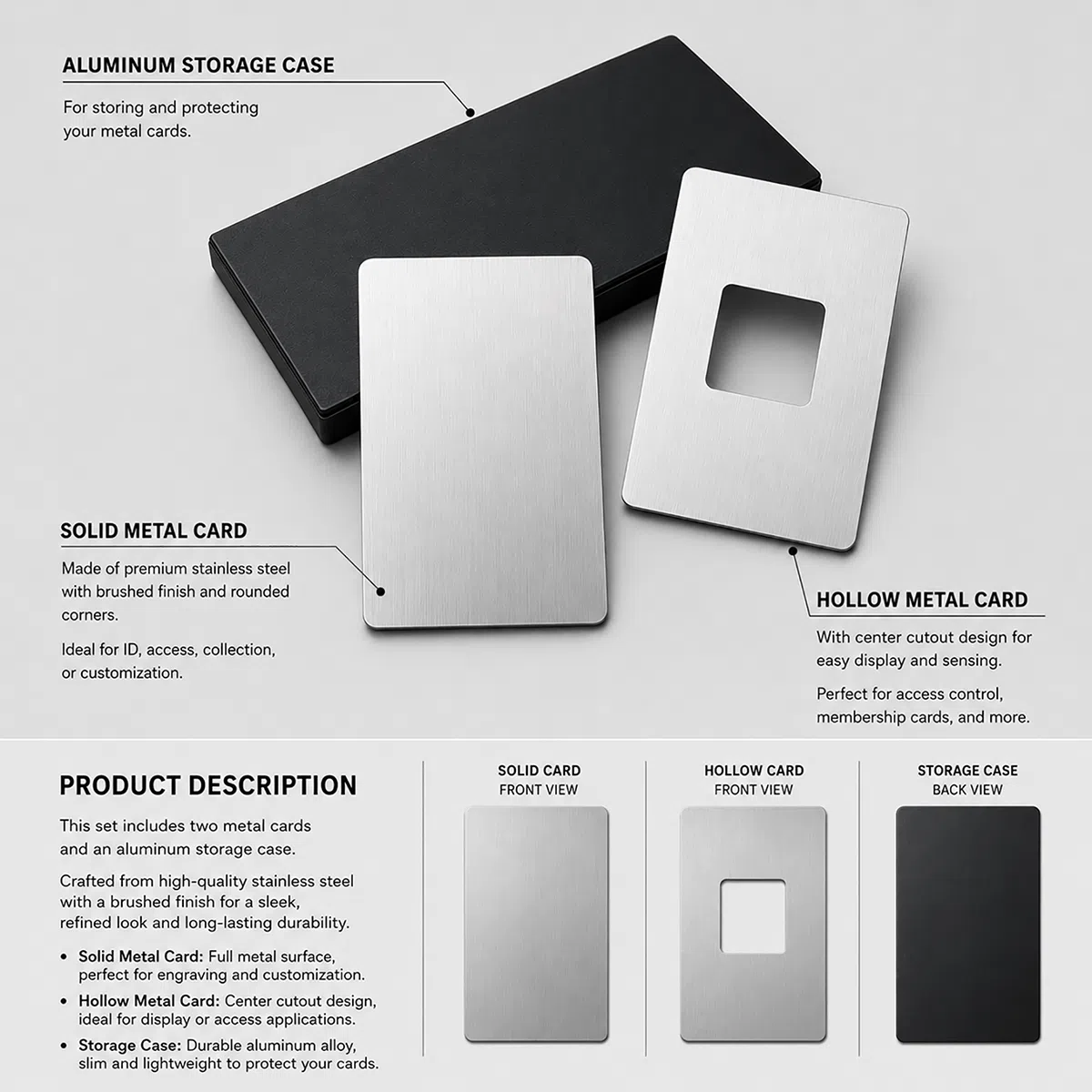
Metal card bodies support a broad range of HF/NFC, UHF and secure CPU chip platforms — browse the tables below or use the search box to find a specific chip, brand, or use case.
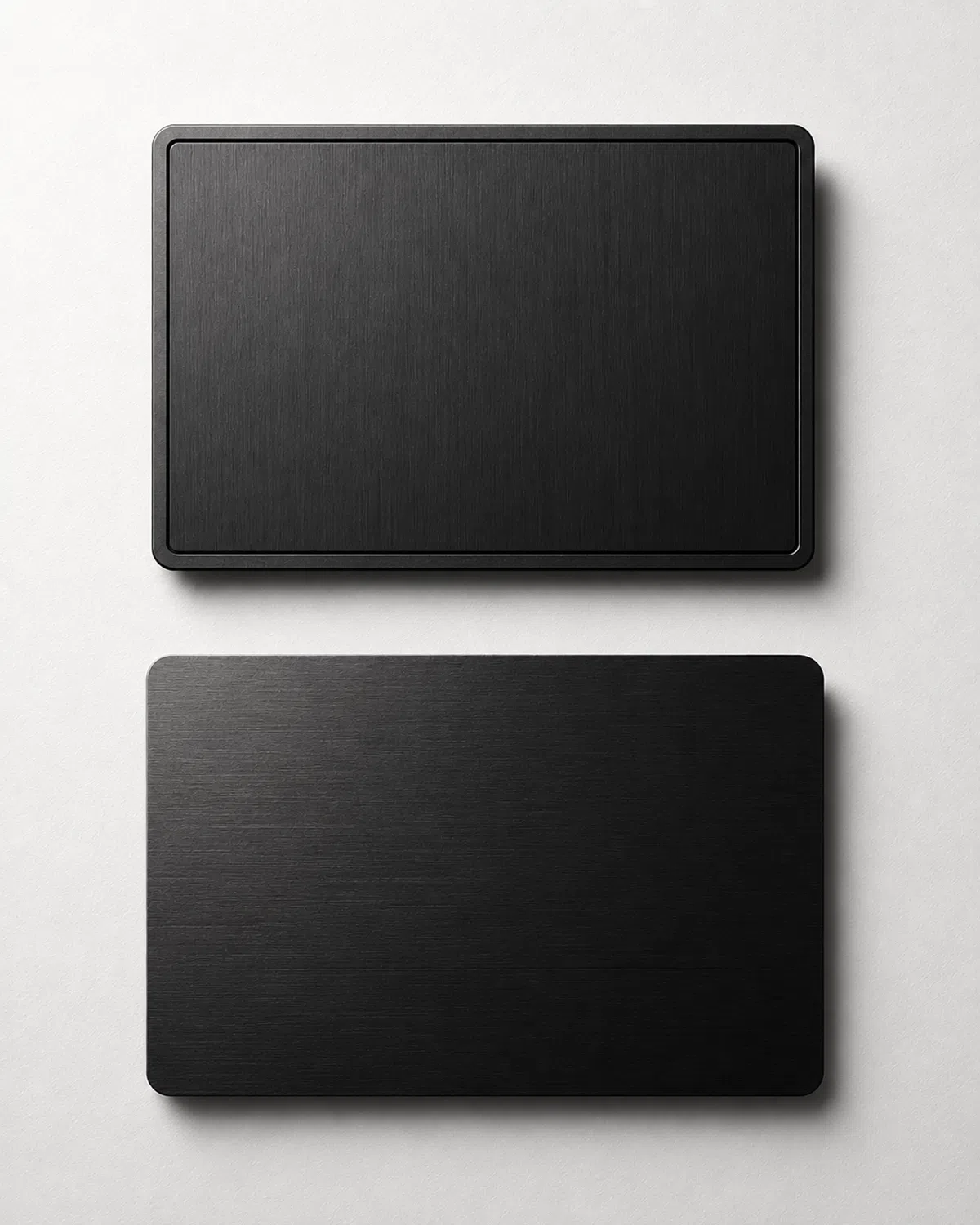
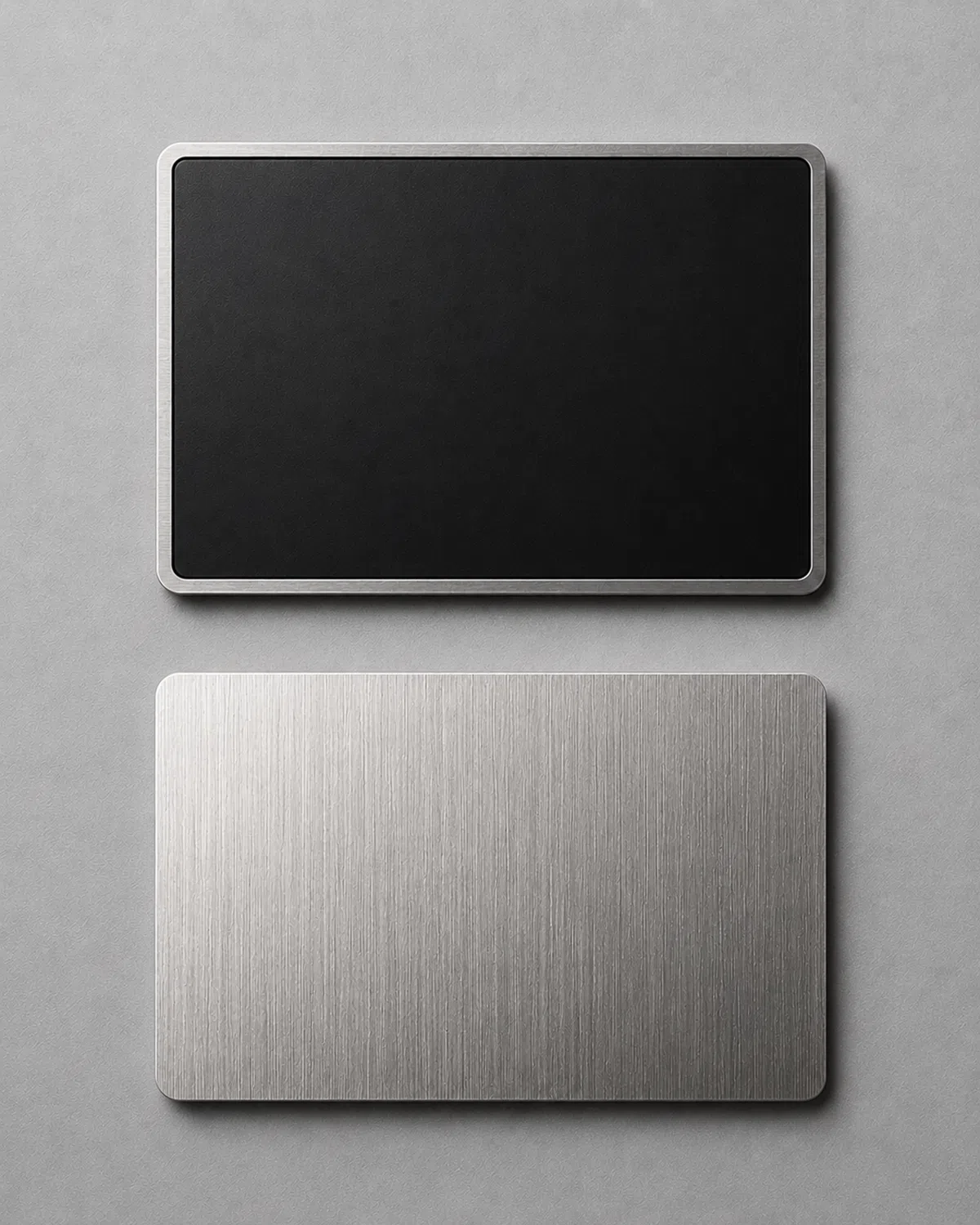
Every metal card ships as one of two constructions, both built on the same premium 304 stainless steel core shown at left.
Solid Metal Card — a full brushed-steel surface, ideal for engraving, ID badges, and general customization.
Hollow Metal Card — a center cutout window that gives the chip a clear, unobstructed read path, purpose-built for access control and membership sensing.
Both constructions accept the same chip range below, so the choice comes down to how the card will be used and displayed — not what it's compatible with. Every set ships in the aluminum storage case shown above, sized to protect two cards in transit or on a desk.
Scrolls horizontally on desktop; shows as stacked cards on mobile.
RF Chip Platforms
| Chip | Brand | Freq. / Standard | Memory | R/W | Security | Best For |
|---|---|---|---|---|---|---|
| HF / NFC — 13.56 MHz | ||||||
| MIFARE Classic 1K / 4K (MF1S50/MF1S70, EV1) | NXP | 13.56 MHz · ISO 14443A | 1 KB / 4 KB EEPROM | Read/Write | Crypto-1 (legacy, cryptographically broken) | Transit, access, closed-loop ticketing… |
| MIFARE Ultralight / C / EV1 / AES | NXP | 13.56 MHz · ISO 14443A, NFC Type 2 | 48–192 B | Read/Write | Ultralight C: 3DES · Ultralight AES: AES-128 | Limited-use tickets, events, transit |
| MIFARE Plus EV1 / EV2 | NXP | 13.56 MHz · ISO 14443A | 2 KB / 4 KB | Read/Write | AES-128, security levels SL1–SL3, Crypto-1 upgrade | Transit, access, ticketing |
| MIFARE DESFire EV1 / EV2 / EV3 / Light | NXP | 13.56 MHz · ISO 14443A, NFC Type 4 | 2 / 4 / 8 KB | Read/Write | AES-128, up to 28 apps, CC EAL5+, EMVCo | Transit, access, micro-payment, multi-app ID |
| MIFARE DUOX — newest | NXP | 13.56 MHz · ISO 14443-4 | secure file system | Read/Write | AES-256 + ECC, public-key, DES removed | High-security transit, access, ID |
| NTAG 210 / 212 | NXP | 13.56 MHz · ISO 14443A, NFC Type 2 | 48 / 128 B | Read/Write | Basic mass-market NFC | Retail, gaming, publishing |
| NTAG 213 / 215 / 216 | NXP | 13.56 MHz · NFC Type 2 | 144 / 504 / 888 B | Read/Write | Password, UID mirror, TagTamper option | NFC marketing, product engagement, digital… |
| NTAG 424 DNA / TagTamper | NXP | 13.56 MHz · ISO 14443-4, NFC Type 4 | 416 B | Read/Write | AES-128, Secure Unique NFC (SUN), CC-certified | Anti-counterfeit, secure authentication |
| NTAG 223 / 224 DNA (+ StatusDetect) — newest | NXP | 13.56 MHz · NFC Type 2/4 | user memory | Read/Write | AES-128, SUN, CC-certified, tamper / battery-free… | Trusted IoT, healthcare, tamper detection |
| NTAG 5 (NT5H) / NTAG I2C plus (NT3H) | NXP | 13.56 MHz · ISO 15693 / NFC Type 5 + I2C | up to 8 KB | Read/Write | Connected NFC, I2C bridge, energy harvesting | IoT pairing, sensors, consumer electronics |
| NTAG X DNA — newest | NXP | 13.56 MHz · ISO 14443-4 + I2C, VHBR | secure EEPROM | Read/Write | CC EAL6+, PKI / ECC public-key | Device / consumable authentication |
| ICODE SLIX / SLIX2 / SLI-L / DNA | NXP | 13.56 MHz · ISO 15693, NFC Type 5 | 128 B – 2560-bit | Read/Write | Long range, anti-collision, EAS · DNA adds AES-128 | Library, item-level retail, supply chain |
| ST25TA (Type 4) | STMicroelectronics | 13.56 MHz · ISO 14443A, NFC Type 4 | 512 b – 64 kb EEPROM | Read/Write | Password protection, ~200-yr data retention | Consumer NFC, product information |
| ST25TN / ST25TV (Type 5) | STMicroelectronics | 13.56 MHz · ISO 15693, NFC Type 5 | 512 b – 64 kb | Read/Write | TruST25 digital signature, tamper-detect | Brand protection, wine/pharma, electronic… |
| ST25DV (dynamic NFC) | STMicroelectronics | 13.56 MHz · ISO 15693, NFC Type 5 + I2C | 4 – 64 kb | Read/Write | Energy harvesting, 256-B fast-transfer mailbox | IoT, ESL, industrial, metering |
| ST25TB / SRIX4K (transport) | STMicroelectronics | 13.56 MHz · ISO 14443B | 512 b – 4 kb | Read/Write | Anti-tearing, transport-optimized | Transit ticketing, event access |
| EM4233 / EM4237 | EM Microelectronic | 13.56 MHz · ISO 15693, NFC Type 5 | up to 2 kbit | Read/Write | Anti-collision, EAS | Library, asset, ticketing |
| my-d move NFC (SLE 66R) / my-d | Infineon | 13.56 MHz · ISO 14443 / 15693, NFC | up to 10 kbit | Read/Write | Configurable, secure options | Ticketing, access, IoT |
| FM11RF08 / FM11RF08S / FM11RF32 | Fudan / FMSH | 13.56 MHz · ISO 14443A | 1 KB / 4 KB | Read/Write | MIFARE Classic-compatible | Transit, access, campus (cost-driven) |
| FM1108 / FM11RF005 | Fudan / FMSH | 13.56 MHz · ISO 14443A, NFC Type 2 | 1 KB / Ultralight-class | Read/Write | MIFARE Classic / Ultralight compatible | Access, disposable tickets |
| LEGIC advant / prime | LEGIC (dormakaba) | 13.56 MHz · ISO 14443 / 15693 | up to 64 kB | Read/Write | Proprietary secure (AES/DES), managed keys | High-security access, closed systems |
| Tag-it HF-I (RF-HDT) | Texas Instruments | 13.56 MHz · ISO 15693, NFC Type 5 | 256 b – 2 kb | Read/Write | Legacy vicinity tag | Library, laundry (legacy) |
| UHF / RAIN — 860–960 MHz | ||||||
| Monza 4 (4D / 4E / 4QT / 4iL) | Impinj | 860–960 MHz · EPC Gen2v2, ISO 18000-63 | up to 512-bit user | Read/Write | AutoTune, Integra, QT public/private memory | Retail, supply chain, general purpose |
| Monza R6 / R6-P / R6-A | Impinj | 860–960 MHz · EPC Gen2v2 | 32–96-bit user | Read/Write | AutoTune adaptive tuning, high sensitivity | Retail apparel, logistics, hospitality |
| Monza X-2K / X-8K DURA | Impinj | 860–960 MHz · EPC Gen2 + I2C | 2 / 8 kbit | Read/Write | Battery-assist mode, embedded IoT, tag-data protection | Equipment mgmt, cold chain, IoT sensors |
| M700 (M730 / M750 / M770 / M775) | Impinj | 860–960 MHz · EPC Gen2v2 | 32-bit user, 128-bit EPC | Read/Write | Sensitivity ~−22 to −24 dBm, high throughput | Retail, logistics, high-density inventory |
| M700 expanded (M780 / M781) | Impinj | 860–960 MHz · EPC Gen2v2 | larger user memory | Read/Write | Extended item-attribute storage | Pharma, food, automotive (batch/date/weight) |
| M800 (M810 / M830 / M850) — newest | Impinj | 860–960 MHz · EPC Gen2v2 / Gen2X | up to 32-bit user | Read/Write | −25.5 dBm, AutoTune V3, smallest die | High-speed inventory, difficult environments |
| UCODE 7 / 7m / 7xm | NXP | 860–960 MHz · EPC Gen2v2, ISO 18000-63 | up to 2 kbit user | Read/Write | High sensitivity, pre-serialized EPC, EAS | Retail, brand protection |
| UCODE 8 / 8m | NXP | 860–960 MHz · EPC Gen2v2 | 128-bit EPC / user option | Read/Write | Self-adjust tuning, high performance | Retail apparel, logistics |
| UCODE 9 / 9xe / 9xm — newest mainstream | NXP | 860–960 MHz · EPC Gen2v2 | 96–496-bit EPC, up to 128 user | Read/Write | −24 dBm, self-adjust, miniaturized die | Retail, food, logistics |
| UCODE DNA / DNA City / DNA Track | NXP | 860–960 MHz · EPC Gen2v2 | user memory | Read/Write | AES-128 cryptographic authentication | Secure supply chain, tolling, brand… |
| UCODE G2iM / G2iM+ (legacy) | NXP | 860–960 MHz · EPC Gen2 | up to 512-bit user | Read/Write | Configurable memory | Industrial, asset (legacy) |
| Higgs-3 (H3) | Alien Technology | 860–960 MHz · EPC Gen2v2, ISO 18000-63 | 800-bit (96–480 EPC, 512 user) | Read/Write | Large user memory, very versatile | Baggage, laundry, manufacturing genealogy |
| Higgs-4 (H4) | Alien Technology | 860–960 MHz · EPC Gen2v2 | 448-bit (128 EPC, 128 user) | Read/Write | Small die, high-volume | Apparel hang tags, retail |
| Higgs-EC | Alien Technology | 860–960 MHz · EPC Gen2v2 | 480-bit (128 EPC, 32 user) | Read/Write | High read/write sensitivity, IoT-oriented | General high-volume, IoT |
| Higgs-9 (H9) — newest | Alien Technology | 860–960 MHz · EPC Gen2v2 | 1024-bit (up to 496 EPC, 688 user) | Read/Write | High memory + high performance | High-memory asset, offline data storage |
| EM4124 / EM4126 | EM Microelectronic | 860–960 MHz · EPC Gen2, ISO 18000-63 | 96–496 EPC / 512-bit user | Read/Write | Passive Gen2 | Logistics, asset tracking |
| EM4325 | EM Microelectronic | 860–960 MHz · EPC Gen2v2 + ISO 18000-64, SPI | 4 kbit | Read/Write | Battery-assist, on-chip temp sensor, active mode | Cold chain, sensing, aerospace logistics |
| QR2233 / eStar series | Quanray | 860–960 MHz · EPC Gen2v2 | up to 512-bit user | Read/Write | Low-cost domestic Gen2 | Retail, apparel (cost-driven) |
| FM13UF / UHF series | Fudan / FMSH | 860–960 MHz · EPC Gen2v2 | varies by part | Read/Write | Domestic Gen2 | Logistics, asset |
| Magnus S3 sensor IC | Axzon (RFMicron) | 860–960 MHz · EPC Gen2 + sensor | sensor + user memory | Read/Write | On-chip moisture / temperature sensing | Sensing, moisture, medical / industrial |
| Dual-Frequency | ||||||
| EM4423 | EM Microelectronic | ISO 15693/NFC Type 5 + EPC Gen2v2 | shared user memory | Read/Write | HF+UHF single die, shared UID | Smart packaging, brand protection + logistics |
| EM4425 (em|echo-V) | EM Microelectronic | ISO 15693/NFC Type 5 + EPC Gen2v2 / ISO 18000-63 | 2048-bit shared | Read/Write | AES-128, digital signature, shared memory & UID | Retail, authentication, consumer engagement |
| LF (EM4100/T5577) + HF (MIFARE/DESFire) in one card | Multi-vendor combo | 125 kHz + ISO 14443A | per embedded chip | Mixed | Two independent chips; migration bridge card | LF→HF access-control migration window |
CPU / Secure ID Chip Platforms
Certification is chip/platform level; product-level payment/ID approvals (EMVCo, Visa, Mastercard, UnionPay, PBOC) are obtained per project. China-brand CPU chips support international algorithms (DES/3DES/RSA/ECC/AES) plus SM1–SM4.
| Brand | Part | Memory | Certification | Cross-Reference | Best For |
|---|---|---|---|---|---|
| Contactless CPU | |||||
| NXP | MIFARE DESFire EV3 — MF3D2301 / MF3D4301 / MF3D8301 (H = high-cap variant: MF3DH…) | 2 / 4 / 8 KB NVM | CC EAL5+ | ↔ Fudan FM1208 / FM1280 (RF use-case) | Transit, access, ticketing, micro-payment, smart city |
| NXP | MIFARE DESFire EV2 — MF3Dx2 (2K / 4K / 8K) — legacy, replaced by EV3 | 2 / 4 / 8 KB NVM | CC EAL5+ | ↔ Fudan FM1208 (use-case) | Transit, ticketing (existing systems) |
| NXP | MIFARE Plus EV2 — MF1P2200 / MF1P4200 (H-variant MF1PH…) | 2 / 4 KB | CC EAL5+ | ↔ Fudan FM11RF08 family (upgrade path) | Transit, access, closed-loop ticketing |
| NXP | SmartMX3 P71D321 (contactless configuration) | up to ~150 KB Flash | CC EAL6+, EMVCo | ↔ Unigroup THD89 · Huada CIU9872B | ePassport, eID, contactless bank card |
| Infineon | SLE78CLFX2400P / CLFX4000P / CLFX5000PH (contactless config) | 240 / 404 / 528 KB NVM | CC EAL6+, EMVCo | ↔ Unigroup THD89 | eID, ePassport, contactless payment |
| STMicroelectronics | ST31G256 / G320 / G384 / G480 (contactless config, MIFARE/Calypso) | 256 / 320 / 384 / 480 KB Flash | CC EAL6+, EMVCo | ↔ Fudan FM1280 · Huada CIU9872B | Transit (Calypso), eID, payment |
| Fudan / FMSH | FM1204 / FM1204M01 (4K CPU, +1K MIFARE option) | 4 KB EEPROM (5 KB array) | PBOC 2.0 | ↔ NXP MIFARE Plus (use-case) | Transit, campus, small-value |
| Fudan / FMSH | FM1208 — FM1208-09 (8K) / FM1208M01 (7K+1K M1) / FM1208-23 (4K+4K S70) | 8 KB EEPROM, 32 KB ROM | PBOC 2.0 (e-wallet) | ↔ NXP DESFire / MIFARE Plus | Transit, campus, highway, micro-payment |
| Fudan / FMSH | FM1280 (contactless configuration, Java / native COS, VHBR) | up to 64 KB EEPROM | Bank-grade secure chip · payment cert. at product level | ↔ NXP SmartMX / Infineon / ST | Social-security, health, transit, citizen card |
| Huada / HED | CIU9872B / CIU9872B_01 (contactless configuration, 32-bit) | 80 KB user memory | CC EAL6+, EMVCo (ICCN0219) | ↔ NXP SmartMX / Infineon | Digital-RMB hard wallet, transit, eID |
| Unigroup Tongxin | THD89 (contactless configuration) | large-capacity (per ordering code) | CC EAL6+ (SOGIS), EMVCo, SM L2 | ↔ NXP SmartMX / Infineon | ePassport, eID, contactless payment |
| Contact CPU | |||||
| NXP | SmartMX2 — P60C080 / P60C144 (contact) | 80 / 144 KB EEPROM · 384 KB ROM | CC EAL6+, EMVCo | ↔ Unigroup THD88 · Huada CIU98 | Banking, eID, TPM |
| NXP | SmartMX3 — P71D320 / P71D321 (contact configuration) | up to ~150 KB Flash | CC EAL6+, EMVCo | ↔ Unigroup THD89 · Huada CIU98 | Banking, SIM/UICC, eID |
| Infineon | SLE78CFX2400P / CFX4000P / CFX5000PH | 240 / 404 / 500 KB NVM | CC EAL6+ | ↔ Fudan FM1280 · Huada CIU98 | Banking, ePassport, eID, TPM |
| Infineon | SLE78CAX512SPHM (serial / contact) | 500 KB NVM | CC EAL6+ | ↔ Unigroup THD89 | Secure element, identity, authentication |
| STMicroelectronics | ST33 series (e.g. ST33J2M0 contact config) · ST23 legacy | up to 2 MB Flash | CC EAL6+, EMVCo | ↔ Fudan FM1280 · Huada CIU98 | Banking, eSIM, TPM (FIPS-140-3) |
| Samsung | S3FS / S3 secure-MCU series (contact config) | varies by part | CC EAL5+/6+, EMVCo | ↔ Unigroup THD89 | Banking, SIM, identity |
| Fudan / FMSH | FM1216 (16 KB) · FM1232 (32 KB) · FM1280 (≤64 KB) — contact config | 16 / 32 / up to 64 KB EEPROM · 64 KB ROM | Bank-grade · SM cert. · EAL4+ (FM1216/1232) | ↔ Infineon / NXP / ST | Social-security, banking, ESAM/PSAM, citizen card |
| Huada / HED | CIU5132A (contact SS) · SHC1302 (banking, 32-bit SC100) · CIU98M25 / CIU98M50 (SIM) | SHC1302: 256 KB ROM / 10 KB RAM · CIU98M50: 2.5 MB · CIU98M25: 1.25 MB Flash | CC EAL · payment cert. at product level | ↔ Infineon / NXP | Social-security, banking, super-SIM |
| Unigroup Tongxin | THD88-E48 / E80 / E120 / E160 · THC20 / THC80 (SIM) | ≈48 / 80 / 120 / 160 KB EEPROM | CC EAL5+/6+ · payment cert. at product level | ↔ Infineon / NXP | Banking, SIM/USIM, social-security, eID |
| Datang | DMT-CFN2HG6 | per ordering code | Bank-grade · payment cert. at product level | ↔ Infineon / NXP / ST | Banking, social-security, eHealth |
| Dual-Interface CPU | |||||
| NXP | SmartMX2 — P60D024 / P60D080 / P60D144 / P60D145 | 24 / 80 / 144 KB EEPROM · 384 KB ROM | CC EAL6+, EMVCo | ↔ Unigroup THD89 · Huada CIU9872B | Banking, ePassport, eID, transit |
| NXP | SmartMX3 — P71D320 / P71D321 | up to ~150 KB Flash · RSA 4096 / ECC 640 | CC EAL6+, EMVCo | ↔ Unigroup THD89 · Huada CIU9872B | Banking, ePassport, eID |
| Infineon | SLE78CLFX2400P / CLFX4000P (400VP) / CLFX5000PH / CLFX6280PH | 240 / 404 / 528 / 628 KB NVM | CC EAL6+, EMVCo | ↔ Unigroup THD89 · Huada CIU9872B | Banking, eID, ePassport, transit |
| STMicroelectronics | ST31G256 / G320 / G384 / G480 · ST31P320 / P450 | 256 / 320 / 384 / 480 KB · 320 / 450 KB Flash | CC EAL6+, EMVCo | ↔ Fudan FM1280 · Huada CIU9872B | Banking, transit, eID, biometric card |
| Samsung | S3 dual-interface secure-MCU series | varies by part | CC EAL5+/6+, EMVCo | ↔ Unigroup THD89 | Banking, identity, fingerprint card |
| Fudan / FMSH | FM1232 (32 KB) · FM12CD32 · FM1280 (≤64 KB) — Java / native COS | 32 / up to 64 KB EEPROM | Bank-grade · EAL4+ (FM1232) · payment cert. at product level | ↔ Infineon / NXP / ST | Banking, social-security, transit, health, citizen card |
| Huada / HED | CIU9872B / CIU9872B_01 (32-bit CPU) | 80 KB user memory | CC EAL6+, EMVCo (ICCN0219) | ↔ NXP SmartMX / Infineon / ST | Banking, digital-RMB wallet, ePassport |
| Unigroup Tongxin | THD89 (THD89 1.0.1 series, EMV one-chip dual-app) | large-capacity (per ordering code) | CC EAL6+ (SOGIS), EMVCo, SM L2, AEC-Q100 | ↔ NXP SmartMX / Infineon / ST | Banking (domestic+intl), eID, eUICC, social-security |
| Datang | DMT-CBS-CE3D | up to 128 KB EEPROM | Bank-grade · payment cert. at product level | ↔ Infineon / NXP / ST | Banking, eHealth, social-security |
| Nationz | Z32 secure-MCU series | per ordering code | CC EAL · SM L2 · payment cert. at product level | ↔ NXP / Infineon | Banking, identity, IoT secure element |
No chips match your search. Try a brand (NXP, Fudan, Unigroup), a part name (DESFire, THD89, UCODE) or an application (access, transit, banking).
Part numbers are family / ordering codes; exact suffix, package and delivery format are confirmed per project. Chip availability and specifications may change — confirm current status before design-in.
Where Metal Cards Are Used

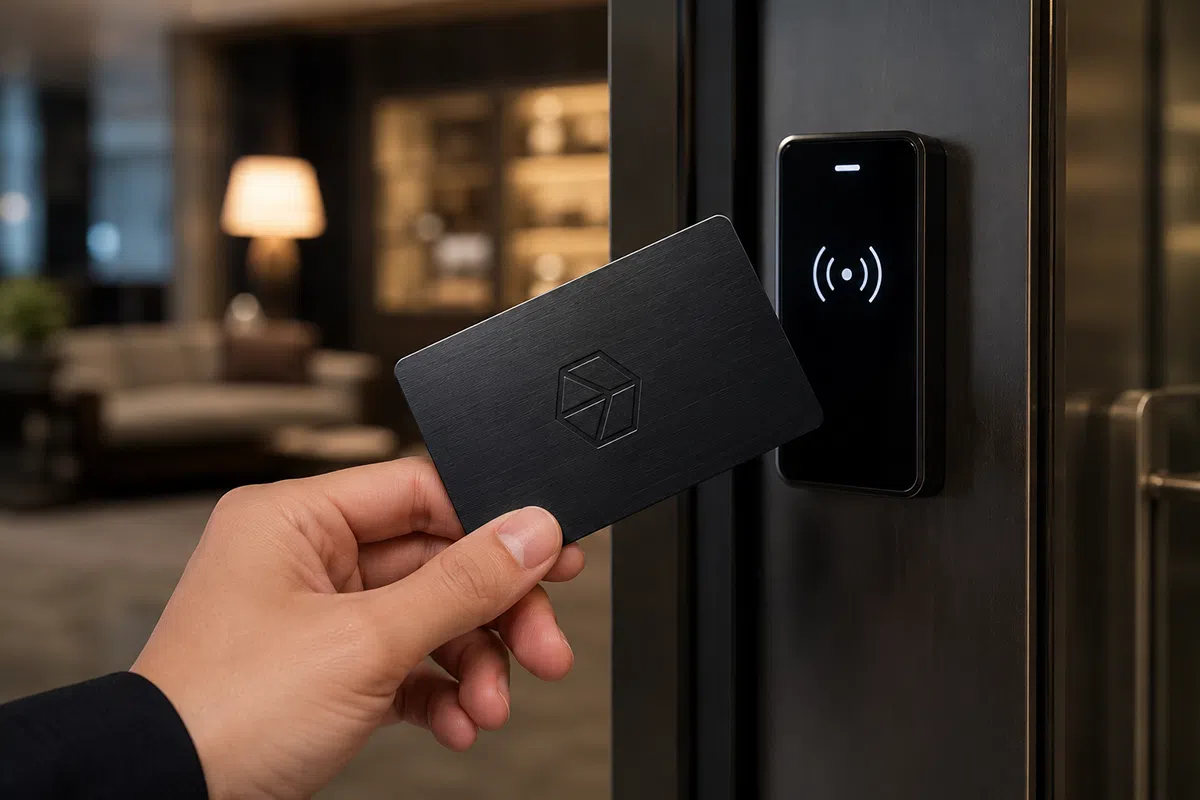
Hotel Key Cards
Part of the arrival experience at boutique and luxury properties.
Membership & VIP Cards
A physically different card for a visibly different membership tier.
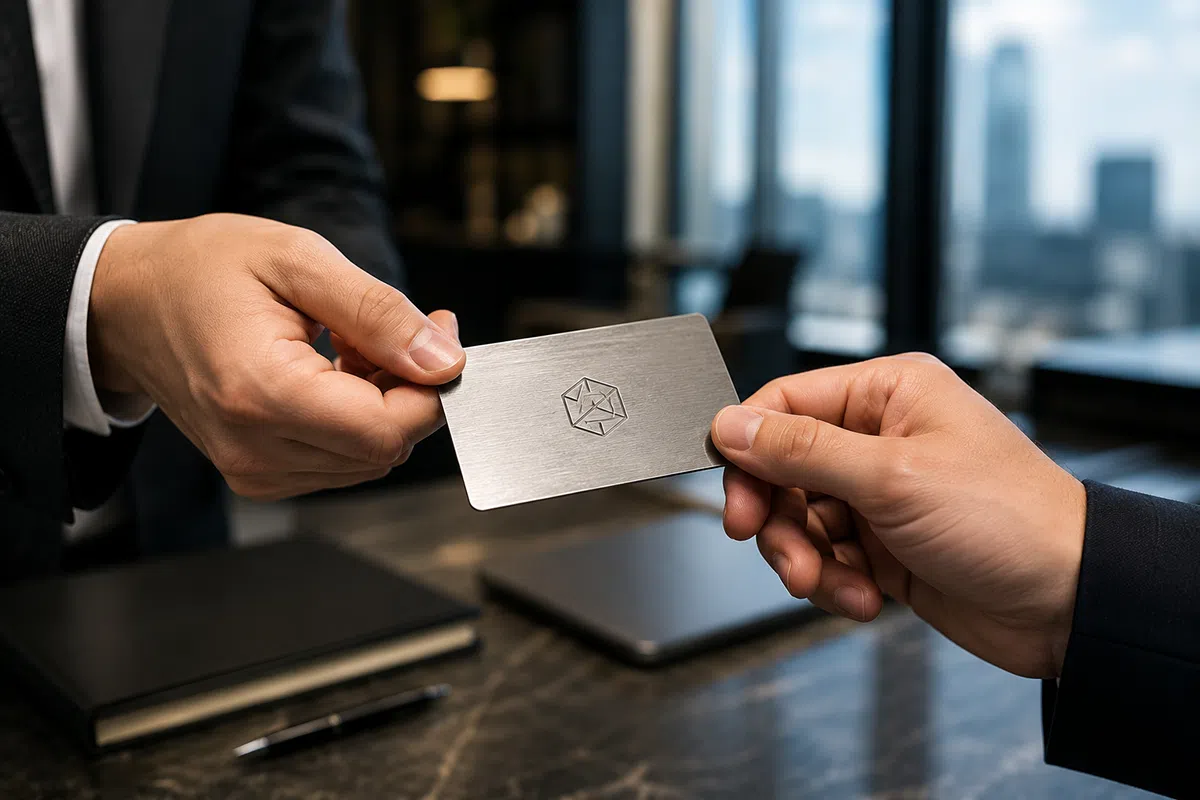
Business Cards
The card that stays on a desk instead of a drawer.
Gift Cards
A premium unboxing moment that outweighs its face value.
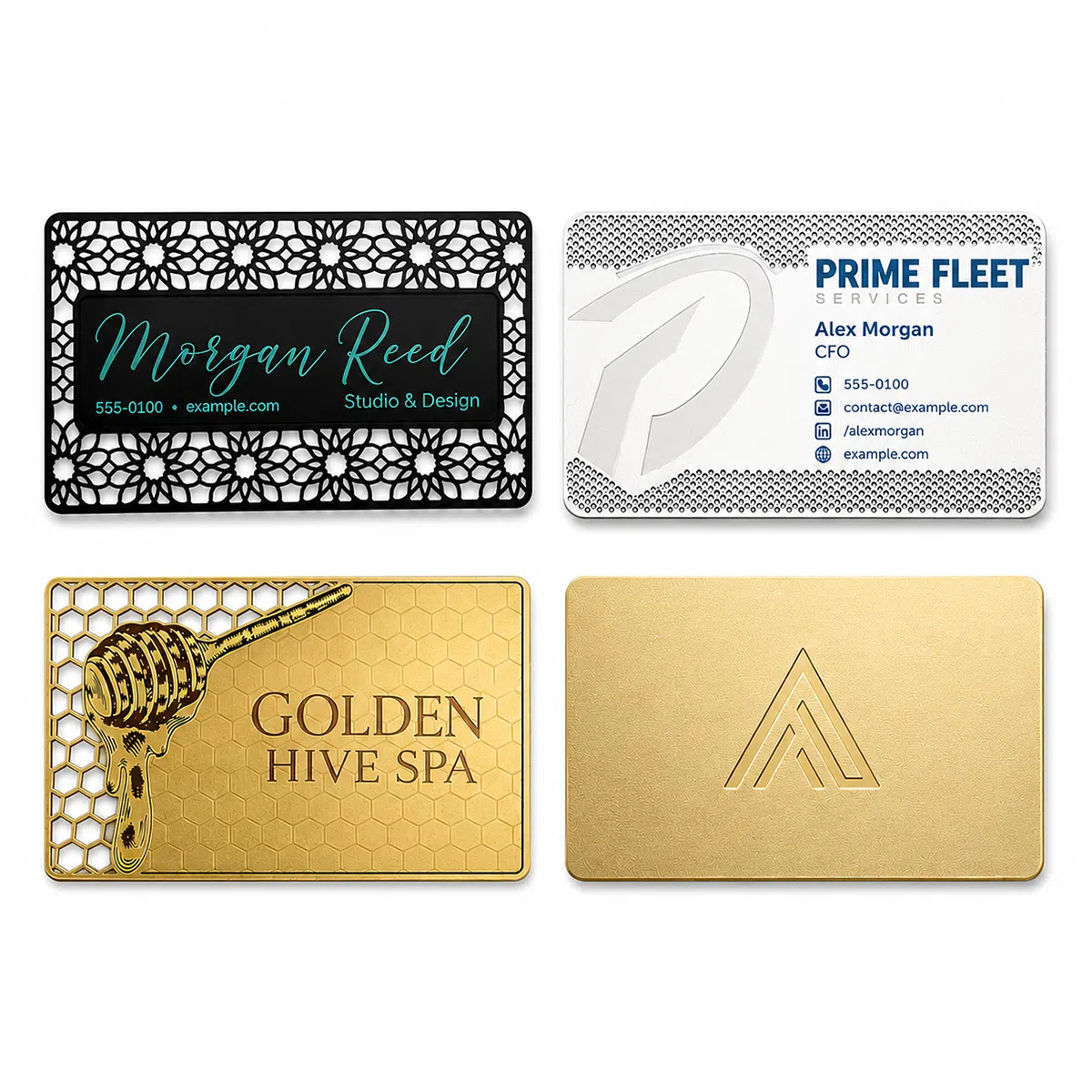
Brand & Event Cards
Outlasts the campaign it was made for.
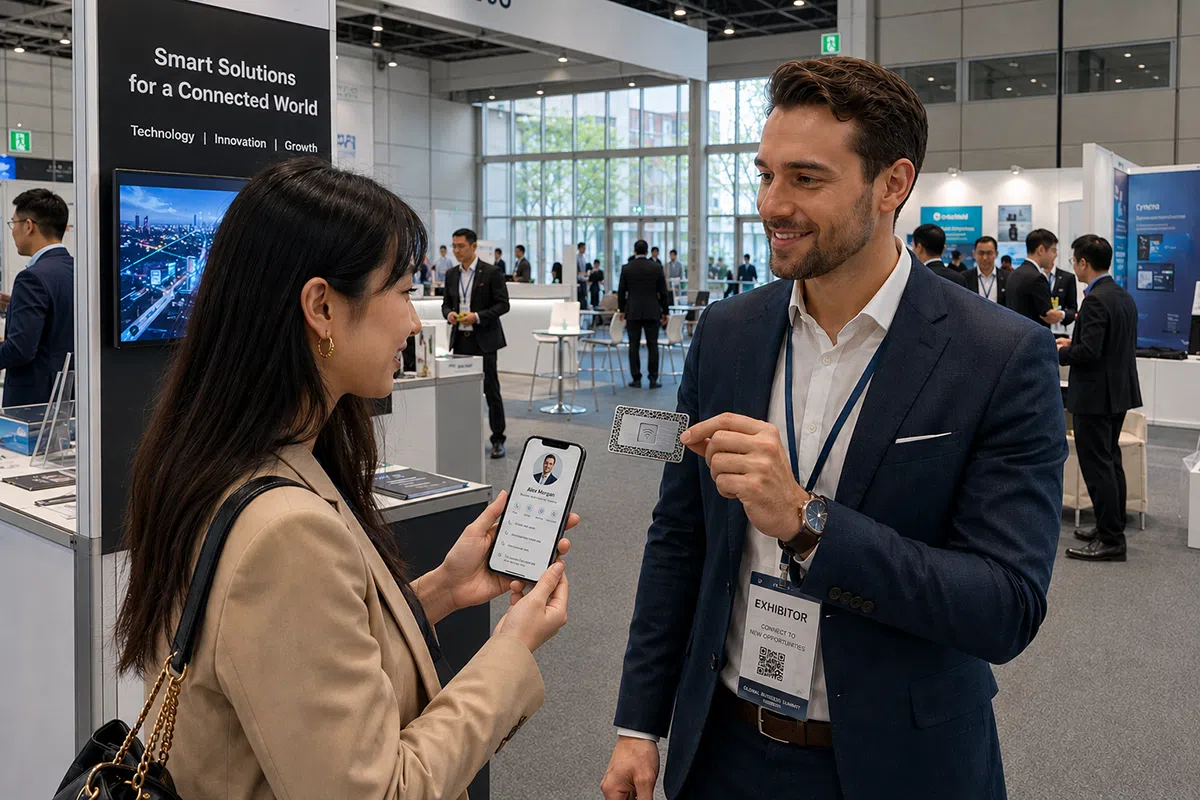
NFC Digital Business Cards
One tap shares your full contact profile, no app required.
Frequently Asked Questions
Does metal block NFC or RFID signals?
Raw metal does interfere with radio signals, which is why every CedaGlo metal card is built with either an internal non-metallic antenna cavity or a laser-cut window around the chip. Both designs isolate the antenna from the surrounding steel, so read range and reliability match a standard plastic card.
What metal finishes are available?
Metal card bodies are available in brushed stainless steel, matte black PVD, brushed gold PVD, and rose gold PVD. Each finish has a distinct weight and tactile quality, and all support precision laser engraving for logos, text, and QR codes.
Are metal cards more durable than plastic or wood cards?
Yes. The stainless steel core resists scratching, bending, and corrosion far better than PVC or wood, and laser-engraved detail won't fade or peel the way printed graphics can. Metal cards are the most physically durable option in our card lineup.
What are the MOQ and lead time for custom metal cards?
Metal cards are available from a 50-piece minimum order, with production taking 12–15 business days after design confirmation. We support OEM/ODM projects including finish selection, chip encoding, laser engraving, and packaging — contact our team with your quantity and chip requirements for an exact quote.
Related Products
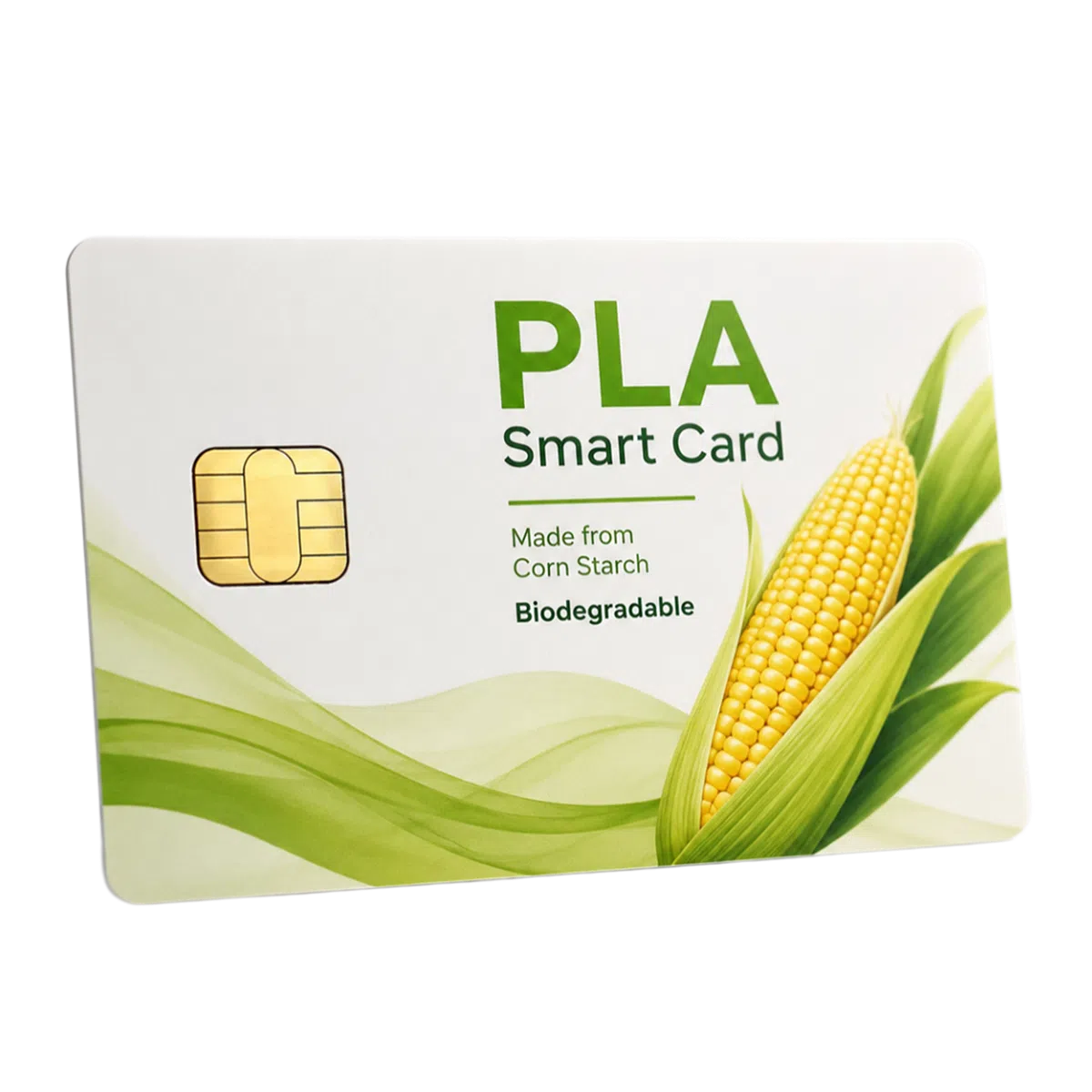
PLA Eco-Friendly Smart Card — Biodegradable RFID Card
Biodegradable PLA smart cards made from plant-based corn starch — an eco-friendly PVC alternative for hotel, access, loyalty, event & transit.
View Details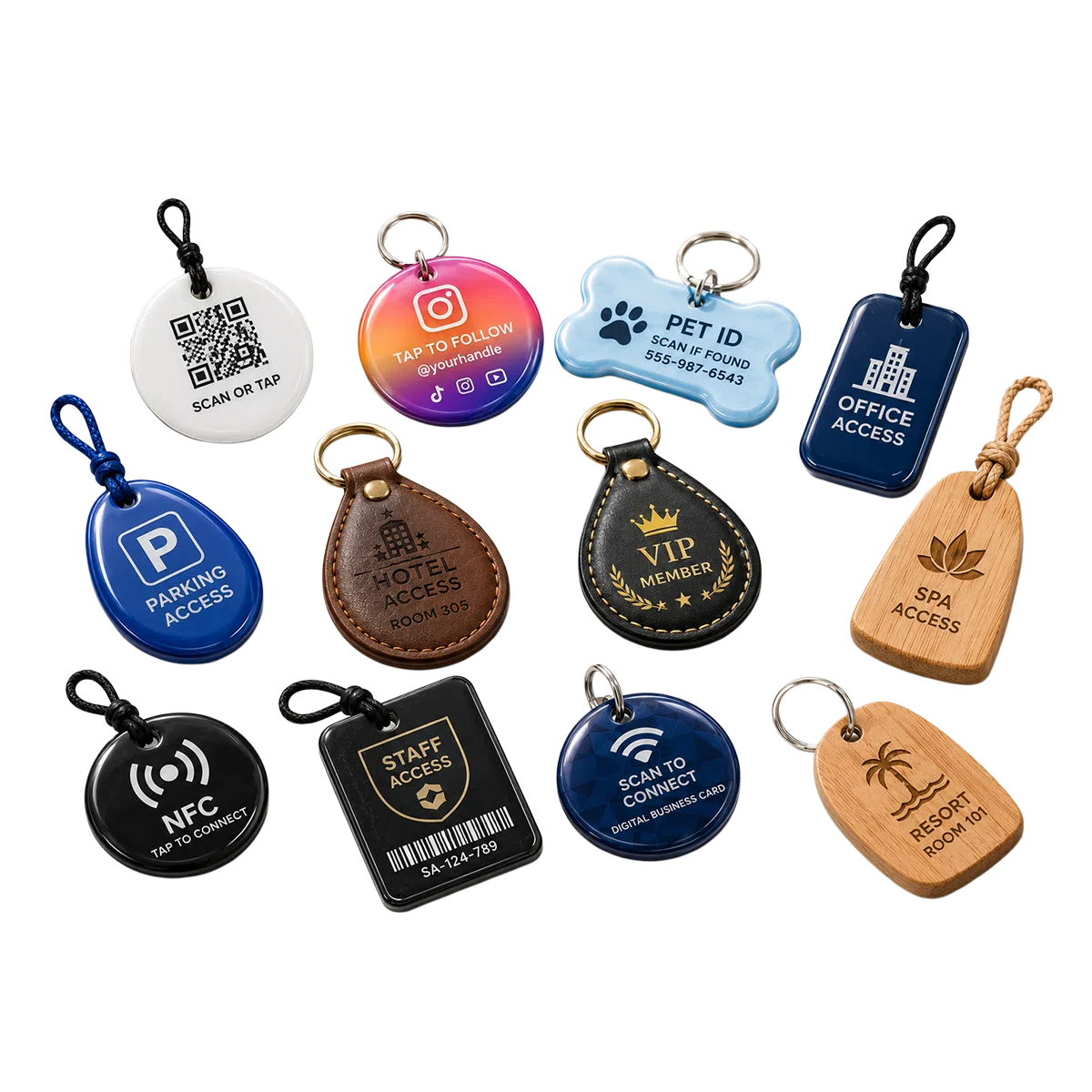
Custom RFID Keyfob │ ABS, Epoxy, Leather & Wood
Order custom RFID keyfobs in ABS, epoxy, leather or wood with LF, HF and NFC chips, logo printing, UID encoding and volume pricing support.
View Details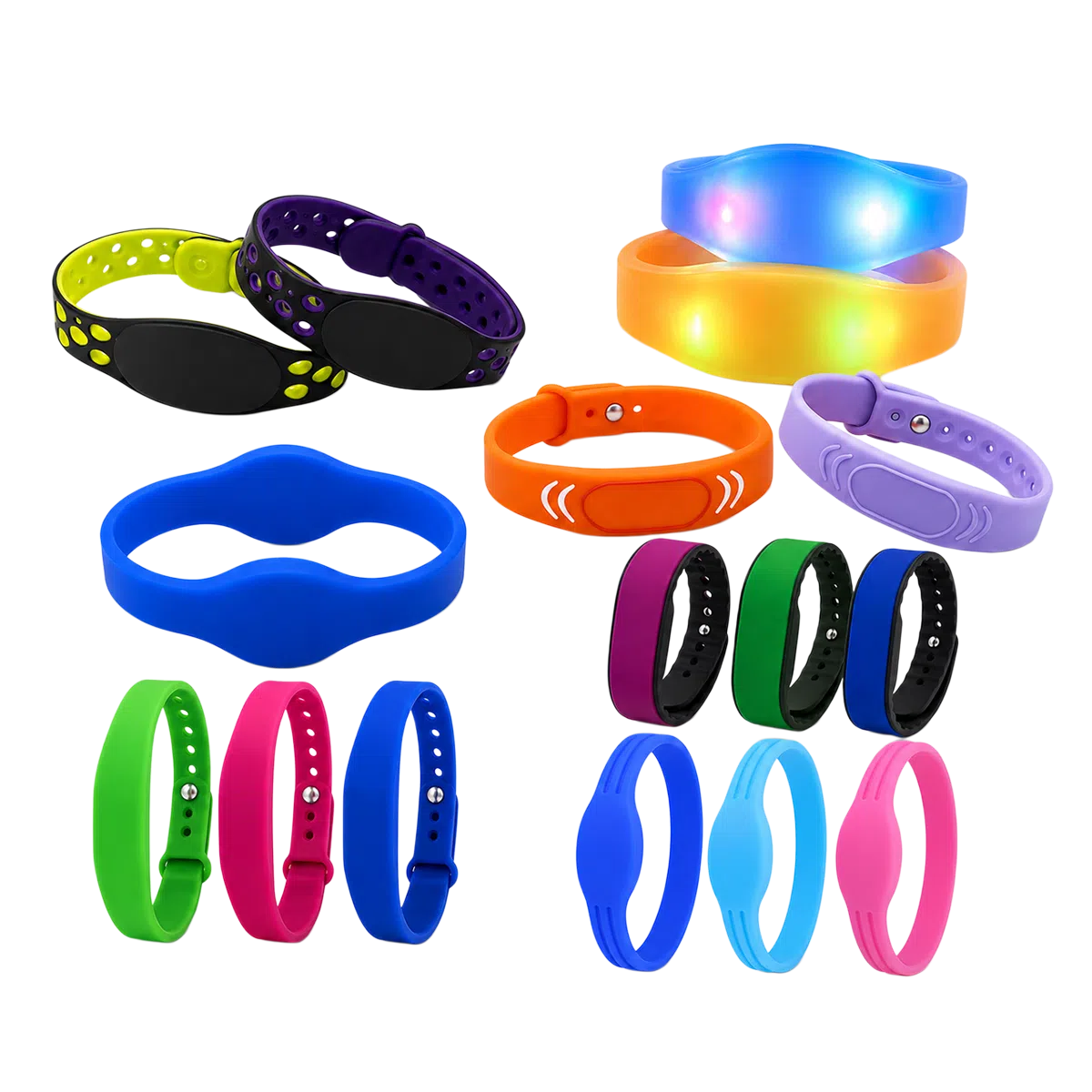
CedaGlo Custom RFID Silicone Wristbands
Reusable custom silicone RFID wristbands with LF, HF and NFC chip options for events, access control, cashless payment and brand promotion.
View Details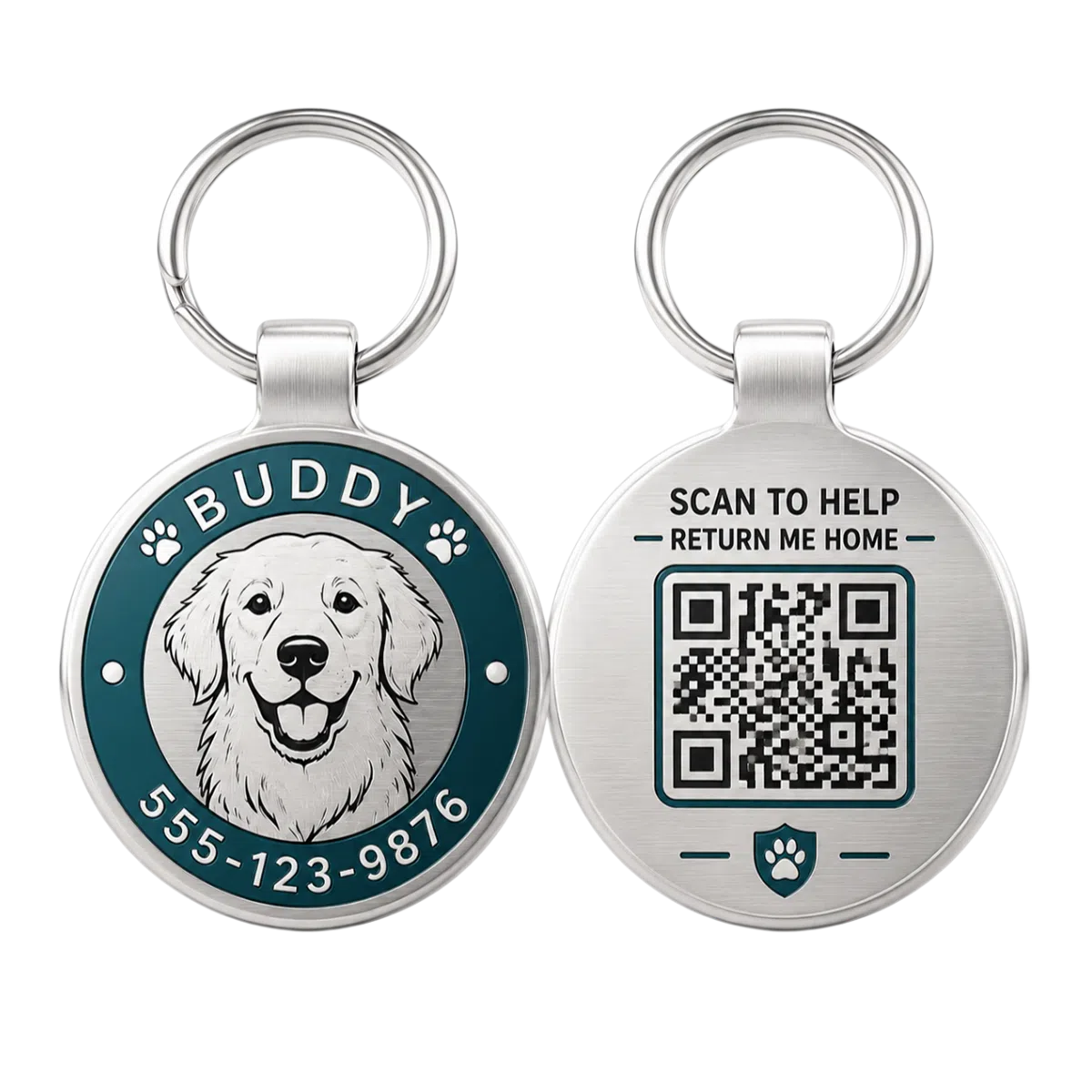
CedaGlo Custom NFC & QR Code Pet ID Tags
Custom NFC QR code pet tags with chip selection, URL encoding, private-label artwork and OEM packaging. Programmable smart tags for online profiles.
View DetailsThe Card Nobody Throws Away
A paper or plastic card gets tossed in minutes. A metal one gets kept on a desk, in a wallet, for years — turning a single handoff into ongoing brand exposure no disposable card can match. Request a sample in your chosen finish and chip type, confirm it works with your readers, then order with confidence. Metal cards start at 50 pieces and ship in 12–15 business days, with chip compatibility confirmed on every quote.